Xi'an 2-Day Itinerary: Warriors, Walls & the Muslim Quarter
Xi’an is a city that makes you work for it. The Terracotta Warriors are 40 kilometers east of the city center. The best food is hidden down alleys with no English signage. The City Wall is 13.7 kilometers around, doable by bike but punishing on foot. Two days is tight. But two days, done right, is enough.
This itinerary assumes you are efficient. You wake up early on Day 1, because the Warriors demand it. You bike the wall at golden hour. You eat your way through the Muslim Quarter after dark. Day 2 is museums, pagodas, drums, and the thing Xi’an is best at: letting you stumble into food you did not plan to find.
Xi’an was the capital of 13 dynasties and the eastern terminus of the Silk Road. For centuries it was the largest city in the world. What remains is a walled city core with a Tang Dynasty grid, a food culture shaped by Persian and Central Asian traders, and an archaeological site that rewrote the textbook on China’s first emperor. Two days will not cover all of it. Two days will cover what matters.
Before You Go: Xi’an-Specific Prep
Xi’an rewards preparation. These five things make the difference between a smooth 48 hours and a frustrating one.
| Task | Why |
|---|---|
| Book Terracotta Warriors tickets online | Tickets are ¥120. Morning slots sell out. Book on Trip.com 3-7 days ahead. The on-site line can take 45 minutes. |
| Set up Alipay before arriving | Xi’an is cashless. Even the lamb-skewer stall in the Muslim Quarter expects a QR scan. See our mobile payment guide. |
| Download Amap (高德地图) | Google Maps is unreliable in China. Amap’s English mode works for navigation. Apple Maps is a passable backup. |
| Carry cash for bus 306 | The tourist bus to the Warriors runs on cash only — ¥8 each way. Small bills. No Alipay, no WeChat Pay. |
| Reserve Shaanxi History Museum 3 days ahead | The museum is free but requires a reservation. Slots open on the official WeChat mini-program 3 days in advance and disappear within minutes. The ¥300 paid ticket (Tang Dynasty Murals Gallery) is the bypass if free slots are gone. |
Where to Stay for This Itinerary
Xi’an is defined by its city wall, a 14th-century Ming Dynasty fortification that encloses the historic core. Stay inside it.
| Area | Why | Price (¥/night) |
|---|---|---|
| Bell Tower / Drum Tower area | Dead center. Walk to Muslim Quarter and metro. Surrounded by restaurants open past midnight. | ¥300-800 |
| South Gate (Yongningmen) | Nicer hotels, quieter, closest to the best City Wall entry and bike rental. Best for couples. | ¥400-1,200 |
| Near Xi’an Railway Station | Cheaper, still inside the wall, bus 306 to the Warriors departs from here. Best for budget travelers. | ¥150-350 |
| Outside the wall | Cheaper hotels but you will spend 30-40 minutes commuting each way. Not worth it for a 2-day trip. | ¥100-250 |
Recommendation: Bell Tower area for first-timers who want to walk everywhere. South Gate for travelers who prioritize a good hotel and quiet nights. Railway Station area for budget travelers who want to be first on bus 306.
For a full breakdown of Xi’an’s neighborhoods, see our Xi’an first-timer’s guide.
Day 1: Warriors, Walls & the Muslim Quarter
Day 1 is the long one. It starts early, with no way around it, and rewards you with three of the most memorable experiences in China: standing before 8,000 life-sized warriors, biking an ancient city wall at sunset, and eating lamb skewers in a street market that has operated for over a thousand years.
Morning: The Terracotta Army (兵马俑)
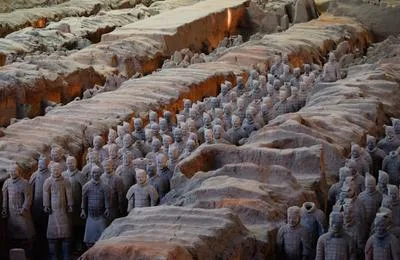
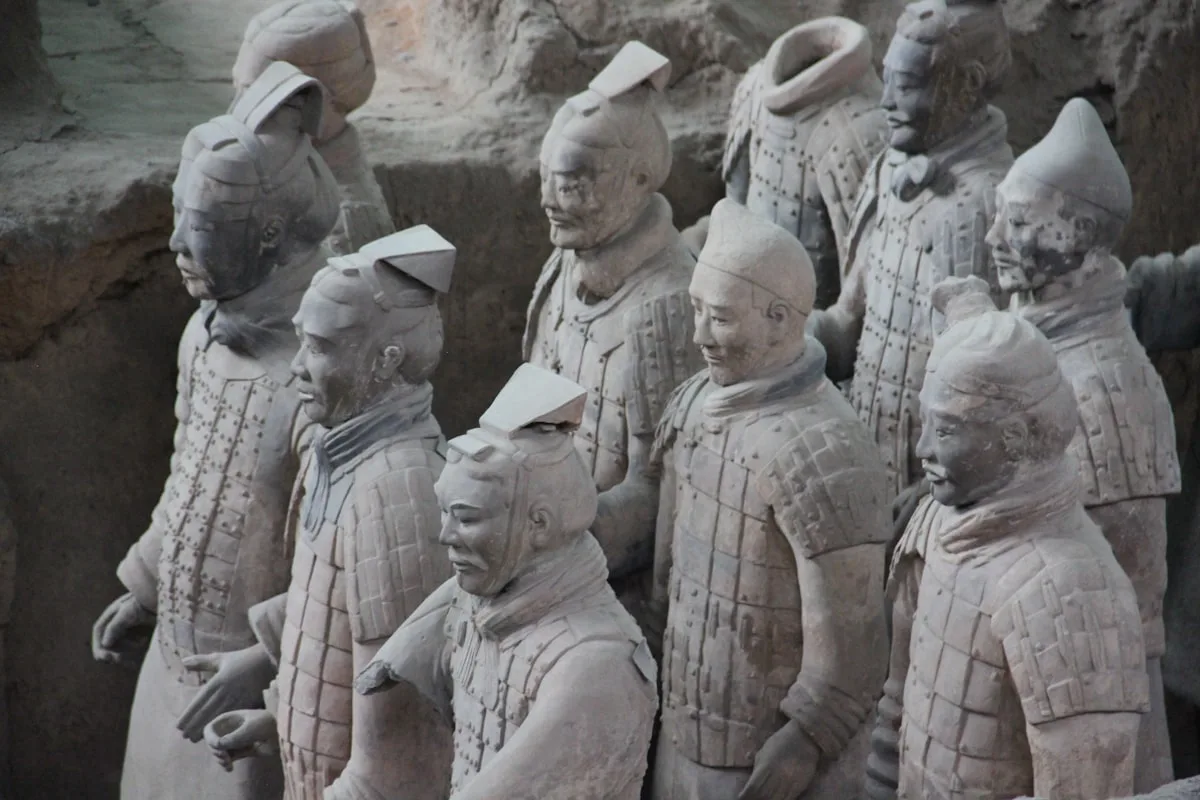
This is the main event. The Terracotta Army (8,000 life-sized clay soldiers, each with a unique face, buried in battle formation to guard China’s first emperor in the afterlife) was discovered in 1974 by farmers digging a well. It has been called the Eighth Wonder of the World, and for once the cliché holds. Standing at the edge of Pit 1, looking down at row after row of warriors stretching into the distance, is one of those travel moments that resets your sense of scale.
Getting there: The site is 40 km east of Xi’an. You have three options:
| Method | Time | Cost | Notes |
|---|---|---|---|
| Bus 306 (Tourist Bus 5) | 60 min | ¥8 | Departs Xi’an Railway Station east square every 10-15 min from 7:00 AM. Cash only. |
| DiDi | 50 min | ¥120-160 | Door-to-door. Useful if you are 3-4 people (split the fare). |
| Metro Line 9 + bus/taxi | 70 min | ¥8 + ¥15 | Metro to Lintong district, then a short bus or taxi to the site. |
The critical timing: Leave Xi’an by 7:15 AM to arrive at 8:30 AM when the gates open. The first 90 minutes, from 8:30 to 10:00 AM, are the sweet spot. Pit 1 is still manageable. You can get a front-row position. Tour groups have not yet arrived in force. By 10:30 AM the railing in front of Pit 1 is a solid wall of selfie sticks, and by noon you will be looking at the back of someone’s tour flag.
Entry: ¥120 ($16.80). Book on Trip.com 3-7 days ahead. The on-site ticket line can take 30-45 minutes and you do not have that time to burn.
Route (3-3.5 hours): The site has three pits and a museum. Visit them in this order:
Pit 1 (1 hour). The big one. 230 meters long, 62 meters wide, containing roughly 6,000 warriors in battle formation. This is the iconic view. Walk the full perimeter. The front rows are the most restored. The back of the pit is still being excavated, and you can see archaeologists at work during weekday mornings. Stand at the front-center viewing platform for the classic photograph.
Pit 2 (30 minutes). Smaller and more diverse. Contains cavalry, chariots, and archers. The lighting is better here and you can get closer to individual figures. The kneeling archer, one of the most intact and expressive warriors, is displayed in a glass case at close range.
Pit 3 (20 minutes). The command center. The smallest pit, with 68 figures believed to be the army’s high-ranking officers. The warriors here face each other rather than east, and archaeologists think this was the war council.
The Bronze Chariot Museum (30 minutes). Two half-scale bronze chariots, each with a driver and four horses, unearthed 20 meters west of the emperor’s tomb. The level of detail (individual reins, harness fittings, the driver’s facial expression) is extraordinary. These are considered among the finest bronze artifacts ever discovered anywhere.
Exit through the gift shop if you want a miniature terracotta warrior (¥20-200 depending on size and quality). The official shop near the exit has fixed prices and better quality than the hawkers outside.
The emperor’s tomb mound: About 1.5 km from the museum complex, the actual tomb of Qin Shi Huang has not been excavated. Historical records describe a map of China with rivers of mercury and a ceiling studded with pearls representing the stars. Soil tests have confirmed elevated mercury levels. The tomb mound itself is a grassy hill with a path to the top. It is a 15-minute shuttle ride (free) from the main museum. Go if you have time. Skip if you are flagging, since the view from the top is of trees.
Lunch: Biangbiang Noodles Near the Station
Take bus 306 back to Xi’an Railway Station (60 minutes). You are back in the city by 1:00-1:30 PM.
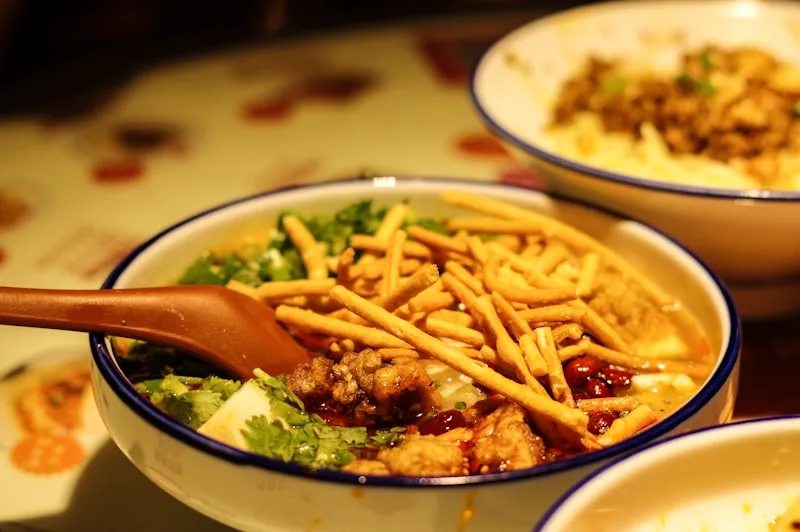
Walk 10 minutes south to the area around Dongmutou Shi (东木头市) near the Bell Tower. This street and its side alleys are dense with noodle shops. Look for biangbiang noodles (油泼面): wide, hand-pulled belt noodles, each strand roughly the width of a belt, doused with hot chili oil, soy sauce, vinegar, and garlic. The name “biang” has one of the most complex characters in Chinese (58 strokes) and is onomatopoeic, echoing the sound of the dough slapping against the counter as the chef pulls it.
A bowl costs ¥15-25 ($2-3.50). Look for a shop with a line at lunchtime. Point at what the person next to you is eating if there is no picture menu.
Afternoon: Xi’an City Wall (西安城墙)
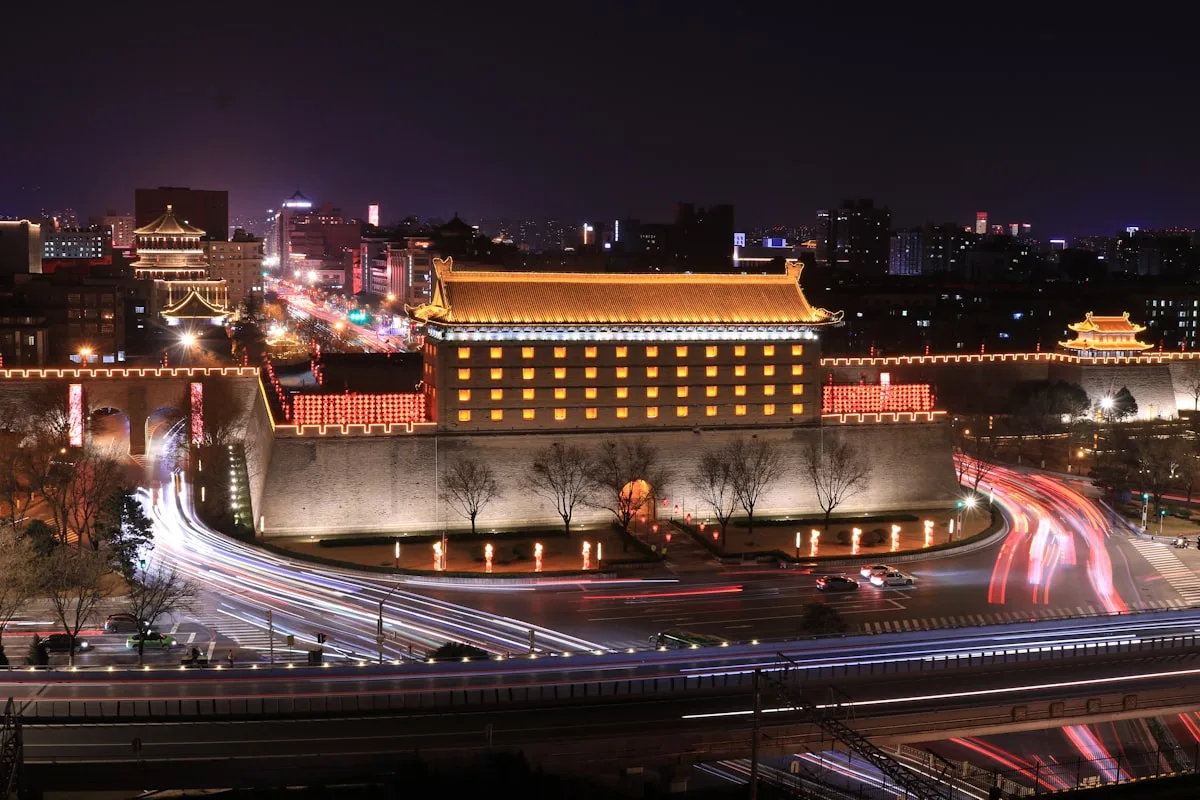
Take a 10-minute walk or ¥10 DiDi to the South Gate (Yongningmen, 永宁门), the most impressive of the four main gates and the best entry point for the wall.
Entry: ¥54 ($7.60). The wall is open 8:00 AM to 10:00 PM (last entry 9:00 PM). Go in the late afternoon: 3:30-4:00 PM is ideal. The golden-hour light on the wall and the rooftops of the old city is the best photo condition of the day.
Biking the wall is the best way to experience it. Rentals are available at the South Gate:
| Type | Cost | Time | Notes |
|---|---|---|---|
| Single bike | ¥45 | 90 min | Enough for a full loop at relaxed pace with stops |
| Tandem bike | ¥90 | 90 min | Good for couples; harder to steer than a single |
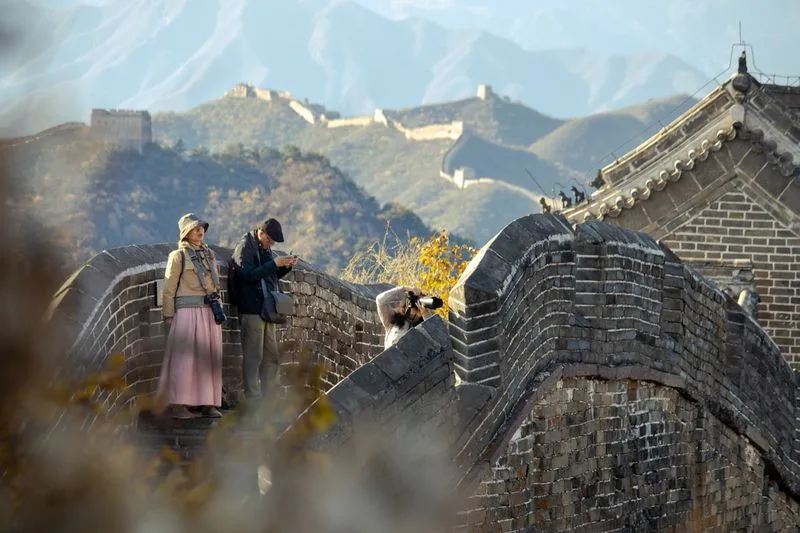
The wall is 13.7 km around, flat, and fully paved. A full loop takes 90-120 minutes at a relaxed pace with photo stops. You can also ride halfway and turn back, since the east and west halves are equally scenic. The south side has the best views of the old city rooftops. The north side overlooks the railway station and the modern city beyond.
The wall is completely exposed, with zero shade. In summer (June-August), the surface temperature can reach 50°C (122°F) at midday. Do not bike the wall between 11:00 AM and 3:00 PM in summer. Bring water. There are vendors on the wall but prices are inflated.
If biking is not your thing, walk a section. The South Gate to East Gate segment is about 3 km and takes 45-60 minutes on foot. Golf carts (¥80 per person for a full loop) are available but miss the point: the wall at walking or biking speed is a different experience than watching it scroll past from a seat.
Evening: The Muslim Quarter (回民街)
Descend from the wall at the South Gate. Walk 15 minutes north or take a ¥10 DiDi to the Drum Tower (鼓楼). The Muslim Quarter begins directly behind it.
The Muslim Quarter (Huimin Street, 回民街) is not a single street. It is a warren of alleys (Beiyuanmen, Xiyangshi, Dapiyuan, Sajinqiao) packed with food stalls, restaurants, and shops, centered around the 1,300-year-old Great Mosque. The Hui Muslim community has lived here since the Tang Dynasty (7th century), when Persian and Arab traders settled in Chang’an (Xi’an’s ancient name) at the eastern end of the Silk Road. The food reflects that history: lamb, cumin, flatbread, and dried fruit sit alongside hand-pulled noodles and steamed dumplings, a fusion that predates the word.
Go after dark. The lanterns come on, the smoke from charcoal grills fills the alleys, and the crowd thickens to a slow-moving river of people eating as they walk. This is not a curated food tour. This is chaos, and it is wonderful.
What to eat:
| Food | What It Is | Price (¥) |
|---|---|---|
| Yangrou paomo (羊肉泡馍) | Crumbled flatbread in rich lamb soup. Xi’an’s signature dish. You crumble the bread yourself before it goes into the broth. | ¥25-45 |
| Biangbiang noodles | Wide belt noodles with chili oil and garlic. If you did not eat them for lunch, eat them now. | ¥15-25 |
| Roujiamo (肉夹馍) | Shredded braised pork in a crisp flatbread. Called a “Chinese hamburger” — a comparison that undersells it. | ¥10-20 |
| Lamb skewers (羊肉串) | Cumin-crusted, grilled over charcoal. Sold by the skewer. | ¥3-5/skewer |
| Liangpi (凉皮) | Cold rice noodles with chili oil, vinegar, and cucumber. Refreshing in summer. | ¥8-12 |
| Sticky rice cakes (甑糕) | Steamed glutinous rice with red dates and beans. Sweet, dense, sold by weight from large steaming pots. | ¥5-10 |
| Persimmon cakes (柿子饼) | Fried persimmon paste filled with red bean or sesame. A Xi’an-specific street sweet. | ¥3-5 each |
The rule: eat where there is a line. A stall with a queue of locals at 8:00 PM is selling food faster than it can go stale. A stall with pre-cooked food sitting under a heat lamp and no customers is a gamble. This rule holds in every street food city on earth and it holds especially true here.
Budget ¥50-100 ($7-14) for a full evening of grazing. Walk from the Drum Tower north along Beiyuanmen, then west into the smaller alleys: Dapiyuan and Sajinqiao are less touristy and have the best food. The main drag (Beiyuanmen) is the most atmospheric but also the most crowded. The side alleys are where Xi’an locals actually eat.
The Great Mosque (大清真寺): If you arrive before the imam’s call to prayer, the Great Mosque is worth 30 minutes. It is one of the oldest and largest mosques in China: a Tang Dynasty courtyard complex built in Chinese architectural style, with pagoda-like minarets and gardens. Entry is ¥25 (closed during prayer times). The contrast between the mosque’s serene courtyards and the street-food chaos 50 meters away is one of the strangest and most memorable juxtapositions in Xi’an.
Day 1 totals: 16,000-20,000 steps. A long day. The morning involves standing and walking on concrete floors at the Warriors. The afternoon involves biking. You will be tired. That is correct.
Day 2: Museums, Pagodas & the Last Bowl of Noodles
Day 2 is gentler. Museums in the morning, a pagoda in the afternoon, and a final meal in the streets around the Bell Tower. You are not rushing anymore. You are savoring.
Morning: Shaanxi History Museum (陕西历史博物馆)
This is one of China’s great museums, on par with the National Museum in Beijing and the Shanghai Museum. The collection spans over a million years, from Neolithic Banpo pottery to Tang Dynasty gold, with a density that rewards a guided approach rather than wandering.
The museum is organized chronologically across three main exhibition halls:
Hall 1 (Prehistoric to Zhou Dynasty): The Banpo pottery, 6,000-year-old painted ceramics from a Neolithic village just east of Xi’an. The bronze ritual vessels of the Zhou Dynasty, including enormous tripods and wine containers inscribed with the earliest examples of Chinese writing.
Hall 2 (Qin to Han Dynasty): The Terracotta Warriors exhibit, smaller than the actual site but with warriors displayed at close range in museum-quality lighting. The Han Dynasty section includes a reconstructed tomb entrance and silk road artifacts that show Xi’an’s role as the starting point of trans-Eurasian trade. Look for the gilt bronze lamp shaped like a goose holding a fish, a Han Dynasty oil lamp that trapped smoke inside the goose’s body, one of the earliest known pollution-control devices.
Hall 3 (Tang Dynasty and beyond): Tang Dynasty gold and silver, in bowls, cups, and ornaments of staggering intricacy. The Tang figurines (ceramic camels loaded with trade goods, Central Asian musicians, court ladies with elaborate hairstyles) are some of the most expressive sculpture in Chinese art. The Tang section alone rewards a full hour.
Entry and tickets:
| Ticket | Price (¥) | What You Get |
|---|---|---|
| Free basic ticket | ¥0 | The three main exhibition halls. Requires reservation 3 days ahead on WeChat. Slots vanish within minutes. |
| Tang Dynasty Murals ticket | ¥300 | Basic halls + the Tang Dynasty Mural Gallery (270 priceless frescoes from Tang tombs). No reservation battle. |
| Hejiacun Hoard ticket | ¥30 | Basic halls + the Hejiacun Treasure exhibit (1,000+ Tang Dynasty gold and silver artifacts found in a single jar in 1970). |
The free ticket is a blood sport. Slots open at midnight 3 days in advance on the Shaanxi History Museum WeChat mini-program and disappear within minutes, literally minutes. If you are not on WeChat or do not want to fight the reservation system, buy the ¥300 Tang Dynasty Murals ticket. It is expensive but it bypasses the reservation requirement, and the murals are genuinely worth seeing: 270 frescoes removed from Tang Dynasty tombs, preserved in a climate-controlled underground gallery that few tourists visit.
If ¥300 is too steep, the ¥30 Hejiacun Hoard add-on also grants entry and is much cheaper, but confirm availability at the ticket counter.
Strategy: Arrive by 8:30 AM (museum opens at 8:30 AM, closed Mondays). Even with a paid ticket, the morning crowd is smaller and the halls are quieter. Budget 2.5-3 hours. The museum café is mediocre, so eat breakfast before you arrive.
Location: 91 Xiaozhai East Road. Metro Line 2 to Xiaozhai Station, Exit D. A 10-minute DiDi from the Bell Tower area costs ¥15-20.
Lunch: The Noodle Shop You Walk Past
Between the museum and the Big Wild Goose Pagoda, the streets around Xiaozhai are dense with small restaurants. Do not overthink this meal. Walk north from the museum along Chang’an Road. Within 10 minutes you will pass at least five noodle shops with plastic stools on the sidewalk and a queue at 12:30 PM. Pick the one with the longest line. Order whatever the person next to you is eating. A bowl of hand-pulled noodles with chili oil and a side of cold cucumber salad runs ¥20-35 ($3-5).
Afternoon: Big Wild Goose Pagoda (大雁塔)
Take a 15-minute walk or ¥10 DiDi from the museum. The Big Wild Goose Pagoda is Xi’an’s most recognizable landmark: a 64-meter brick pagoda built in 652 AD to house Buddhist scriptures brought back from India by the monk Xuanzang. His 17-year journey across the Silk Road to India and back, carrying 657 Sanskrit texts, is one of the great travel stories in human history. The pagoda was built to store those texts.
Entry: ¥50 ($7) for the pagoda and temple complex. Additional ¥30 ($4.20) to climb the pagoda’s seven stories. The climb is steep, with narrow stone stairs and low ceilings, but the view from the top looks south toward the Qinling Mountains and north across the city grid. On a clear day you can see the city wall. On a hazy day (more common), the view is still worth it for the perspective on Xi’an’s layout.
The temple grounds, Da Ci’en Temple (大慈恩寺), include several halls with Buddhist statuary, a bell tower, and a drum tower. The gardens are peaceful and shaded. Budget 1.5-2 hours total.
The fountain show: The North Square of the pagoda has the largest musical fountain in Asia. Shows run at 12:00 PM, 2:00 PM, 4:00 PM, and 8:00 PM (the evening show includes lights). It is a spectacle: choreographed water jets set to classical Chinese music, with the pagoda as a backdrop. If you are here at 4:00 PM, stay for the show. If not, do not rearrange your day for it.
Late Afternoon: Bell Tower & Drum Tower (钟楼·鼓楼)
Take a 10-minute DiDi (¥15-20) back to the city center. The Bell Tower and Drum Tower stand at the geographic heart of Xi’an, marking the intersection of the city’s four main streets. The Bell Tower (built 1384) rang the morning. The Drum Tower (built 1380) beat the evening. Together they regulated daily life in imperial Xi’an for 600 years.
Combined ticket: ¥50 ($7) for both towers. If you only visit one, pick the Drum Tower: the view north over the Muslim Quarter’s rooftops is better, and the drum exhibit (two dozen ancient drums from across China) is more interesting than the Bell Tower’s bell.
Climb the Drum Tower first (20-30 minutes). Cross the square to the Bell Tower (15-20 minutes). Budget 1 hour for both.
Photo note: The best photograph of the Bell Tower is from the southeast corner of the square at dusk, when the tower’s lights come on and traffic circles below in light trails. This is a classic Xi’an image. The best photograph of the Drum Tower is from inside the Muslim Quarter looking south: the tower framed by red lanterns and food-stall smoke.
Evening: A Final Xi’an Dinner
You have eaten street food in the Muslim Quarter. For your last meal, try a sit-down restaurant. Three options, all within walking distance of the Bell Tower:
| Restaurant | Specialty | Price (¥/person) |
|---|---|---|
| De Fa Chang (德发长) | Dumpling banquet — 20+ varieties of dumplings in shapes matching their fillings (duck-shaped duck dumplings, fish-shaped fish dumplings). A Xi’an institution since 1936. | ¥80-150 |
| Tongshengxiang (同盛祥) | Yangrou paomo — widely considered the best version in the city. If you skipped it in the Muslim Quarter, eat it here. | ¥50-100 |
| Chunfasheng (春发生) | Hulu tou (葫芦头) — a local specialty of pork intestine soup with flatbread. An acquired taste that rewards the adventurous. | ¥40-80 |
After dinner, walk through the Muslim Quarter one last time. The stalls start closing around 10:00-11:00 PM on weekdays, midnight on weekends.
Day 2 totals: 12,000-15,000 steps. Museum floors are hard. Wear comfortable shoes.
Xi’an Food Strategy
Xi’an is one of China’s great food cities, and the street food scene, shaped by centuries of Silk Road trade, is unlike anything in Beijing or Shanghai. The Muslim Quarter is the beating heart of it, but the best individual dishes are scattered across the city.
| Dish | What It Is | Where | Price (¥) |
|---|---|---|---|
| Yangrou paomo (羊肉泡馍) | Crumbled flatbread in lamb soup. You break the bread yourself at the table. The broth is rich, cumin-scented, restorative. Xi’an’s defining dish. | Tongshengxiang (同盛祥) near the Bell Tower | ¥30-55 |
| Biangbiang noodles (油泼面) | Wide belt noodles with blazing chili oil, garlic, soy sauce, vinegar. The character “biang” has 58 strokes. | Street shops near Dongmutou Shi, south of the Bell Tower | ¥15-25 |
| Roujiamo (肉夹馍) | Braised pork, shredded and stuffed into a crisp, flaky flatbread. Often called a Chinese hamburger. Better than that sounds. | Fan Ji (樊记) on Zhubashi near the Drum Tower, est. 1925 | ¥10-20 |
| Lamb skewers (羊肉串) | Cumin-crusted, charcoal-grilled. Xinjiang-style, sold by the skewer, best eaten standing up. | Muslim Quarter — look for the stall with the most smoke and the longest line | ¥3-5/skewer |
| Liangpi (凉皮) | Cold rice noodles with chili oil, vinegar, cucumber, and bean sprouts. Refreshing in Xi’an’s summer heat. | Street stalls throughout the Muslim Quarter | ¥8-12 |
| Soup dumplings (灌汤包) | Thin-skinned dumplings filled with hot broth and pork. Bite a small hole, suck the soup, eat the dumpling. | Jia San (贾三) in the Muslim Quarter | ¥18-28 |
| Qishan saozi noodles (岐山臊子面) | Thin noodles in a sour-spicy broth with minced pork, wood ear mushroom, tofu, and carrot. A Shaanxi province classic. | Local noodle shops near the South Gate | ¥12-20 |
| Zenggao (甑糕) | Steamed glutinous rice layered with red bean paste and dates. Sweet, dense, scooped from a giant steaming pot. | Street carts in the Muslim Quarter, mornings only | ¥5-10 |
Three rules for eating in Xi’an:
First, go where the line is. A stall with a queue at 8 PM is serving food too fast to spoil. A stall with pre-cooked skewers sitting under a heat lamp is a bet you do not need to make.
Second, the Muslim Quarter is halal. No pork. The lamb and beef dishes are the stars, so do not go looking for char siu or hong shao rou. The absence of pork is not a limitation. It is the reason the lamb skewers are this good.
Third, Xi’an food is heavy. Noodles, bread, lamb, oil. By the end of day two you will crave a vegetable. Order a plate of liangban huanggua (凉拌黄瓜, smashed cucumber salad with garlic and vinegar, ¥12-18) as a side dish with every meal. Your stomach will thank you.
Getting Around Xi’an
Xi’an’s historic core, the area inside the city wall, is compact and walkable. Most movements are on foot or a short DiDi ride. The Warriors are the exception.
| Method | Best For | Cost | Notes |
|---|---|---|---|
| Walking | Bell Tower, Drum Tower, Muslim Quarter, South Gate — all within a 20-minute walk of each other. | Free | The grid inside the wall is logical and flat. |
| Metro | Long distances, Shaanxi History Museum (Line 2), Big Wild Goose Pagoda (Line 3), Xi’an North Railway Station (Line 2). | ¥2-8 | 8 lines, clean, English signage. Use Alipay transport QR at gates. |
| DiDi | Late night, rain, with luggage, or when your feet give out. English interface inside Alipay. | ¥10-25 within the wall | Faster than the metro for short hops. No cash, no negotiation. |
| Bus 306 | To the Terracotta Warriors. Departs Xi’an Railway Station east square. | ¥8 | Cash only. Departs every 10-15 min. 60 min to the site. |
| Shared bikes | Short hops inside the wall. Scan QR with Alipay or Meituan. | ¥1.50/ride | Xi’an is flat. The streets inside the wall are grid-patterned and easy to navigate. |
Airport note: Xi’an Xianyang International Airport (XIY) is 40 km northwest of the city center. Metro Line 14 connects the airport to Xi’an North Railway Station (30 min, ¥8), where you transfer to Line 2 or Line 4 for the city center. A DiDi from the airport to the Bell Tower area takes 50-60 minutes and costs ¥120-160. The airport shuttle bus (¥25) runs to several city-center stops but is slower.
High-speed rail: Xi’an North Station is the main HSR hub, 20 minutes north of the city center by Metro Line 2. Xi’an Station (the old railway station, inside the city wall) serves conventional trains and a few HSR routes. Confirm which station your train uses before heading out.
Budget Planning
Two days, per person, excluding accommodation. Convert at ¥1 = $0.14 USD.
| Level | Daily Cost (¥) | Daily Cost ($) | Includes |
|---|---|---|---|
| Budget | ¥150-300 | $21-42 | Street food, bus 306 to Warriors, walk the wall (no bike), free museum (if you win the reservation), metro |
| Mid-range | ¥400-650 | $56-91 | Restaurants + street food, Warriors ticket + bike rental + DiDi, Hejiacun or mural ticket for museum |
| Comfort | ¥700-1,200+ | $98-168+ | Private car to Warriors, Tang Dynasty Murals ticket, dumpling banquet at De Fa Chang, best seats wherever |
Sample mid-range Day 1 breakdown:
- Bus 306 to Warriors (round trip): ¥16
- Warriors ticket: ¥120
- Lunch (biangbiang noodles): ¥20
- City Wall entry + bike rental: ¥99
- Muslim Quarter dinner (5-6 items): ¥80
- Metro + DiDi: ¥30
- Total: ~¥365 ($51)
Sample mid-range Day 2 breakdown:
- Museum (Hejiacun Hoard ticket): ¥30
- Lunch (noodles near Xiaozhai): ¥25
- Big Wild Goose Pagoda entry: ¥50
- Bell + Drum Tower combo: ¥50
- Dinner (De Fa Chang dumplings): ¥120
- Metro + DiDi: ¥25
- Total: ~¥300 ($42)
Xi’an is cheaper than Beijing and Shanghai. A ¥400/night hotel inside the wall gets you something comfortable and well-located. Food costs are the real bargain: the best meal of your trip could be a ¥15 bowl of biangbiang noodles from a shop with plastic stools.
Common Mistakes
Arriving at the Warriors at 10:30 AM. Pit 1 is already a solid wall of people. You will see the warriors, but you will see them over shoulders, between selfie sticks, and from four rows back. The difference between 8:30 AM and 10:30 AM at the Terracotta Army is the difference between a transcendent archaeological experience and a crowded museum visit. Set the alarm. Get bus 306 by 7:15 AM. You can sleep on the way back.
Not carrying cash for bus 306. This is the one place in Xi’an where Alipay will not save you. The tourist bus to the Warriors takes cash only, ¥8 each way, exact change appreciated. Stop at a convenience store the night before, buy a bottle of water with a ¥20 bill, and pocket the change.
Visiting the museum on a Monday. Like virtually all major museums in China, the Shaanxi History Museum is closed on Mondays. Plan your 2 days around this. If one of your days is a Monday, put the Warriors on that day, since it is open daily, and the museum on the other day.
Riding the City Wall at noon in summer. The wall has no shade. The surface temperature on a July afternoon can exceed 50°C (122°F). Heatstroke is not a souvenir you want. Go at 3:30 PM or later. Bring two bottles of water.
Skipping the Muslim Quarter because it is touristy. Yes, Beiyuanmen (the main street) is touristy. The side alleys (Dapiyuan, Sajinqiao, Xiyangshi) are where Xi’an locals eat. Walk 100 meters west of the main drag and the crowd thins, the prices drop, and the food improves. The Muslim Quarter is a thousand-year-old neighborhood with a living food culture. Do not judge it by its most crowded street.
Trying to see everything. Two days is enough for the Warriors, the wall, the Muslim Quarter, the museum, the pagoda, and the towers. It is not enough for Huashan (a full-day mountain hike requiring a separate trip), the Hanyangling Mausoleum (half-day), or the Tang Paradise theme park (skip it, since it is a concrete reconstruction). Do the essentials well rather than the full checklist badly.
Frequently asked questions
Is 2 days enough for Xi’an?
Yes, if you are strategic. Day 1 covers the Terracotta Warriors in the morning, the City Wall by bike in the afternoon, and the Muslim Quarter for dinner. Day 2 covers the Shaanxi History Museum, Big Wild Goose Pagoda, and the Bell and Drum Towers. Two days hits every essential experience in Xi’an. Three days is more comfortable: it lets you add Huashan (one of China’s most dramatic mountain hikes) or the Hanyangling Mausoleum (a smaller but fascinating Han Dynasty tomb with walkways over the excavation pits). But two days is the minimum that does the city justice. One day is a mistake: you will see the Warriors and nothing else, and Xi’an is far more than its army of clay soldiers.
How do I get to the Terracotta Warriors from central Xi’an?
Take bus 306 (also marked as Tourist Bus 5) from the east square of Xi’an Railway Station. It departs every 10 to 15 minutes starting at 7:00 AM, takes about 60 minutes, and costs ¥8 one way. This is a public bus. It is not fancy, but it is reliable and cheap. Pay cash. Small bills. The bus does not accept Alipay or WeChat Pay. Alternatively, a DiDi from the city center costs ¥120 to ¥160 each way and takes about 50 minutes. Metro Line 9 now reaches the Lintong district where the Warriors are located, but you still need a short bus or taxi from Lintong metro station to the museum entrance, since the metro does not deliver you to the gate. Bus 306 is the simplest option for most travelers.
What time should I arrive at the Terracotta Warriors?
8:30 AM, when the gates open. The site is 40 km east of central Xi’an, so you need to leave the city by 7:15 AM. The first 90 minutes, from 8:30 to 10:00 AM, are the sweet spot: Pit 1 is still manageable, you can get a front-row position at the railing, and the tour groups have not yet arrived in force. By 10:30 AM Pit 1 is a solid wall of selfie sticks. By noon you will be looking at the back of someone’s tour flag. Book tickets on Trip.com three to seven days ahead, because the on-site ticket line can take 30 to 45 minutes, and you do not have that time to waste.
Can I bike on the Xi’an City Wall?
Yes, and you should. The wall is 13.7 km around, completely flat, and fully paved the entire way. Bike rentals are available at the South Gate (Yongningmen): ¥45 for a single bike and ¥90 for a tandem, for 90 minutes. That is enough time for a full loop at a relaxed pace with photo stops. Go in the late afternoon: the golden-hour light on the wall and the rooftops of the old city is the best photo condition of the day. By the time you finish the loop, the lanterns come on and the wall is beautifully lit. The wall is completely exposed with zero shade. Avoid biking at midday in summer, when the surface temperature can exceed 50°C (122°F). Bring water. There are vendors on the wall but prices are inflated.
What should I eat in Xi’an?
Yangrou paomo, crumbled flatbread in rich lamb soup, is Xi’an’s signature dish and the one meal you should not leave without eating. Biangbiang noodles, wide, hand-pulled belt noodles doused with chili oil and garlic, are the street-food icon. Roujiamo, braised pork in a crisp flatbread, is the city’s best snack. The Muslim Quarter is the epicenter of everything: go hungry, go after dark, and eat from the stalls with the longest lines. For a sit-down meal, De Fa Chang near the Bell Tower serves a legendary dumpling banquet with more than 20 varieties, and Tongshengxiang is widely considered the best yangrou paomo in the city. Budget ¥50 to ¥100 ($7 to $14) for a full evening of street food grazing.
Where should I stay for 2 days in Xi’an?
Stay inside the city wall: the historic core is compact, walkable, and everything you want to see except the Warriors is inside it. The Bell Tower and Drum Tower area is the most central: walking distance to the Muslim Quarter, connected to both metro lines that matter, and surrounded by restaurants open past midnight. The South Gate (Yongningmen) area has nicer hotels, is quieter at night, and is closest to the best City Wall entry point and bike rental. Budget travelers should look near Xi’an Railway Station, where the hotels are cheaper, it is still inside the wall, and bus 306 to the Warriors departs from here. Avoid staying outside the wall, or you will spend 30 to 40 minutes commuting each way, and on a 2-day trip that time is too valuable to lose.
Bottom Line
Xi’an is not Beijing. It does not overwhelm you with monuments on every block. It asks you to go looking. The Terracotta Warriors are 40 kilometers outside the city, so you have to want them. The best bowl of biangbiang noodles is in a shop with no English sign, no picture menu, and a queue of locals that tells you everything you need to know. The Muslim Quarter rewards the person who walks past the first five stalls and into the side alley where the lamb skewers are ¥3 and the smoke from the grill has been rising since the Tang Dynasty.
Two days is tight. It is also the right amount of time if you do it in order: Warriors first, wall at golden hour, Muslim Quarter after dark, museum in the morning, pagoda in the afternoon, and a final meal that makes you start looking at return flights before you have even finished eating.
Wake up early on Day 1. Bring cash for bus 306. Bike the wall. Eat the lamb skewers. Xi’an has been welcoming travelers for two thousand years. It knows what it is doing.
Related guides for your Xi’an trip:
- Xi’an First-Timer’s Guide: complete 3-day plan, where to stay, when to visit
- Xi’an History Guide: dynasties, city walls, and the Silk Road explained
- China High-Speed Rail Guide: train classes, booking, station navigation
- China Mobile Payment Guide: Alipay and WeChat Pay step by step