Skiing in China or Japan? Cost, Snow and Crowds Compared

China and Japan are the two realistic ski trips within a five-hour flight of each other, and the internet has decided which one is cheap. China, the story goes, is half the price. Japan has the snow. Book accordingly.
Half of that is right. The price claim does not survive a currency conversion, and it has not been true since the yuan stopped being a cheap currency. What China actually offers is a cheaper trip around the skiing: the hotels, the food, the rental gear, the lessons. Japan offers better snow, more English and, for most passports, no paperwork at all.
This comparison is about the decision, not the resorts. If you have already picked China, the three-region comparison covers Chongli, Jilin and Xinjiang in detail, and the Chongli guide handles that trip down to the train timetable.
The short version
Japan wins on snow, on English, on visa ease and usually on airfare. China wins on everything you pay for once you are on the ground, and it wins by a wide enough margin to matter on a week-long trip.
If you are American and the trip is one week, Japan is the easier decision, because you can fly to Tokyo with no visa and no plan. If you are British, Canadian, Australian or from most of the EU, the visa question disappears for both countries until the end of 2026, and the comparison becomes purely about money and snow.
If you are already in China, or adding skiing to a Beijing trip, there is no comparison to make. Chongli is 90 minutes from Beijing by train.
Lift tickets: the half-price claim does not survive the exchange rate
At the rates in the first week of November 2026, one US dollar bought about ¥6.72 Chinese yuan and about ¥157 Japanese yen. That second number is the one people forget. The yen has spent two years near multi-decade lows, which means Japanese lift tickets quoted at 13,500 yen are not the luxury item they look like.
| Resort | 2026-27 day ticket (CNY in China, JPY in Japan) | Approximate US dollars |
|---|---|---|
| Wanlong, Chongli | ¥560 weekday walk-up; ¥499 weekday pre-sale | $83; $74 |
| Yunding, Chongli | ¥418 weekday, ¥448 weekend, ¥608 holiday | $62, $67, $90 |
| Thaiwoo, Chongli | ¥299 to ¥339 (2025-26 rates) | $45 to $50 |
| Beidahu, Jilin | ¥294 weekday early bird; ¥532 holiday | $44; $79 |
| Niseko United | JPY 13,500 peak, 12,600 regular, 8,800 early | $86, $80, $56 |
| Hakuba Valley | JPY 11,100 all-mountain | $70 |
| Hakuba Goryu and 47 | JPY 10,000 walk-up | $63 |
| Shiga Kogen | JPY 9,500 window, 8,500 online | $60, $54 |
Read that table twice. Niseko’s peak-day ticket and Wanlong’s walk-up weekday ticket differ by about three dollars. The cheapest Chinese tickets are around $44, and the cheapest Japanese ones, bought early or online, are around $54. The gap is real at the bottom and gone at the top.
Chinese resorts also publish their prices later and in more formats. The 2026-27 cards have been trickling out through October and November, some as pre-sale only, some in WeChat mini-programs rather than on a website. The numbers above are the published or pre-sale rates as of early November, and where a resort has not published, the 2025-26 rate is marked.
Two details change the arithmetic. Chinese tickets are often priced with rental gear included, and Japanese ones rarely are. Yunding charges ¥598 with skis and boots against ¥418 without, which is roughly $89 for a day that would cost about $70 at Hakuba plus $35 to $50 for rental. Second, Chinese resorts sell dated, discounted pre-sale tickets weeks ahead, and the walk-up price is the worst price in the building.
Where China’s savings actually are
The lift ticket is the wrong place to look. Lodging is the place.
Japan’s own visitor data gives the number. The Niseko Promotion Board reported that international visitors spent an average of about 580,000 yen, roughly $3,700, per person on a winter trip in 2025-26. That is an average across hotels, meals, lift tickets and everything else, and it is 4.6 times what a Japanese overnight visitor spends. Niseko is a resort town with resort-town pricing and a global clientele that will pay it.
Chinese resort accommodation is cheaper at every tier, and the packages are aggressively priced. A two-night ski-and-stay package at Beidahu was being advertised around ¥1,699, about $253, including lodging and lift tickets. Songhua Lake’s three-night, two-ski-day package started at ¥1,199, about $178. In Chongli, a room at Yunding starts around ¥798 on a weekday and ¥888 at a weekend in the opening weeks, before the peak-season climb.
Food follows the same pattern. A bowl of noodles in a Chongli resort canteen is ¥25 to ¥45. A bowl of ramen in Hirafu is around 1,500 yen, and dinner with a drink rarely lands under 4,000 yen a head. Neither number is outrageous for what it is, but over six days the gap is several hundred dollars.
Lessons are the third line. A two-hour beginner session at Thaiwoo is ¥600, about $89. Wanlong’s private English instruction runs ¥400 to ¥600 an hour. Japanese ski schools are excellent and priced accordingly, with group lessons in Niseko commonly 8,000 to 12,000 yen for a half day.
Put together, a five-day trip for two people lands somewhere around $1,800 to $2,600 on the ground in Chongli, and around $4,000 to $6,000 in Niseko, before flights. The lift tickets are almost identical in both totals. The difference is the hotel, the dinner and the lesson.
Airfare is the line item that can cancel the savings
This is where the comparison usually gets dishonest, because nobody wants to price a flight from a specific city on a specific date.
The pattern, from fare data in 2026, is that Japan is the cheaper transpacific market and China has not recovered. US to China route capacity was still roughly 73 percent below 2019 levels in early 2026, according to Cirium, and the budget carriers that used to set the floor on Chinese routes never came back. Aggregator averages put US to China round trips around $1,000 to $1,200, with sale fares in the $700 to $820 range.
Japan has Zipair, which sells lie-flat and standard seats at prices that undercut the legacy carriers, and West Coast deal fares to Tokyo have been running $425 to $650 round trip in 2026. From Los Angeles or San Francisco, that difference alone is $400 to $700 per person.
Run the numbers on a couple from California, five days skiing, two people. China: about $2,200 in flights plus $2,200 on the ground, call it $4,400. Japan: about $1,100 in flights plus $4,800 on the ground, call it $5,900. China still wins, but by a third rather than by half, and the gap narrows further if you fly from a city with a cheap Tokyo route and an expensive Beijing one.
For travellers from Europe, the arithmetic flips harder. Flights to Tokyo and to Beijing are similarly priced from most European hubs, and the Chinese ground costs then dominate.
Snow: thirteen metres against a made base
Japan’s advantage here is structural and no amount of Chinese investment closes it in the near term.
Niseko United recorded 13.5 metres of snowfall in the 2025-26 season, 6.2 metres of it in January alone, with 80 fresh-snow days and a four-metre base at 850 metres on 20 February. The Japan Meteorological Agency station at Kutchan, down in the town at 176 metres, averages 921 centimetres a year. The mountain gets considerably more. Shiga Kogen opened on 5 December and runs to 5 May. Hakuba’s resorts sit under the same storms.
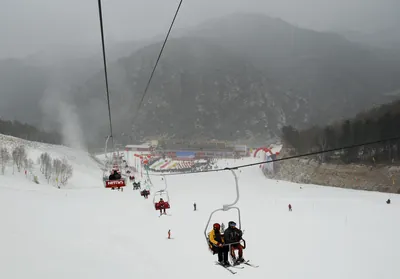
China’s snow is made. Chongli’s resorts run large snowmaking systems, and the base they lay down is reliable, groomed and consistent. It is also a base, not a snowpack. Off-piste is limited, the season ends when the weather turns warm, and a dry December shows up as white ribbons on brown hills. The resorts are honest about this in their own marketing: they sell piste kilometres and vertical drop, not powder days.
The exceptions are inland and far away. Beidahu in Jilin is cold and dry, with natural snow and 870 metres of vertical, and Songhua Lake has the most beginner terrain in the country. Altay in Xinjiang has the lightest, driest snow in China, and Keketuohai opened on 20 October 2026 with 1,350 metres of vertical. The catch is that Altay is a four to five hour flight from Beijing or Shanghai, plus an hour or more by road.

Season dates and the weeks that matter
| Opens | Closes | Best window | |
|---|---|---|---|
| Altay, Xinjiang | mid-October; Keketuohai 20 October 2026 | late April | December to March |
| Chongli, Hebei | late October; Wanlong 23 October 2026, Yunding 6 November, Thaiwoo 13 November | early April | mid-December to late February |
| Jilin | early November; Beidahu trial skiing 7 November, Songhua Lake 20 November | mid-April | January and February |
| Niseko United | 28 November 2026 | 5 May 2027 | late December to mid-February |
| Shiga Kogen | 5 December 2026 | 5 May 2027 | January to March |
| Hakuba Valley | late November, snow permitting | early May | January to February |
The Chinese and Japanese seasons overlap for about four months, so the calendar rarely decides it. What decides it is the holiday calendar, and that cuts against China in 2027.
Chinese New Year falls on 6 February 2027, and the State Council’s holiday notice, published on 5 November 2026, sets the public holiday at 5 to 13 February, nine days running. That is the single worst week of the Chinese ski season: lift queues double, hotel rates triple, and every resort within a train ride of Beijing sells out. If your dates are fixed to that window, Japan is the better answer, though note that Japanese resorts also fill with Lunar New Year travellers.
Western holidays matter less in China than they do in Niseko, where Christmas and New Year are peak pricing and the village is at capacity. In Chongli, a random Tuesday in January is quiet.
Crowds: the numbers, and where they concentrate
Both destinations are busy. They are busy in different shapes.
Niseko’s promotion board counted 2.135 million visitor arrivals across Kutchan, Niseko and Rankoshi between November 2025 and March 2026, up 8.4 percent, with January alone at 630,200. International overnight guest nights rose 32.9 percent to 973,798, meaning people are staying longer. The United States is now the largest overnight source market at 40,504 guests. The board’s own report describes peak months as close to capacity.
Chongli counted 5.24 million tourist visits in the 2024-25 season, spread across nine resorts, 219 runs and 178 kilometres of piste. Yunding, the Olympic venue, was seeing around 6,000 visitors a day in the 2025-26 season, and Wanlong was averaging more than 3,000 a day at weekends. The metrics are not identical, visits against arrivals, but the shape is clear: China’s totals are larger and spread wider.
The practical difference is concentration. Niseko funnels its traffic into four interconnected areas served by one lift system, and the Grand Hirafu gondola is the choke point on a powder morning. Chongli spreads its traffic across nine separate resorts and a high-speed rail line that delivers people to a station rather than a lift queue. On a weekday in January, a Chinese resort can feel empty. In Niseko in January, it cannot.
Getting to the mountain
Chongli is the fastest resort transfer in either country. Trains from Beijing North take 1 hour 20 to 1 hour 26 minutes to Taizicheng for ¥79 to ¥99, and from Qinghe about an hour for ¥74 to ¥93, with free shuttles from the station to the resort clusters. You can land at Beijing Capital in the morning and be on a chairlift after lunch. The high-speed rail guide covers the passport booking workaround, which you will need.
Niseko takes two steps. Fly to New Chitose, about 1 hour 35 minutes from Tokyo, then take a bus or the train for another two to three hours. From Tokyo, that is most of a day. Hakuba is easier from Tokyo, with the Hokuriku Shinkansen to Nagano and a bus, around three hours door to door.
Once you are there, Chinese resorts are compact and walkable, or served by the free shuttle. Japanese resorts are similar, though Niseko’s four areas are spread along a road and the shuttle matters more than the trail map suggests.
English, lessons and gear
Japan is easier for a first-time visitor and it is not close. Signage, rental shops, ticket windows and most restaurant staff in Niseko and Hakuba work in English. Ski schools have English-speaking instructors as a matter of course.
China has improved, unevenly. Chongli is the best of it: bilingual signage, rental staff who can handle a sizing conversation, and English instruction at Wanlong and Thaiwoo. Jilin is good inside the big hotels and Club Med, and thinner outside them. Xinjiang has the least, and a translation app is not optional there.
Gear is where tall and large-footed skiers get caught. Chongli rental fleets commonly stop at EU46, with EU48 needing a phone call ahead, and there are reports of no ski lengths above 170 centimetres at Wanlong. None of the big resorts publishes a maximum boot size. If you are over 190 centimetres or take EU47 and up, bring your own boots.
Payments are their own small project. Chinese resorts run on Alipay and WeChat Pay, with foreign cards linked, and a few deposit desks still struggle with Visa. The mobile payment guide covers the setup. Japan takes cards almost everywhere, which is one less thing to think about.
Passes: Ikon now covers both countries
For 2026-27, the Ikon Pass has ten destinations in Japan, including Niseko United, Shiga Kogen and Furano, and three in China: Yunding, plus Beidahu and Songhua Lake, which joined this season. The full pass gives seven days at each destination and the Base Pass gives five, with blackout dates that include 26 to 30 December, 16 to 17 January and 13 to 14 February.
The detail most comparisons get wrong: Hakuba Valley is on the Epic Pass, not Ikon. If your plan is built around Hakuba, an Ikon pass does nothing for you.
Days are counted per destination, not pooled, so a two-country trip with an Ikon pass uses one allowance in Niseko and a separate one at Beidahu. That is generous if you are doing both anyway and close to useless if you are not. A full Ikon Pass cost $1,449 and a Base Pass $1,019 in September 2026, before the usual October increase.
Visas: the asymmetry that decides it for Americans
Japan is visa-free for 90 days for US, UK, Canadian, Australian, New Zealand and most EU passports. You need a valid passport and an onward ticket, and that is the whole requirement.
China’s 30-day unilateral visa-free scheme covers 50 countries, including Japan, the UK, Canada, Australia and most of the EU, but as of November 2026 it runs only to 31 December 2026, which is mid-season. The United States is not on the list.
American skiers have two options. A tourist visa takes an application, an appointment and a fee. Or the 240-hour visa-free transit, which covers 24 provinces and includes Beijing and Hebei, so Chongli works through a Beijing arrival. It explicitly excludes Jilin and Xinjiang, which rules out Beidahu, Songhua Lake and Altay for transit-based trips. The visa-free entry guide tracks the current list and what happens if the scheme lapses, and the visa hub covers the transit rules in more detail.
That asymmetry is the single biggest practical difference between the two trips. A British skier compares snow and money. An American skier compares snow and money and then adds a visa application to one side of the ledger.
Which one to pick
Take Japan if the snow is the point, if you are American and want to avoid a visa, if you are travelling with people who have never skied and need English instruction, or if you have four days rather than ten. Niseko for the snow and the village, Hakuba for a bigger mountain and a cheaper base, Shiga Kogen for space and a five-month season.
Take China if you are already there, if you want a week of skiing for the price of four days in Japan, if you like the idea of a resort where a Tuesday is empty, or if you want to combine skiing with Harbin’s ice city, which the Harbin guide covers properly. Chongli for convenience, Jilin for vertical and quiet, Altay for powder and a long flight.
Take neither if your dates are 5 to 13 February 2027 and you have not booked. That week is Chinese New Year, and both countries are full.
Whichever you choose, budget the same way: flights, accommodation, lift tickets, gear, lessons, food. The ticket price is the number everyone argues about, and in 2026 it is the number that matters least.
Frequently asked questions
Is skiing cheaper in China or Japan?
On lift tickets alone, the two are closer than most guides admit. Converted at the exchange rates in November 2026, a peak day at Niseko United costs about $86 and a walk-up weekday at Wanlong costs about $83. China is cheaper at the low end, where early-bird and weekday tickets run $44 to $62, and level at the top. The real saving is in lodging, food and lessons, where a Chinese resort week can cost a third of a Japanese one. Airfare can erase all of it, because US to Japan fares are frequently lower than US to China fares.
How much is a lift ticket in China compared with Japan?
A 2026-27 single-day adult ticket is roughly ¥418 to ¥560 in Chongli, ¥294 to ¥532 in Jilin, and about 13,500 yen at Niseko United in peak season, 11,100 yen for the Hakuba Valley pass and 9,500 yen at Shiga Kogen. In dollars at about 6.72 yuan and 158 yen to the dollar, that is $62 to $83 for China against $60 to $86 for Japan. Chinese tickets more often bundle rental gear, which is a separate cost in Japan.
Which country has better snow?
Japan, and it is not a close call. Niseko United recorded 13.5 metres of snowfall in the 2025-26 season, with a four-metre base at 850 metres in late February and 80 days of fresh snow. Most of Chongli’s base is made by snow guns, so the groomers are reliable and the off-piste is limited. Jilin and Xinjiang have better natural snow than Chongli, and Altay has genuinely light powder, but neither matches a good Hokkaido January.
When is the best time to ski in China?
Mid-December to late February, once the base is deep and before the spring melt. Avoid the 2027 Spring Festival: Chinese New Year falls on 6 February and the official holiday runs 5 to 13 February, when lift queues double and hotel rates triple. The same warning applies to Christmas and New Year in Chongli, which is a two-hour train ride from a city of 22 million people.
Do I need a visa to ski in China?
It depends on your passport. China’s 30-day unilateral visa-free scheme covers 50 countries including Japan, the UK, Canada, Australia and most of the EU, but it runs only to 31 December 2026. The United States is not on the list, so American skiers either apply for a visa or use the 240-hour visa-free transit, which covers Beijing and Hebei and therefore Chongli, but not Jilin or Xinjiang. Japan is visa-free for 90 days for US, UK, Canadian, Australian and EU passports.
Can I use one ski pass in both China and Japan?
Yes, partly. The Ikon Pass covers Niseko United, Shiga Kogen and Furano in Japan, plus Yunding, Beidahu and Songhua Lake in China, with seven days at each destination on the full pass and five on the Base Pass. Hakuba Valley is on the Epic Pass, not Ikon, which is the detail most comparisons get wrong. Days are counted per destination, so a two-country trip uses two separate allowances.