Huashan from Xi'an: Cable Cars, Routes and Route Planning

Huashan sits about 120 kilometres east of Xi’an, close enough to be a day trip and steep enough that most people treat it as one. It is a single block of granite with five peaks on top, and for most of its history there was only one road up. That is no longer true, because two cable cars now do most of the climbing for you. The decision you actually face is which car to take, which peak to finish on, and what time to be at the bottom.
One thing has changed this autumn. The cliff routes everyone has seen in photographs, the plank walk bolted to a vertical face and the ladder around a rock spine, closed on 15 September 2026 for maintenance and have not reopened. If those were the reason for the trip, read the section below before you book anything. The rest of the mountain is open, and it is still the best mountain day within reach of Xi’an.
The mountain in numbers
Five peaks stand on the summit plateau, and the official survey heights put four of them above 2,000 metres. South Peak is the highest at 2,154.9 metres, which also makes it the highest point of the Five Great Mountains. East Peak, where people watch the sunrise, is 2,096.2 metres. West Peak, where the long cable car arrives, is 2,082.6 metres. Centre Peak is 2,037.8 metres, and North Peak, the low one, is 1,614.9 metres.
That last number matters more than the others when you plan. The north cable car leaves you 540 metres below the highest point, so a north-side ascent means climbing. The west cable car puts you almost at the top, which is why it costs more and why it is the right choice for a first visit.
Getting there from Xi’an
Most people base themselves in the Xi’an old city, which earns its stop for the city walls and the warriors alone, and bolt Huashan on as a long day at the end. Trains from Xi’an North to Huashan North take 28 to 45 minutes and cost ¥54.5 in second class, with more than fifty services a day and the first ones leaving around 06:30. Book to Huashan North (华山北), not Huashan station. The old station is closer to the town and far less useful, with few trains and awkward connections.
From Huashan North it is about five kilometres to the visitor centre. Free local buses 1 and 2 run the route from roughly 07:00 to 19:00, taking fifteen to thirty minutes depending on traffic. A taxi is ¥15 to 20 and saves the wait. If you are coming from Luoyang or Zhengzhou, the same line continues east, and the high-speed rail guide covers how the booking works with a passport.
The visitor centre is not the mountain gate. It is where you board the shuttle buses to the two cable car stations, and where the ticket checks happen. Hikers heading for the traditional route take a separate free shuttle to Yuquan Temple, a few minutes away, and start walking from there.
Tickets, prices and the passport problem
Prices for 2026 are stable and easy to remember. The entrance ticket is ¥160 from 1 March to 30 November and ¥100 from 1 December to the end of February. Students and visitors aged 6 to 18 pay half. Visitors aged 65 and over, children under 1.2 metres, serving military and disabled visitors enter free, but they still need a reservation.
The ticket is valid for 48 hours from first entry and covers the main scenic area once, plus Yuquan Temple, Xianyu Valley and Xiyue Temple once each. That makes an overnight stay sensible rather than extravagant: you pay once and walk in twice.
| Item | Peak season (1 Mar to 30 Nov) | Off season (1 Dec to end Feb) |
|---|---|---|
| Entrance ticket | ¥160 | ¥100 |
| West Peak cable car, one way | ¥140 | ¥120 |
| North Peak cable car, one way | ¥80 | ¥45 |
| West shuttle bus, one way | ¥40 | ¥40 |
| North shuttle bus, one way | ¥20 | ¥20 |
Booking is the part that catches international visitors. The mountain uses real-name timed reservations through the WeChat mini-program 华山旅游服务平台, with an Alipay equivalent called 华山旅游官方平台. Sales open ten days ahead, and new inventory for the tenth day is released at 16:00. Leftover tickets for the same day appear at 08:00, 10:00 and 12:00. On busy dates the daily cap is 30,000 people, and there is no ordinary ticket window to fall back on.
The Chinese system wants a Chinese ID number, so a passport will usually stop you at the last step. The workaround is the special ticket counter (特殊票种办理处) at the visitor centre, where staff issue the ticket against your passport and you swipe the same document at the gate. The scenic area announced in May 2024 that overseas visitors could also book through the Trip.com overseas channel and enter by swiping a passport at a handheld reader, but that channel launched with only three products: the walking ticket, and the ticket bundled with either the west or the north shuttle bus. Cable car tickets may still need to be bought at the counter. Budget fifteen minutes and arrive earlier than you think you need to.
If you have not set up WeChat Pay or Alipay yet, do it before this trip. The payment setup guide walks through it, and it is the difference between buying water at the top and not.
The two cable cars, and how to choose
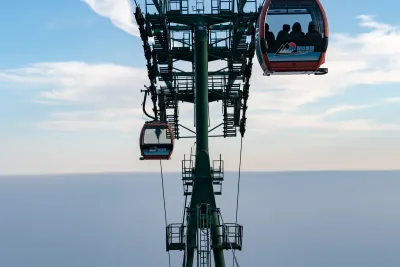
The west cable car, properly the Taihua cableway, is the long one. It runs 4,211 metres from the Wengyu valley with 894 metres of vertical gain, takes about twenty minutes, and finishes a short walk below West Peak. It opened in 2013 and the cabins hold eight people. In wind it sways in a way that people who dislike heights will remember.

The north cable car is short and steep: 1,524 metres long, 755 metres of rise, five to eight minutes, ending at North Peak. It is cheaper, busier and the reason the north side is the crowded side.
Both run roughly 07:00 to 19:00 in peak season, and check-in for riding up closes at 16:00. In winter the hours shrink to about 08:00 or 09:00 until 17:00 or 18:00. Winds above the safety threshold stop the cars, which happened on 5 November 2025 when passengers were left hanging for a while, so treat the afternoon as a deadline rather than a suggestion.
Four routes, and what each one costs you
Almost every visitor takes one of four combinations. The prices below assume one adult, peak season, and one shuttle ride in each direction you travel.
| Route | Time on the mountain | Cost per adult | What it gives you |
|---|---|---|---|
| West up, north down | 6 to 8 hours | ¥440 | All five peaks, one-way walking, the standard route |
| West up, west down | 4 to 5 hours | ¥520 | West, South and Centre Peaks, no North Peak, retraces its steps |
| North up, north down | 6 to 7 hours | ¥350 | The cheapest cable route, but you climb the whole ridge both ways |
| Walk up from Yuquan Temple | 8 to 10 hours | ¥160, or ¥260 with a cable down | The old road, 4 to 6 hours of stairs before the peaks begin |
West up and north down is the right answer for a first visit, and it is not close. You start at the top, walk the ridge in one direction while collecting the five peaks, and finish with a downhill staircase to North Peak instead of a climb. The one cost is the Canglong Ridge descent, a narrow spine of stone with steps and chains that is hard on the knees and slow when it is busy.
West up and west down suits anyone travelling with children, nursing a knee injury, or arriving after 10:00. You see the three best peaks and skip the traverse. It costs more because you pay the west cable car twice.
North up and north down is the budget route and the one locals use, but it front-loads 470 metres of climbing on the staircases around Canglong Ridge, and you repeat them on the way down. In ice or rain, do not.
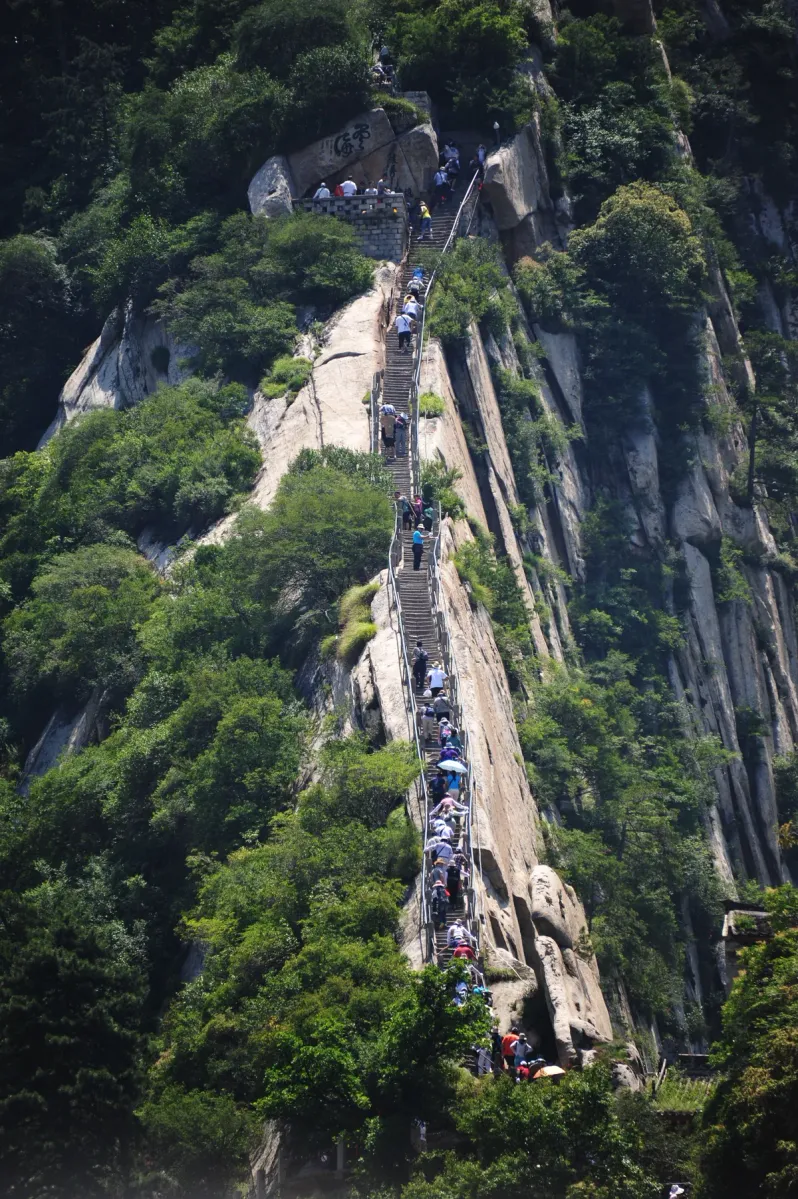
Walking up from Yuquan Temple is a different trip, closer in effort to the full Mount Tai climb than to anything else on this list. The gate is open 24 hours, the path climbs through the Thousand-Foot Precipice and Hundred-Foot Gorge, and most people who do it start in the dark so they can watch the sunrise. Take the cable car down.
West up, north down, hour by hour
Be at the visitor centre by 06:40. The first west shuttle leaves around 07:00 and takes 40 to 45 minutes up the valley to the lower cable car station, so even the earliest arrivals are on the mountain at half past seven. Buy or collect everything you need at the visitor centre; there is nothing useful at the top station except a toilet and a queue.
The cable car ride is twenty minutes. From the upper station it is a ten-minute walk to West Peak, where the rock splits into a shape that looks like a lotus, and another forty minutes along the ridge to South Peak, the highest point of the day. The stretch between South and East Peak takes about an hour and passes Centre Peak, a short detour that most people skip and should not.
East Peak is where the ridge turns and the descent begins. From there it is forty minutes to Golden Lock Pass, where thousands of brass padlocks hang from chains, and then the Canglong Ridge steps down to North Peak. Allow ninety minutes for that section, more if it is wet or crowded, because the steps are narrow, the drop is real, and everyone moves at the pace of the slowest person ahead.
From North Peak the cable car takes eight minutes and the shuttle twenty. Be at the north cable car station by 18:00 to leave a margin before the last car, and plan on the train back to Xi’an between 19:00 and 21:00.
What is closed, and why it matters
The Changkong Plank Walk and the Yaozi Fanshen route both closed on 15 September 2026 for a full overhaul of their fittings and safety systems. The notice said they would reopen after inspection, with the date to be announced through official channels, and as of late October nothing has been announced. Guides that still describe them as open are out of date, and photos of the plank walk are not a promise of anything.
When they do reopen, expect the same conditions as before: a separate safety harness fee of about ¥30, a same-day booking made on the mountain near South Peak, a minimum age and height, a two-person minimum, and closures in wind or rain. None of that applies while the works are running.
Sleeping up there for the sunrise
East Peak is the sunrise viewpoint, and there is a hotel a few minutes below it, plus a cluster of simpler guesthouses around the summit plateau. Rooms are basic and priced for the location, and in October they go early. The entrance ticket covers both days, so the only extra cost is the bed and the cable car down.
The cheaper option is the night climb from Yuquan Temple, which is open all night. People start around 22:00, reach the summit in four to six hours, and stand in the cold waiting for first light. Bring a head torch, a warm layer and gloves, because the chains are metal and the wind at the top is not gentle.
Sunrise in late October arrives a little before 07:00. In summer it is closer to 05:30, which is why the night climb is a summer habit. The cable cars do not run overnight, so anyone who walks up in the dark waits for the first car down unless they walk back.
When to go
Late September and October are the best weeks: clear air, cool temperatures, and the hillsides turning. April to June is the second window, with more haze and more flowers. July and August are hot, wet and crowded, and the stairs between the peaks turn into a queue.
Winter is a genuine option if you accept the trade. The ticket drops to ¥100, the crowds vanish, and snow on the granite is worth the cold, but ice closes sections and one cable car is usually under maintenance. In the last cycle the west cableway shut from 17 November to 14 December 2025 and the north one from 14 to 22 January 2026. The 2026 dates had not been published when this was written, and the notice usually appears one or two weeks ahead, so check the official account if you are travelling in November.
Budget-wise, Huashan is one of the pricier day trips in the country: ¥440 is more than a week of street food in Xi’an. The city-by-city cost guide shows where it sits against the rest of a typical itinerary. Public holidays are the one period to avoid. The daily cap of 30,000 applies, the cable queues run for hours, and the ridge becomes a slow procession. A Tuesday in October is a different mountain.
What to bring, and who should skip it
Grippy shoes matter more than boots. The steps are polished stone, the chains are there to be held, and a pair of thin gloves makes the descents much more comfortable. Bring layers rather than one thick jacket, two litres of water, and cash for the small vendors on the ridge; mobile payment works at the hotels but not everywhere on the path.
Anyone with a serious fear of heights should think carefully about the west cable car and the Canglong Ridge steps. Neither is dangerous in normal conditions, but both are exposed, and there is no alternative exit once you are committed to the traverse. Bad knees are the other common problem: the descent from Canglong Ridge is roughly 1,500 steps, and trekking poles help. Kids manage the cable routes fine; the full walk up from Yuquan Temple is too much for most children under ten.
Frequently asked questions
Can I visit Huashan as a day trip from Xi’an?
Yes. High-speed trains run from Xi’an North to Huashan North in 28 to 45 minutes for ¥54.5 in second class, with more than fifty departures a day. A cable-car route takes six to eight hours on the mountain, so a 07:00 train gives you a comfortable day and a train back to Xi’an in the evening. A full walk up from Yuquan Temple does not fit in one day comfortably.
Do I need to book Huashan tickets in advance, and can I book with a passport?
Book in advance: the mountain runs a real-name timed reservation, opens sales ten days ahead with new inventory at 16:00, and has no general ticket window on site. The Chinese booking system expects a Chinese ID number, so passport holders usually collect or exchange at the special ticket counter at the visitor centre. The scenic area also announced an overseas booking channel through Trip.com in May 2024 that accepts a passport, but only for a few ticket types, so check what is included before you pay.
Which Huashan route should a first-time visitor take?
West cable car up and North cable car down. You start at 2,082 metres near West Peak with the climbing already done, walk the summit ridge past South, Centre and East Peaks, then descend the Canglong Ridge stairs to North Peak. It covers all five peaks in six to eight hours. If your knees are doubtful or you have half a day, go up and back down on the west cable car instead.
Is the Huashan plank walk open?
No. The Changkong Plank Walk and the Yaozi Fanshen cliff route have been closed since 15 September 2026 for maintenance and safety upgrades, and the scenic area has not announced a reopening date. Everything else on the mountain is open. Check the official Huashan WeChat account before you travel if these two are the reason you are going.
How much does a day on Huashan cost?
For the standard west-up, north-down route in peak season: ¥160 entrance, ¥40 for the west shuttle bus, ¥140 for the west cable car, ¥80 for the north cable car and ¥20 for the north shuttle. That is ¥440 per adult, before trains and food. The entrance ticket is valid for 48 hours, so an overnight stay does not mean paying twice.
Can I stay overnight on Huashan to see the sunrise?
Yes. There are hotels near East Peak, which is the sunrise viewpoint, and they fill early in autumn. The other option is the night climb: the Yuquan Temple hiking gate is open 24 hours, and people start around 22:00 to reach the top before dawn. The cable cars do not run at night, so a night climb means walking both ways or waiting for the first car down.