Luoyang Hanfu Rental: What You Actually Get at Each Price

What renting hanfu in Luoyang actually involves
Luoyang has turned hanfu rental into an industry, and the numbers are large enough to be worth stating with their sources, because the three figures in circulation do not measure the same thing. The Henan provincial statistics office counts more than 1,600 hanfu businesses citywide. The old city district, where almost all of them cluster, counts around 1,300 experience shops. Meituan, the booking app, lists roughly 2,000 online. None of those contradict each other. They are a province-wide registry, a single district, and an app listing.
What you are buying is a package, not a costume. The standard transaction is: pick a garment, get your hair and face done in the back room, walk out, take photographs, come back before closing. Almost every shop in Luoyang works this way, and the price difference between tiers is mostly about how much of that chain is included and how much of it is done by hand.
This matters for planning because the costume is the cheap part. A shop can hand you a robe in ten minutes. The makeup and the hair take an hour, and that is where the money and the queue are.
The price tiers, and what each one buys

Luoyang’s rental market has settled into four bands, and the 2023 starting price quoted by the city’s own newspaper, Luoyang Daily, was ¥69 for the costume alone.
| Tier | Typical price | What is included |
|---|---|---|
| Costume only | from about ¥69 | The garment, and usually a basic sash or belt. No hair, no makeup |
| Costume plus styling | ¥119 to ¥299 | The garment, hair styling and makeup. The ¥199 and ¥299 tiers reported by Henan Daily in 2024 include flowers pinned into the hair |
| Restored or high-end | ¥300 to ¥500 and up | Historically researched reconstruction, heavier fabrics, more elaborate hair, and often a dedicated stylist |
| Photographer | ¥399 to ¥1,299, on top | A shooter for one to two hours, edited files delivered afterwards |
Three things about that table are worth pulling out.
The first is that ¥39, which still appears on a lot of English pages, was a 2021 price. It was real then. It is not a tier you can walk in and buy now.
The second is that the photographer is the expensive part, not the costume. If your budget is tight, rent at the ¥119 to ¥199 level and shoot on a phone. The old city is lit, crowded and photogenic enough that you do not need a professional to get a usable picture. What you would be paying ¥399 and up for is direction, a fast lens and edited files, not access to a better location.
The third is the phrase on the board. Costume-only shops advertise as 租衣, garment rental, and the word for the full service is 妆造, literally makeup and styling. If you point at a price and do not check which of the two it is, you will find out at the till.
Where the shops are

Almost everything is in the old city district, on the north bank of the Luo river, and the density is highest in the lanes around Luoyi Ancient City and Lijing Gate. Metro Line 1 has stations named after both, Yingtianmen and Luoyi Ancient City, and either one puts you inside the cluster.
One warning saves people half an hour. Cross Street, Shizi Jie, is the old city’s food street. It is frequently described in English as the hanfu district, and it is not. It is a row of snack stalls. The rental shops are in the streets around it, not on it.
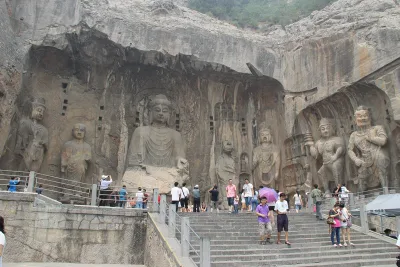
There are smaller clusters near the Mingtang and Tiantang halls, around the Jiuzhou Pond, and along the commercial strip outside the Longmen Grottoes. Those are convenient if you are already at the sight. The old city is where the choice is, and where you can compare four shops on one street before committing.
Practical note: the shops stay open late, commonly until 22:00 or 23:00, because the whole point is the night shoot. Walking the district at seven in the evening and picking a shop on the spot is a normal way to do this.
The deposit, the clock and the return
The deposit is the part international visitors get caught by, because it is large, it is in cash or by phone, and it is set per garment rather than per person. The Luoyang Consumers Association found deposits running from ¥200 to ¥1,000. A heavy reconstructed robe with a lot of embroidery sits at the top of that range.
Rental windows run from 3 to 24 hours. In practice, most shops assume same-day return, and the 24-hour option exists for the cheaper garments rather than the elaborate ones. Overtime is charged, and the amount is one of the things the shop is legally required to display.
Return works like this. You bring the costume back, staff inspect it, and the deposit is refunded. Small stains or loose stitching that can be cleaned or repaired are usually accepted without argument. Serious damage is charged at market value with depreciation applied, so a torn sleeve on a ¥400 robe costs real money.
Two habits protect you here. Photograph the costume, inside and out, before you leave the shop, with the timestamp on. And ask what the overtime rate is before you pay, not when you are running late.
Luoyang has also trialled a courier return, where you drop the costume into a locker and it is shipped back to the shop within a day for a ¥10 fee. It was introduced in 2023 and is not universal, so ask rather than assume.
Priced by law, which works in your favour
The old city market regulator requires hanfu shops to display their prices, and the required board is unusually specific. It has to list the costume rental, the makeup, the hair styling, the photography, the props, the deposit and the return time as separate lines.
That is a genuinely useful rule, because it means the information you need is supposed to be on the wall rather than quoted verbally. Read the board before you sit down in the chair. If a shop will not show you one, walk.
The regulator’s counterpart is the complaint line. Consumer disputes in China go to 12315, which works from a phone and has an English option in most provinces.
The pattern to watch for is not outright fraud, which is rare in a district this visible, but add-ons. A low headline price plus charged extras for false eyelashes, a hairpiece, a prop fan or a second costume change. None of that is illegal as long as it is on the board. It is only a problem when it is not, and the board is exactly what lets you tell the difference.
Ignore anyone offering a free photo session as the hook. Free sessions convert into paid prints often enough that the English internet has decided they are always a scam, which overstates it, but the safe reading is that a free add-on is a sales route and you should establish the price of everything else first.
Doing it without Chinese
Walk-in rental works, and the language barrier is smaller than it looks. Prices are on a board, garments are chosen by pointing, and a translation app handles the rest. What you cannot easily do without Chinese is discuss fit, negotiate, or explain that you want a Ming dynasty cut rather than a Tang one.
If you would rather not improvise, the international platforms sell it as a packaged experience. Those run two to three hours and include an English-speaking guide, usually meeting near Lijing Gate, and the standard shape is costume selection, roughly ninety minutes of makeup and styling, then an hour to an hour and a half of shooting, with around thirty unedited digital files and six retouched ones at the end. Booking requires each participant’s full name, passport number and phone number, and you are told to carry the passport on the day.
The passport does double duty even on a walk-in. It is the document a shop will want if it takes a deposit against identification, and it is what you would need if anything went wrong. Carry it.
If you are doing this as part of a longer Henan trip, the four ancient capitals rail route puts Luoyang third and gives you a sensible arrival time, and the station comparison explains which of Luoyang’s stations to book into, which is a genuine trap.
The sizing question nobody answers
Here is an honest gap. There is no published sizing data for Luoyang’s hanfu shops. No size chart, no plus-size inventory list, no confirmation anywhere that men’s cuts or extended sizes are stocked in depth.
What the reporting does show is range. Shops advertise collections of two to three hundred garments spanning Tang, Song and Ming styles, and the customer base includes families with children and older visitors, which suggests stock spreads wider than the young women in the advertising. Whether it spreads far enough for a tall or large build is a question you have to ask a specific shop.
Do that by phone before you go, or by message through the shop’s Meituan or Dianping listing. Ask two things: whether they have men’s cuts, and what the largest size on the rack is. Shops that cater to international visitors answer this routinely.
Two practical points. Book a day or two ahead if you want a specific garment or size, and a week ahead around public holidays, because the good stock goes early and the popular shops stop taking walk-ins. And if you are tall, ask about length specifically. Hanfu are cut for smaller frames, and a robe that fits across the shoulders can still finish above the ankle.
What to check before you pay
Six things, in order.
Read the price board and confirm the tier you are buying is the one you think it is, costume only or costume with 妆造.
Ask whether the makeup is the standard version or the finer one, and whether lashes, hairpieces and accessories are included or charged.
Try the garment on. Fit is the thing you cannot fix afterwards.
Photograph the costume before you leave, and photograph any existing damage or marks.
Confirm the return time and the overtime rate out loud, and check it matches the board.
Keep the receipt or the payment record. It is what you would need for a 12315 complaint, and it is also what proves the deposit amount.
Then go and enjoy it. The photographs are the point.
Is it worth it

Yes, for most people, and the entry tier is the honest place to start.
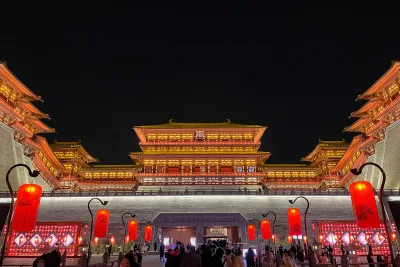
The ¥69 to ¥119 end of the market gets you a costume, and if you skip the makeup you can be out of the shop in fifteen minutes and shooting by the lake while everyone else is still in the chair. The photographs will be good. The old city is built for this: grey brick, red lanterns, water, and lighting that comes on at 18:30 and turns the whole district gold.
The top tier is for people who want the photographs to look like a production, and it delivers that. What it does not buy is a better location or a quieter one. Everyone is in the same lanes, and by eight in the evening the bridges are a queue.
One more thing worth saying plainly. Luoyang is not Xi’an, and the comparison is not close in the way the internet suggests. Xi’an has far more shops and a higher ceiling. Luoyang is cheaper, the old city is more compact, and the costume is treated as ordinary rather than as a novelty, which makes it a better first attempt. The Xi’an guide covers the other side of that if you are doing both cities. If you are choosing between them and this is your only stop, do it here.
Where to take the photographs, and which of the three main locations suits which costume, is the subject of the photo spot guide.
Frequently asked questions
How much does it cost to rent hanfu in Luoyang?
A plain costume rental starts around ¥69. Costume plus hair and makeup is the mainstream tier at roughly ¥119 to ¥299, and a fully restored historical look runs ¥300 to ¥500 and up. A photographer is a separate package, usually ¥399 to ¥1,299. Deposits are separate again and run ¥200 to ¥1,000.
Can international visitors rent hanfu in Luoyang?
Yes. There is no rule restricting rentals by nationality, and shops rent to anyone who walks in. The practical obstacle is language, since most of the old city shops operate in Chinese only. If you want an English-speaking experience, the pre-booked packages sold through international platforms include a guide, and they ask for your passport details when you book.
Is the ¥39 hanfu rental in Luoyang real?
It was, in 2021. Luoyang media reported ¥39 rentals that year and the figure has been copied online ever since. By 2023 the official starting price quoted by the city’s own newspaper was ¥69, and current shop boards sit higher. Treat any English page advertising ¥39 as describing a price that no longer exists.
How long can I keep the costume?
Rental windows are typically 3 to 24 hours, and which one you get is set by the price you pay rather than by how long you need. Overtime is charged. Most shops expect the costume back the same evening, so plan your shoot around a return time rather than assuming you have it until tomorrow.
What is the deposit for, and do I get it back?
The deposit covers damage, stains and loss, and runs ¥200 to ¥1,000 depending on how expensive the costume is. You get it back when the shop inspects the returned garment. Small marks that can be cleaned or repaired are normally tolerated; serious damage is charged at market value minus depreciation, which is why you should photograph the costume before you leave the shop.
Is a Luoyang hanfu rental worth it?
For the photographs, yes, and the cheap tier is the honest entry point. For a day of sightseeing in costume, only if you enjoy the attention, because you will be photographed by strangers constantly and the old city is jammed after dark. The people who regret it are the ones who paid for the top package and then spent the evening queueing for a bridge.