Henan's Four Ancient Capitals by High-Speed Rail: A 3,600-Year Route

Four of China’s eight ancient capitals sit in one province
The Chinese capital you have heard of is Xi’an, or Beijing, or maybe Nanjing. The China Ancient Capital Society recognises eight, and four of them are in Henan: Zhengzhou, Anyang, Luoyang and Kaifeng. Between them they cover the Shang, the Eastern Zhou, the Northern Wei, the Sui, the Tang and the Northern Song. Almost nobody visits all four in one trip, and that is a mistake a rail map makes easy to fix.
Here is the thing that changes the planning. All four sit on high-speed lines that meet at Zhengzhou East, and no leg between any two of them takes more than an hour. This is not a backpacking route. It is a hub with three spokes, and you can run it out of one hotel if you want to.
Zhengzhou East is the hub, and that decides everything
The running times, in the order you will probably use them.
| Leg | Typical time |
|---|---|
| Zhengzhou East to Kaifeng North | about 20 minutes |
| Zhengzhou East to Luoyang Longmen | 36 to 40 minutes |
| Zhengzhou East to Anyang East | 41 to 56 minutes |
| Luoyang Longmen to Kaifeng North | direct, about 1 hour |
Two stations need care. Luoyang has a high-speed station and a conventional one, and they are 12 to 13 km apart. Luoyang Longmen is the high-speed station, on the Xuzhou to Lanzhou line, and it is the one you want for the grottoes. Luoyang station is the old one, in Xigong district near the old town, and a train that arrives there has cost you 40 to 60 minutes of cross-city travel. Look for the four characters 洛阳龙门 on your ticket and nothing shorter.
Zhengzhou East itself is one of the biggest stations in the country, with 16 platforms and 32 tracks, and a floor area of about 412,000 square metres. Budget 30 minutes between the metro and your departure gate, and do not book a 15-minute connection.
Zhengzhou: the oldest of the four, and the least visited
Zhengzhou is the youngest city and the oldest capital. In 2004 the China Ancient Capital Society confirmed it as the eighth of the great ancient capitals, on the strength of the Shang city whose rammed-earth walls still stand under the modern streets. The Shang founders walled it about 3,600 years ago, which makes it the earliest of the four and the reason a walk through central Zhengzhou is an archaeological exercise as much as a city stroll.
What to do with a day here. The Henan Museum is the reason most people stop at all, and it is free. It opens Tuesday to Sunday with Monday closed, from 09:00 to 17:30 in summer and to 17:00 in winter, and entry is by timed real-name booking through the museum’s WeChat mini-program. Chinese visitors swipe an ID card at the gate. If you are carrying a passport, go to the staffed counter instead, because the automatic gates will not read it. Booking slots go three times a day and each one closes when it fills.
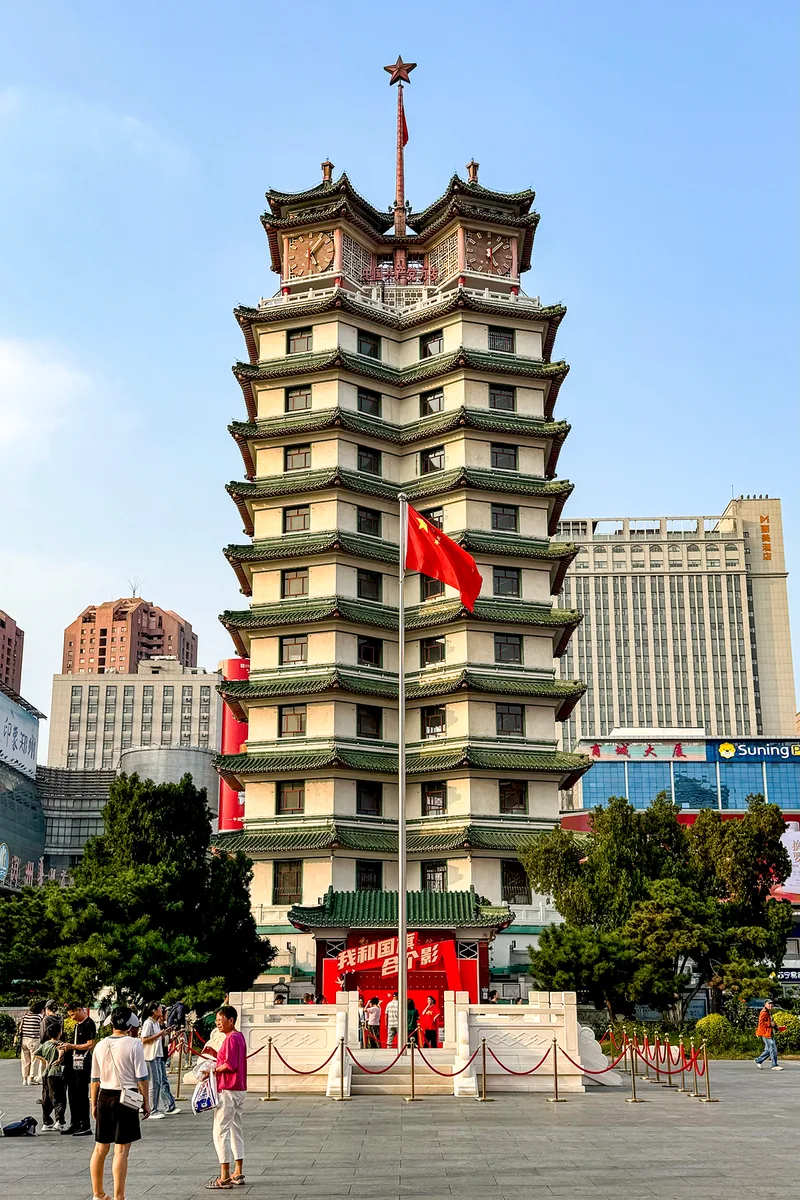
Downtown, the Erqi Memorial Tower is the city’s pin on the map, a 1971 tower on the square where the 1923 railway strike is commemorated. It is a ten-minute stop, not an afternoon.
Anyang: oracle bones, and the reason Chinese characters look the way they do
Anyang is the one people skip, and it holds the single best thing on this route. Yin Xu was the last capital of the Shang dynasty, occupied from about 1300 BC, and it is where the oracle bones came from: turtle shells and ox shoulder blades scratched with the questions officials put to their ancestors, and with the answers. Those scratches are the earliest mature Chinese writing. Some of the characters on them are still recognisable in the script used today.

Tickets at Yin Xu come in several forms and the price depends on which part you are buying. The new Yin Xu museum is ¥80, under a price document issued by Anyang’s development and reform commission. The site also sells a combined ticket at ¥120, a ruins-area ticket at ¥50 and an evening ticket at ¥40. Those three are the scenic area’s own pricing without a separate published document, so treat them as changeable and check the official WeChat account before you travel.
The other half of Anyang is free. The Chinese Character Museum, in the north of the city, is dedicated entirely to the writing system, and it runs the same pattern as the Henan Museum: free entry, real-name booking one to three days ahead through WeChat, Monday closed, and a passport needed at the desk rather than the gate.
Getting there from Anyang East station is easy but not instant. A taxi takes about 20 minutes for ¥25 to ¥30. A city bus takes closer to an hour, which is fine if you have the time and pointless if you do not.
Luoyang: the famous one, and the station that catches people out
Luoyang was capital for thirteen dynasties and the Longmen Grottoes are why it is on the tourist map. Some 2,345 numbered niches and roughly 110,000 carved figures run along a limestone cliff above the Yi River, cut over four centuries from the Northern Wei into the Tang. The seated Vairocana Buddha at Fengxian Temple is 17.14 metres tall and was finished in 675.
Tickets are ¥90 under a 2018 provincial price reduction, and one ticket covers the west hill, the east hill, Xiangshan Temple and Bai Garden. English-language guides still quote a ¥120 peak-season price. There is no price document behind that number, and the official site has not charged it.
Two things trip people up. First, there is no metro station at the grottoes. Luoyang has two metro lines and neither goes there, whatever a search result tells you. From Luoyang Longmen station it is 4 to 5 km, ten to fifteen minutes and about ¥15 in a taxi. From the old Luoyang station it is 16 km, and bus 81 takes about an hour. Second, there is no ticket window. Entry is by timed real-name booking through WeChat, slots are limited, and missing your slot is recorded against you: one no-show restricts you for three days, two for thirty, three for a hundred and eighty.
The rest of Luoyang is cheaper and quieter. White Horse Temple, the first Buddhist temple in China, is a taxi ride east. Luoyi Ancient City is free, lights up at 18:30, and needs a booking of its own. Yingtianmen, the rebuilt Sui and Tang gate, charges about ¥60 to climb, and its north square light show is free.
Kaifeng: the Song capital that turned into a theme park
Kaifeng was the Northern Song capital from 960 to 1127 and, by most accounts, the largest city in the world while it held that role. Very little of it survives above ground, partly because the Yellow River buried the city repeatedly, and partly because the Song court took the art collection north when it fell. What you get instead is a reconstruction industry, done unusually well.

Qingming Shanghe Garden rebuilds a Song painting as a working park, with day tickets at ¥120. The Iron Pagoda, a 13-storey glazed brick tower from 1049, is the genuine article and the best surviving thing in the city. Kaifeng has no metro, so plan on buses and taxis. From Kaifeng North station to the Qingming park is about 11 km, with bus 38 running the route and a taxi costing around ¥25.
The multi-ride ticket does not cover all four
China Railway sells tourist multi-ride passes in the 12306 app under the 计次票 and 旅游 tabs. Two of them touch Henan, and neither will get you around this route.
The Zhengzhou-Kaifeng-Luoyang pass covers six stations: Zhengzhou, Zhengzhou East, Luoyang Longmen, Kaifeng, Kaifeng North and Songcheng Road. It starts at ¥40 and lets you assemble between two and ten legs of your own choosing. The Huaxia Ancient Capitals pass covers seven stations including Beijing West, Zhengzhou, Luoyang Longmen and Xi’an North, and starts at ¥115.
Neither includes Anyang. So the four capitals cannot be done on one pass, and the Anyang legs have to be bought separately. There is also no official word on whether the tourist passes are open to non-Chinese passports, so if you want to use one, check with your passport account in the app before you build a plan around it. You will also see a ¥155 pass for four legs quoted in older guides. That was the 2024 version and it no longer applies. The current passes run 2 to 10 legs and must be activated within 30 days of purchase.
If that sounds like more trouble than it is worth, single tickets on 12306 are cheap and the legs are short. Our high-speed rail guide covers booking, seat classes and the ID rules at the gate.
How to sequence it
Run it in the order the capitals rose, and the route makes sense on the ground as well as in the history books.
Day one, Zhengzhou. The walled Shang city and the Henan Museum, which is the best single introduction to the province. Day two, Anyang by an early train, with the Yin Xu museum in the morning and the Chinese Character Museum in the afternoon. Day three, Luoyang on the first fast train, the grottoes in the late afternoon when the tour groups thin out. Day four, Kaifeng, and back to Zhengzhou in 20 minutes for the evening.
Four days is the minimum and it is rushed. Six days lets you add White Horse Temple, the Song city wall in Kaifeng and a night in Luoyang’s old town, which is when the city is at its best. If you are extending west afterwards, Xi’an’s historical core is two hours from Luoyang Longmen on the same line, and it makes an obvious pairing.
You can base in Zhengzhou for the whole thing and day-trip, which saves on repacking and costs you the evenings. The alternative, moving hotels each night, is not as painful as it sounds because every station on this list is close to its city centre.
What to know before you book
Spring and autumn are the seasons to aim for. Avoid the first week of May, the first week of October and the Spring Festival period, when the same trains and the same grottoes fill with domestic holiday traffic and the timed bookings at Longmen become genuinely hard to get.
Book museum and grotto slots before you book trains, because they are the constraint. Trains between these cities run all day and you can usually buy a ticket the same morning. Museum slots cannot be conjured at the door.
Finally, this is a province that rewards a bit of homework. Henan gets a fraction of the foreign visitors that Shaanxi and Beijing do, and the smaller cities are not set up for people who arrive without a plan. Our notes on the Chinese cities most travelers skip explain why that is worth pushing through, and where to stay once you decide to.
Frequently asked questions
How many days do I need for Henan’s four ancient capitals?
Four days is the working minimum, one per city, and it feels rushed. Six days is comfortable and lets you add White Horse Temple in Luoyang, the Song city wall in Kaifeng and an evening in Luoyang’s old town. Anyang is the one people cut, and it is also the one with the best site.
Is there a direct train between Luoyang and Kaifeng?
Yes. Direct high-speed services run from Luoyang Longmen to Kaifeng North in about an hour, so you do not have to go back through Zhengzhou. Zhengzhou East is still the hub for Anyang, which sits north on the Beijing line.
Which Luoyang station should I use for the Longmen Grottoes?
Luoyang Longmen, the high-speed station, which is 4 to 5 km away and about ¥15 in a taxi. Luoyang station is the conventional station 16 km away in a different district. The two are 12 to 13 km apart, and a ticket to the wrong one costs you 40 to 60 minutes.
How much are the tickets for Longmen Grottoes and Yin Xu?
Longmen Grottoes cost ¥90, covering the west hill, the east hill, Xiangshan Temple and Bai Garden. The ¥120 peak-season price in older guides has no price document behind it. At Yin Xu the museum is ¥80, with a ¥120 combined ticket, ¥50 for the ruins area and ¥40 for the evening session.
Can I visit all four cities on one multi-ride rail pass?
No. The two tourist passes that cover Henan between them include Zhengzhou, Luoyang Longmen, Kaifeng and Kaifeng North, but neither includes Anyang. Buy the Anyang legs as ordinary tickets. The ¥155 four-leg pass quoted in older guides was the 2024 version and no longer applies.
Do I need to book the Longmen Grottoes in advance?
Yes, and there is no ticket window at the site. Entry is by timed real-name booking through WeChat, and the slots are capped. Missing a booking is recorded: one no-show restricts you for three days, two for thirty and three for a hundred and eighty.