Sanya and Hainan: Beaches, Resorts and Visa-Free Entry

Sanya is the one place in China where the beach is the whole point. Elsewhere you visit a coast between other things. Here you fly in, check into a hotel, and do very little for a week, and the island is built for exactly that: an airport close to the hotel strips, a coastal railway, and enough rooms to absorb a national holiday.
The complication is paperwork, and it is a bigger complication than most guides admit, because Hainan runs its own immigration policy. The national 30-day visa-free scheme covers around 50 countries and leaves out the United States. The 240-hour transit needs an onward ticket to a third country. Hainan has a third door, open to 61 countries including the US, Canada, Brazil and Mexico, good for 30 days on an ordinary passport.
What follows is that policy explained properly, then the practical parts: which bay to book, what the beach is like once you arrive, what transport really costs, when the weather turns, and where the duty-free rules catch people at the till.
How Hainan’s visa-free entry actually works
The scheme has run since 9 February 2024 and expanded to 61 countries on 20 August 2026, when Kyrgyzstan and Vietnam were added. The list is unusual in who it includes. The United States, Canada, Mexico, Brazil, Argentina and Chile are all on it. So are the UK, Australia, New Zealand, Japan, South Korea, Singapore, Malaysia, Thailand and most of Europe.
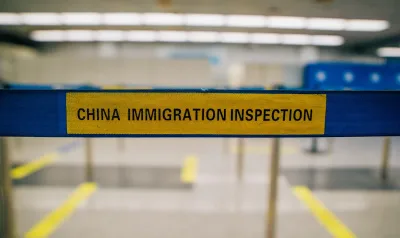
You need an ordinary passport, and you need to arrive at an open Hainan port. That means Sanya Phoenix, Haikou Meilan or Qionghai Boao by air, or the seaports at Haikou, Sanya, Yangpu, Qinglan and Basuo by ship. Land in Guangzhou first and take a domestic connection down, and you never entered under this policy at all.
Thirty days, counted from midnight on the day after you arrive, which is the National Immigration Administration wording. No pre-registration, no fee, no interview. The officer may ask for a return ticket and a hotel booking, so have both on your phone.
The restriction that catches people is geographic. The permission covers Hainan Province and nothing else. Sanya, Haikou, the surf villages on the east coast and the rainforest in the middle are all fine. A flight to Shanghai is not. If you want to continue to the mainland, apply for a visa at Hainan’s exit-entry administration before your 30 days expire, and do it early.
Purpose matters too. Tourism, business, family visits, medical treatment, conferences and sports are covered. Work and study are not, and neither is journalism.
Hainan’s own government puts the combined figure at 88 countries when this scheme is stacked with the national one, since the two lists overlap but neither contains the other. If your passport is on only the national list, you can enter anywhere in China for 30 days, though that policy currently runs to 31 December 2026 with no renewal announced. The full country list and the entry routes are worth ten minutes before you book, and the differences between the national schemes matter if your itinerary includes the mainland.
Which bay to book
Sanya has four developed bays and a couple of smaller ones, and they are not interchangeable. Pick the wrong one and you spend the week in a taxi.
Dadonghai is the city beach. Ten to twenty minutes from downtown, walkable, lined with guesthouses, seafood restaurants, bars and a surf school or two. The beach is public and free, with a signposted swimming zone, and the water can turn cloudy for a day after heavy rain. The drop-off is steeper than at Yalong and the waves are bigger. Stay here if you want to walk to dinner and you would rather spend money on food than on a room.
Sanya Bay is the long city beach on the west side, with the Coconut Dream Corridor promenade running behind it and the Phoenix Island towers offshore. You stay here for sunsets and convenience, not for the water. It is free, it is busy in the evening, and the swimming is ordinary.

Yalong Bay is the postcard. Seven and a half kilometres of white sand in a crescent, hills behind, calm water, and a resort strip that has been the default for well-off Chinese families for twenty years. Public access is at the east end near Yalong Bay Square and again beside the Underwater World, where there are fewer people and clearer water. Between resorts, walking along the sand is easier than walking along the road.
Haitang Bay is the newest and the most expensive. Wide, quiet, white sand, the huge CDF duty-free mall at the back, and international brands that arrived in the last decade. The trade-off is that much of this coast has strong currents, and swimming is restricted or unsafe outside the flagged public section at Haitang Square. If you want a resort with a pool and a view, this is the place. If you want to swim in the sea every morning, think again.
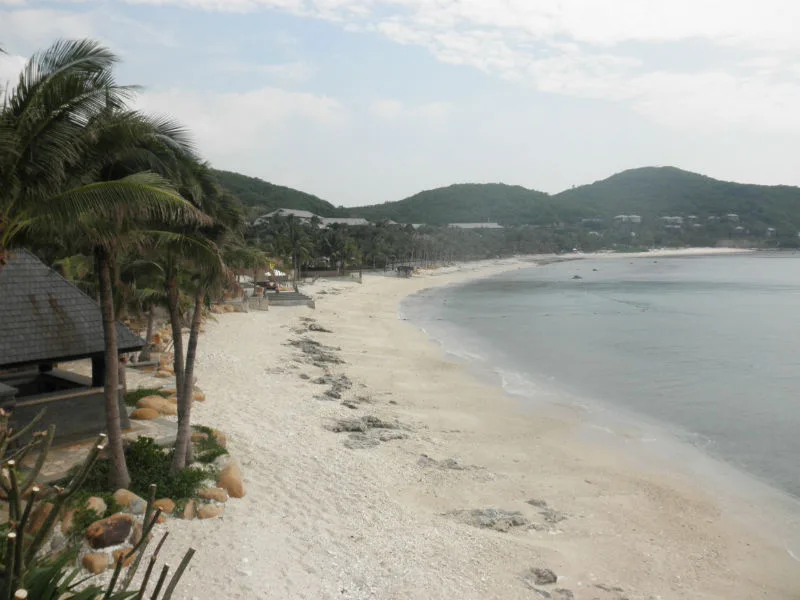
Then there is Houhai, also called Queen’s Bay, next to the Wuzhizhou Island pier on the east side. Surfboards, hostels, cheap seafood, a young crowd and a village that still feels like one. It is the answer for anyone who finds Yalong Bay too polished.
What the beaches are actually like
Every beach in Sanya is free and public. There are no tickets, no gates and no private sand. What hotels own is the frontage: their loungers, umbrellas and showers are for guests, and staff will politely move you on if you settle into one. Public sections have no shade and no facilities beyond a shower block, so bring a towel and expect to buy water from a cart.
Swimming is the part that needs judgement. Yalong is sheltered and calm, the closest thing on the island to a swimming pool with tides. Dadonghai has a marked zone with lifeguards. Sanya Bay is fine near the promenade. At Haitang Bay, red flags go up for good reason: the bay faces open water and several sections have rip currents, so stay between the flags near Haitang Square or stay out.
The sun is not a minor issue. Hainan sits at 18 degrees north, the UV index runs extreme for most of the year, and an overcast afternoon burns people just as efficiently as a bright one. Reef-safe sunscreen, a shirt for the water and a hat are not optional. The packing list for a China trip covers the rest of what people forget.
Resorts: what you get and what you pay
Sanya’s hotel stock splits cleanly. Haitang Bay has the newest buildings and the big international names, each with several pools, a kids club and a beach that may or may not be swimmable. Yalong Bay has the established resorts, slightly older, with better swimming in front of them. Dadonghai and downtown have the mid-range and the guesthouses, and Sanya Bay has apartment hotels aimed at longer stays.
Expect resort pricing to behave seasonally rather than rationally. The government price list defines peak season as 1 October to 30 April, and the first week of February 2027 is the annual spike, because Spring Festival falls on 6 February. Book that week months ahead or avoid it entirely. The same room in June can cost a fraction of the February rate, and June has better swimming weather than most people assume.
For the money side beyond the room, the city-by-city cost breakdown is a better planning tool than any single resort quote, and the accommodation guide explains what international guests can expect at check-in, including the registration paperwork hotels handle for you.
When to go
Here is the honest version, because the standard advice oversimplifies it. Hainan’s official flood season runs from 15 May to 15 November, set by the provincial meteorological bureau, and typhoons are most concentrated from July to September. That is the risk window, not a guarantee of bad weather: a typhoon near the island closes boats, beaches and sometimes the airport for two or three days, and the rest of the month can be glorious.
November to April is the comfortable stretch, dry, 25 to 29 Celsius, and it is also when everyone comes. Prices peak, Yalong Bay fills, and the good restaurants need booking. The useful compromise is May and June, hot and humid but quiet and cheap, or the second half of October once the National Day crowds have gone and the rain is thinning.
Attraction tickets follow the same calendar. Hainan’s price list treats 1 October to 30 April as peak, so the island’s paid sights cost 20 percent less from May to September.
Getting there and around
Sanya Phoenix International is west of the city, and the run into town takes twenty to thirty minutes.
The oddest and most useful piece of transport is the Sanya to Ledong tourist railway, opened in November 2024. It runs like a metro along the coast on S trains, bookable on 12306 or through Alipay, and it is far cheaper than a taxi: Sanya station to the airport is ¥3 and eight minutes, to Tianya Haijiao ¥6, to Nanshan North ¥12, to Yazhou ¥17. Departures are limited, though, so do not plan a flight around it. For a beach-hopping day it is excellent.
The airport buses are the sensible budget option. Line 1 runs to Yalong Bay from 09:00 to 02:00, timed to the last flights, with about 18 departures. Line 2 runs to the Haitang Bay duty-free mall from 10:00 to 22:00 on the hour, about 13 departures. The fare is capped at ¥25 per person, half for children, or ¥30 to ¥35 for the business van. Board at the Ground floor of Building C, opposite Gate 5 in domestic arrivals, and confirm the current timetable on the 海汽行 ticketing page before you rely on it.
Taxis follow a published tariff: ¥11 for the first 2.5 kilometres, then ¥2.4 per kilometre, rising to ¥3.6 per kilometre beyond ten kilometres, with a 20 percent surcharge between 23:00 and 06:00 and the first five minutes of waiting free. In practice that means roughly ¥40 to ¥80 into town, ¥80 to ¥110 to Yalong Bay and ¥130 to ¥160 to Haitang Bay. Ride-hailing works normally and is usually cheaper; the digital survival guide covers the app and the payment setup.
For the rest of the island, the ring railway is the backbone. Sanya to Haikou East costs ¥100 on a D train and ¥119 on a C train, taking between 1 hour 24 and 1 hour 58. The western route round to Haikou runs ¥128 to ¥152 and takes two and a half to three hours. The high-speed rail guide explains how to book with a passport, which matters more than the timetable.
Duty-free: where the rules bite
The CDF mall at Haitang Bay is the reason some people come. It is enormous, it is busy, and the rules are more specific than the marketing suggests.
The allowance is ¥100,000 per person per year, and since November 2025 you must be 18 to use it, down from 16 in the old rules. The category list now runs to 47, up from 45.
The part that decides whether you actually save money is collection. Immediate pickup, meaning you walk out with the bag, applies only to 15 categories of goods with a unit price below ¥20,000, and there are per-category quantity limits. Items between ¥20,000 and ¥50,000 must be collected at the port when you leave or sent by post. Anything at ¥50,000 or above goes through a guarantee scheme and is verified when you exit the island. And you must leave Hainan within 30 days of the purchase.
Two things are separate and often confused. The ¥10,000 annual allowance for Hainan residents buying duty-free goods on the island is a different scheme. So is the national rule for arriving international passengers.
What else is worth a half day
Nanshan, at the western end of the coast, is where the 108-metre Guanyin stands offshore on its own platform, and the temple complex behind it fills a morning easily. The gate price is ¥108, floating up to about ¥129 in peak season and down to about ¥86 in low, with a separate charge for the electric cart. It is the most impressive single sight on the island.
Tianya Haijiao, the famous rocks with the carved characters, is now free but requires a timed reservation. Older guides still quote ¥80 to ¥90, which is out of date.
Wuzhizhou Island, off Haitang Bay, has the clearest water in Sanya and the best snorkelling, at ¥144 in peak season and ¥136 in low, including the round-trip ferry. Real-name booking is required, and in winter you should reserve one to two days ahead. West Island, near the airport, is cheaper at ¥98 and ¥95 and has a fishing village worth an afternoon.
What to eat
Hainan has four dishes it considers canonical: Wenchang chicken, Jiaji duck, Hele crab and Dongshan goat. The chicken is poached and served cool with a ginger and lime dip, and it is better than it sounds. Coconut chicken hotpot, where the broth is coconut water and the bird goes in raw, is the dish most visitors end up eating twice.
For dessert there is qingbuliang, a bowl of coconut milk, beans, jelly and shaved ice that costs almost nothing and is the correct response to a 32 degree afternoon.
At the First Market in downtown Sanya you buy seafood by weight and carry it to a nearby restaurant that cooks it for a fee. This is a good system and the classic place to be overcharged: agree the price per jin, watch the scale, and confirm the cooking fee before the fish leaves the counter.
What goes wrong
A typhoon arrives in your week and the boats stop. Nothing to do but check the forecast before booking and buy flexible tickets in September.
Someone swims at Haitang Bay outside the flags. The currents there are real.
A duty-free purchase above ¥20,000 is made on the last morning, and the buyer discovers at the airport that it must be collected at the port, which is the airport, which is fine, except the counter closes before the flight. Read the collection rule before you pay.
A traveler books Sanya plus Shanghai on the Hainan visa-free entry. That itinerary needs a visa, and the airline will ask about it at check-in.
Frequently asked questions
Can I visit mainland China on Hainan’s visa-free entry?
No. The permission covers Hainan Province only. A flight to Shanghai or Beijing would be an overstay, and you need a visa issued by Hainan’s exit-entry administration before your 30 days run out if you want to continue to the mainland.
Do US citizens need a visa for Sanya?
No, for stays of up to 30 days. The United States is on Hainan’s list of 61 countries even though it is not on the national 30-day scheme. You need an ordinary passport and you must arrive at an open Hainan port, such as Sanya Phoenix or Haikou Meilan.
Which Sanya beach is best for swimming?
Yalong Bay has the calmest water and the best sand. Dadonghai has a signposted public swimming zone and is the easiest to reach without a car. At Haitang Bay, swim only in the flagged section near Haitang Square, because currents along much of that coast are strong.
How do I get from Sanya airport to Yalong Bay?
Bus line 1 runs from the airport to Yalong Bay from 09:00 to 02:00 for no more than ¥25 per person, with the ticket bought through the 海汽行 app or web page. A taxi runs about ¥80 to ¥110 and takes 40 to 50 minutes.
Is Sanya duty-free worth it?
It can be, with a limit of ¥100,000 per person per year, but the pickup rules decide whether you save anything. Immediate pickup applies only to 15 categories priced under ¥20,000 a unit, items from ¥20,000 to ¥50,000 must be collected at the port or posted, and anything above that needs a guarantee and verification when you leave the island.
When is the best time to visit Sanya?
November to April is the comfortable stretch, and also the most expensive. The official flood season runs from 15 May to 15 November, with typhoons most concentrated between July and September. May, June and the second half of October are the useful compromise.