Arxan in Winter: The River That Never Freezes

Minus 40 is an abstraction until you stand next to it. Then it becomes a sound: the crunch of snow that has been cold for weeks, the creak of a camera strap, the way your own breath hangs in front of your face and drifts sideways instead of disappearing.
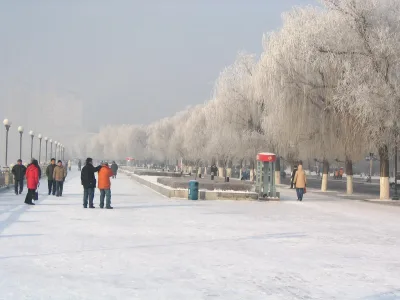
And then the river. In a valley in the far northeast of Inner Mongolia, with snow a metre deep on both banks and the air at the temperature where Celsius and Fahrenheit stop arguing, a stretch of water about 20 km long keeps moving. Steam lifts off it in slow sheets, the vapour freezes onto the willows along the edge, and for two hours after first light the whole valley looks like it is exhaling.
This is Arxan, and it is the strangest winter landscape in China that most international travellers have never heard of.
The coldest corner of Inner Mongolia
Arxan sits at about 47°N, high in the Greater Khingan range, in a part of Inner Mongolia that is closer to Mongolia and to Heilongjiang than to Hohhot. The town itself is around 1,000 m above sea level. The name comes from the Mongolian for warm holy springs, which tells you what the ground is doing under all that snow.
The geology is the reason to come. Arxan is a volcanic field with more than 50 cones, the highest being Motianling at 1,711.8 m, sitting on top of a large hot spring system with over 100 mineral springs of different temperatures. In May 2017 it was admitted to the UNESCO Global Geoparks network, China’s 34th, covering about 3,653 km². The Arxan-Chaihe scenic area was rated 5A, the top tier of China’s attraction grading, in February 2017. The core zone inside the gate is roughly 1,031 km².
January averages minus 25.1°C, with an average overnight low of minus 30.7°C. It gets colder. The park’s own signs talk about minus 40, and they are not exaggerating for effect.

Why one stretch of the river stays open
The Halaha River drains this part of the range and runs north towards the Mongolian border. For most of its length it freezes solid in December. One section, roughly 74 km from Arxan town, does not.
The explanation given by Chinese state media, including Xinhua and CCTV, is geothermal heat: the riverbed here sits above a concentration of hot rock and hot water, enough to keep the water temperature above freezing while the air above it drops to minus 40. The official length of the open section is 20 km, and that number has been repeated in reporting for a decade. Some recent tourism copy says 25 km. Take the shorter figure.
The physics does the rest. Water at a few degrees above zero meets air at minus 35, evaporates, and condenses instantly into visible vapour. The vapour drifts onto branches, fences and the wool of the horses that graze the bank, and freezes there as rime. It is the same process you see at Jilin’s rime spots, except that Jilin runs a daily star rating and a forecast service for its spectacle, and this one is a valley with nobody in it.
The morning problem nobody mentions
Every guide to the unfrozen river says the same thing: go at dawn. Almost none of them mention that the park gate opens at 08:30.
The mist window is roughly 06:30 to 09:00. Sunrise in late December and January falls between 07:20 and 07:40, and the hour either side of it is when the steam is thickest and the light is softest. By 09:00 the top of the mist is burning off. By 10:00, on a sunny morning, you are looking at a wet river.
So the single most useful decision you will make is where you sleep. Arxan town is 60 to 70 km from the river, which is 1 to 1.5 hours on icy mountain road in the dark. Do that and you arrive at 10:00 with the show over. Sleep inside the park and you walk to the water before breakfast.
There are two service areas inside the gate. Tianchi is the transport hub and the biggest cluster of guesthouses, and it is about ten minutes from the river. Xing’an is quieter, close to the lava field and the lakes. The accommodation is wooden cabins with a heated kang, the traditional brick bed, and it is basic: thin walls, shared dining, no English. In winter it is also cheap by Chinese winter-resort standards, well below what Harbin or Snow Town charge for the same week. Book in Chinese, by phone or through a Chinese booking app, and confirm that the place is open for your dates. Many close in the shoulder weeks.
One more detail worth knowing: the ticket is valid for 48 hours with multiple entries. Staying one night inside fits inside a single ticket.
What else is behind the gate
The river is the headline, but the park is 1,031 km² of volcanic terrain, and in winter the snow rewrites all of it.
Shitanglin, the stone forest, is a lava field of more than 200 mounds of black basalt, and under snow it turns into a black and white ink painting. Santan Gorge is where the Halaha cuts through a basalt gorge; in winter the side streams hang as icefalls. Tianchi is a crater lake, frozen flat and ringed by larch, with a boardwalk that takes about 40 minutes at a stroll. Tuofengling Tianchi, the other crater lake, is the one photographers rate highest. Dujuan Lake, the Grand Canyon and Dichi, a maar lake, fill out the list.
Plan on two days, not one. The gate is 60 km from the visitor centre, the core sights are spread along a long north-south road, and daylight runs from 08:30 to 16:30. A single day gives you the river at dawn, one lake and a lot of driving.
What it costs
Winter prices at Arxan are published and stable, which is more than you can say for most Chinese ski country.
| Item | Winter 2026-27 | Notes |
|---|---|---|
| Park entry | ¥130 per person | Valid 48 hours, repeat entry |
| Concession entry | ¥65 | Students; free for over-60s and under 1.2 m |
| Internal shuttle | ¥105 per person | Runs in winter according to current park information |
| Private car entry | ¥300 per car per day | Book through the official mini-program |
| Rafting on the open river | about ¥120 per person | 40 to 50 minutes; confirm it is running |
| Charter SUV with driver | ¥450 to ¥600 per day | Seven-seaters ¥700 to ¥900 |
Two warnings on the numbers. First, ¥285 is the peak-season combined ticket, entry plus shuttle, and it does not apply in winter; you will see it quoted in summer guides. Second, Arxan ran a ¥1 pass covering nine attractions in the 2025-26 season, which ended on 15 March 2026. Nothing equivalent has been announced for 2026-27, so do not budget for it.
The park hotline is 0482-7155555. It is answered in Chinese, and it is the fastest way to confirm whether the shuttle is running on a given day.
Getting there

No high-speed rail reaches Arxan. The Bai’a line ends here, at a 1937 timber station building that is now a protected heritage site and, by common agreement, the prettiest small station in China. It also appears on the cover of this article. Services are few: K7565 and K7566 connect Shenyang, K7595 and K7596 connect Baicheng, and the Baicheng run takes about 4.5 to 5 hours for roughly ¥54.5 in hard seat. Winter timetables change, so check 12306 before you build a plan around a specific train.
Flying is faster in theory. Yiershi airport is 16 to 25 km from town, with a taxi into the centre around ¥70. In winter the flight schedule thins out to roughly a daily service, usually via Beijing or Hohhot, and snow cancels flights here more often than it does in most of China. The reliable workaround is to fly to Ulanhot, where there is more capacity, and continue three to four hours by bus or private car.
Driving is the option that gives you the park. G302 and G331 are paved and plowed, but the mountain sections hold ice, winter tyres are effectively mandatory, and the park road in is a mountain road. There are no public buses to the park in winter. Charter prices above are per vehicle, not per person, which makes a group of three or four the cheapest way to do this.
What is not true any more
Two things you will read online are out of date, and one of them matters.
In January 2026 Arxan briefly ran a free “body drift” experience on the unfrozen river, where visitors floated downstream in dry suits. It was filmed, it went viral, and it was stopped within days: a small weir had been built upstream to slow the current and thicken the rime, residents complained that the river was icing over behind it, and the park removed the weir and cancelled the programme. Do not plan a trip around it. Commercial rafting on the open water is a separate, older operation, and even that is worth confirming by phone in deep winter.
The second is the shuttle. Some guides still say the internal buses stop for the season and that you must self-drive. Current park information says the opposite, that the shuttle runs in winter at ¥105 and that private cars can be booked in for ¥300. Both may be true on different days. Ask at the ticket office.
Short-notice closures are real. The park shut from 4 to 6 November 2026, in the middle of the shoulder season, with no advance notice worth planning around.
What to wear, and what the cold does to your gear
At minus 30 and below, ordinary winter clothing is not enough. You want a down jacket rated for polar use, a windproof shell over it, insulated boots with a thick sole, mittens rather than gloves, and something covering your face. The dry cold here is easier to dress for than the damp cold of the south, which is a subject worth its own detour if you are travelling further south afterwards.
Your equipment will fail before you do. Camera batteries lose most of their capacity within minutes, so carry two spare sets inside your jacket. Phones shut down at 30 percent. Bring the camera out of the bag slowly in a plastic bag, or the lens will fog and then freeze. Tripods need gloves to touch.
The full packing list, layer by layer, is in the China packing guide.
Is it worth the trip?
For the river at dawn, yes. It is one of the few genuinely strange landscapes in the country, it is empty in a way that Chinese attractions almost never are, and it does not require a ticket to a show or a queue for a photo spot. You stand on a snowy bank at 07:00 with steam rolling past and the temperature at minus 33, and there is nobody else there.
For the rest of the park, manage expectations. The lakes are frozen and beautiful and also, after the third one, similar. The infrastructure is Chinese-provincial: signage in Chinese only, mini-programs in Chinese only, staff who will be helpful and will not speak English. If you want a curated winter trip with English service, Harbin’s ice festival is three hours away by train and does that job properly. Arxan is the opposite proposition: a two-day detour into a cold valley where the main event happens before breakfast.
Skiers should treat this as a side trip rather than a destination. The serious terrain in China is in Chongli, Jilin and Xinjiang, and the resort comparison covers where to go for that. Arxan is for the river.
One last thing. Check your visa situation before booking anything. Arxan has no international flights and sits well outside the port areas used for transit without a visa, so the visa-free entry guide is the page to read first, and the rules have changed often enough that anything older than a few months is worth re-checking.
Frequently asked questions
When is the best time to see the mist on the unfrozen river?
December through February, and always in the morning. The mist needs a hard overnight freeze, ideally below minus 25°C, and a still night. The window runs from about 06:30 to 09:00, with the thickest steam and the best light in the hour around sunrise, which falls between 07:20 and 07:40 in late December and January. Warm weather kills it. A night at minus 10°C gives you a wet river and no spectacle.
Can I see the river without sleeping inside the park?
You can see it, but you will miss the best hour. The park gate opens at 08:30 in winter, and the river is about 60 to 70 km from Arxan town, so day visitors from town arrive around 10:00, after the steam has mostly gone. If you want the dawn window, sleep at the Tianchi service area inside the park, which is about ten minutes from the river. Tickets are valid for 48 hours with multiple entries, so one night inside fits the ticket.
What does Arxan National Forest Park cost in winter?
The winter adult ticket is ¥130 per person, valid for 48 hours with repeat entry. Students pay half, and visitors over 60 or under 1.2 m enter free. The park shuttle is ¥105 per person when it runs. Taking your own car in costs ¥300 per car per day and has to be booked through the official Arxan-Chaihe scenic area mini-program. Tickets are sold at the visitor centre in the hot spring street area of town. The park hotline is 0482-7155555.
How do I get to Arxan in winter?
There are three ways and none of them is fast. Yiershi airport (YIE) is 16 to 25 km from town, but winter flights are heavily reduced and often cancelled by snow, so most travellers fly to Ulanhot and continue three to four hours by road. Trains on the Bai’a line are limited to a handful of services, including K7565 and K7566 from Shenyang and K7595 and K7596 from Baicheng, roughly 4.5 to 5 hours from Baicheng. Driving on G302 or G331 is possible but needs winter tyres and daylight.
Is the park open in winter and are the shuttle buses running?
The park is open in winter, from 08:30 to 16:30, which is a short day at this latitude. Current park information says the internal shuttle operates in winter at ¥105 per person and that private cars can be booked in for ¥300 per car per day. Some older guides say the shuttle stops for the season, and the arrangement can change with snow clearing, so confirm at the ticket office when you arrive. Short-notice closures also happen: the park shut from 4 to 6 November 2026.
Do I need a visa to visit Arxan, and does visa-free transit cover it?
Arxan has no international airport and sits in a remote part of Inner Mongolia, well away from the ports used for transit without a visa. Assume a normal tourist visa or a national visa-free scheme is what applies to you, and check the current rules rather than an old blog post, since China’s visa-free lists have changed repeatedly. The 30-day unilateral scheme has been extended in stages and currently runs to 31 December 2026 with no further extension announced.