Jilin in Winter: Rime Ice at Dawn, Beidahu and Songhua Lake

Jilin city has the best winter phenomenon in China and almost no international visitors. That is not an exaggeration born of enthusiasm. On a cold January morning, the Songhua River runs unfrozen through the middle of town, the vapour off the water freezes onto every tree along the bank, and for about three hours the place looks like it has been dipped in glass. Then the sun comes up, the frost falls off, and by lunchtime it is an ordinary northern Chinese city again.
Harbin gets the crowds and the ice festival. Jilin is 1 hour 41 minutes away by train and has two ski resorts, a river that does not freeze and a daily frost forecast. Most people do Harbin and stop. This guide is about the other stop.
Why the river does not freeze
The Songhua comes down from the Changbai Mountains and passes through the Fengman hydropower station upstream of Jilin city. The water released through the turbines stays around 4°C even in the middle of winter, which is warm enough to keep a long stretch of river open when the air above it is at minus 25°C.
That temperature difference does the rest. Water vapour rises off the river, hits cold air and condenses directly onto branches, wires and fences as ice crystals. The Chinese call it wusong, rime ice. It is not snow and it is not frozen rain. It builds up on the windward side of a branch, grows into white needles a few centimetres long, and looks more like coral than weather.
The official forecast, published by the China Meteorological Administration, gives the conditions: air temperature below minus 20°C makes rime likely, below minus 26°C makes it almost certain, humidity above 95 percent and a light wind of 1 to 2 m/s. A completely still night is worse, because the vapour needs a little movement to reach the branches. This is the one place where the old travel-blog line about “still, freezing mornings” is wrong.
The season runs from mid-November to mid-February, roughly 100 days. The first rime of the 2026-27 winter appeared on 2 November at Hantun and Wusong Island, which is early. The reliable window is late November through January.
The morning report decides your day
Jilin city publishes a rime morning report before 06:00 every day of the season. It rates 17 viewing points across 11 viewing belts, from one to five stars, and it is the most useful piece of travel information in the province.
The report is published on the Jilin City culture and tourism bureau’s WeChat account, under the name Jilin Shi Xing. If you do not read Chinese, the star ratings and place names are still readable, and hotel staff will happily translate the top line. The forecast is based on air temperature, humidity, wind speed and river water temperature, and it is specific enough to tell you whether the city promenade is worth getting up for or whether you need to drive 45 km north.
Use it. The difference between a three-star morning and a five-star morning is the difference between bare branches and a forest of white coral, and it costs nothing to check before your alarm goes off.
Sunrise in Jilin in early January is around 07:10. You want to be in position by 07:00, which means leaving a downtown hotel at 06:30 if you are staying in town, or 05:00 if you are going to Wusong Island. Nothing opens for breakfast at that hour. Take food.

Four places to see rime ice
There are more than four, but these cover the range from free and ten minutes away to paid and two hours away.
Wusong Island
Wusong Island, or Rime Island, is the postcard. It sits in the Songhua about 40 to 45 km north of Jilin city, in Longtan district, near Wula Street. The island itself is small; the villages of Hantun on the east bank and Zengtong on the island are the two bases.
The ticket is around ¥60, though platforms sell 48 to 70 yuan products and the price has been set by the operator rather than the government since 2022. The ferry from Hantun dock is about ¥30 return; another dock charges closer to ¥60. The season runs from about 20 November to 20 February, day entry from 06:10 to 13:50. Call 0432-63588008 before relying on any of those numbers, because the ticket structure changes with the operator.
There is a detail that decides where you sleep. Hantun is on the outer bank, so every entry to the island needs a new ticket: stay two nights and you pay twice. Zengtong is on the island, so one ticket covers several days, but the rime trees there are more scattered. If you are staying two or three nights specifically for photography, Zengtong is the better base. If you are doing a single dawn, Hantun is fine.
Getting there without a car takes three legs: a local bus from Chalu Xiang bus station to Wula Street for around ¥10 to ¥11, about an hour; a minivan or taxi for ¥3 to ¥5; then the ferry. A charter car from Jilin city is ¥120 one way and ¥150 to ¥200 return, and the drive is 1 to 1.5 hours. In winter, budget two hours each way.

Is it worth it? On a five-star morning, yes. The island has the densest rime and the widest river views, and the frozen river with steam rising off it is the shot everyone comes for. On a three-star morning, no. You will spend four hours in a car and ¥150 on transport to photograph grey branches.
Ashihada
Ashihada is the local answer to Wusong Island: 11 to 15 km from downtown along Jifeng East Road, free, and local photographers rate it among the places with the most five-star mornings in the season. The trees line the road in a corridor, which makes it easy to walk and photograph, and the river is close enough that the steam is part of the frame.
The drawbacks are crowds and parking. Chinese photographers know about it, and on a good morning the roadside fills up by 07:00. Take a taxi rather than driving, and arrive early.
Songjiang Middle Road
The riverside promenade in the city centre is free, flat and five minutes from most downtown hotels. This is where you go when you have one morning, no car and no interest in a 05:00 start. The rime here is on willows and plane trees along a formal promenade, with the river on one side and the city on the other, and the effect at sunrise is better than the setting suggests.
Best time is 06:30 to 09:00. The promenade runs for several kilometres, so walk away from the main squares to lose the crowd.
Beidahu
The resort also gets rime on cold mornings, and the gondola takes you above the base area where the trees are fully coated. It is not a substitute for the river, because the mechanism is the same but the scale is smaller. Treat it as a bonus on a ski morning rather than a reason to go.
One more option, if the rime habit takes hold: Arxan in Inner Mongolia runs the same physics at a much larger scale, with 20 km of river kept open by geothermal heat and no promenade, ticket queue or crowd in front of it.
Beidahu or Songhua Lake
The two resorts are 40 km apart, share a mountain range and a frosty climate, and suit different people. Jilin city sits between them: Songhua Lake is 15 km southeast of the centre, Beidahu is 53 km southwest.
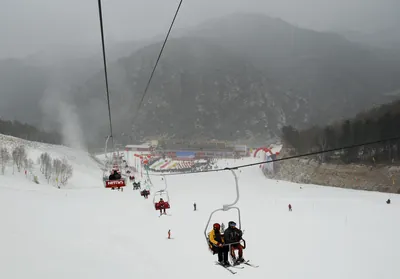
Beidahu is the serious mountain. It has 81 runs across 90 km and 285 hectares, 15 lifts and 7 magic carpets, a maximum vertical of 870 m and a summit at 1,404.8 m on Nanlou Mountain. The resort says total lift capacity is about 33,000 to 35,000 people an hour. In practice 74 of the 81 runs opened in 2025-26, so the official count is a plan rather than a promise. For 2026-27 it has added the A cable car to the Nanlou summit and replaced the old UU chair with a gondola, which is aimed squarely at the lift queues.
Songhua Lake is the friendlier mountain. It has 50 runs over 55 km, 220 hectares, 6 high-speed lifts and 8 magic carpets, about 22,000 people an hour and a vertical of 605 m. The terrain split is roughly 40 percent beginner, 40 percent intermediate and 20 percent advanced, which is why it is the default for families and first-timers. It also runs night skiing, and it is close enough to town that you can sleep in Jilin city and be on the hill by 08:30.
For 2026-27 Songhua Lake is opening a 300,000 m² west-side zone with a new six-person high-speed lift and five magic carpets, plus a 4,500 m² service centre with ticket desks, rental, lockers, food and lessons. The operator changed in August 2025 from Vanke to China Tourism Group, so the resort is now branded CTG Songhua Lake. Older guides still call it Vanke Songhua Lake; the mountain is the same.
A simple rule: if you ski blacks and want vertical, go to Beidahu. If you ski blues, have children or want a short transfer, go to Songhua Lake. If you have two days, do one of each. The comparison of China’s ski regions puts both against Chongli and Xinjiang if you are still choosing a province.
Opening dates and lift prices
The 2026-27 season has already started. Beidahu began trial skiing on 7 November 2026 and expects its formal opening in mid-November. Songhua Lake opens on 20 November. The 10th Jilin Snow Expo, the new-season opening and the 32nd Jilin Rime Ice Festival all open together at CTG Songhua Lake on 28 November, which tells you where the provincial government thinks the season begins.
| Resort | Vertical | Runs | Lifts | 2026-27 opening |
|---|---|---|---|---|
| Beidahu | 870 m | 81 (74 open in 2025-26) | 15 lifts + 7 carpets | 7 November, trial |
| Songhua Lake | 605 m | 50 runs / 55 km | 6 lifts + 8 carpets | 20 November |
Prices are the weakest part of the public information. Beidahu’s 2026-27 price sheet, as circulated in local media, lists a peak-season full-day lift pass at ¥420 midweek, ¥532 at weekends and ¥602 on public holidays, with early-bird passes at ¥294 and ¥365 and a Northeast-resident rate of ¥158 to ¥199. That is a real spread, and the resident rate is why the lift queue on a January weekend is full of people who paid less than half what you did. None of it applies to an international passport. Confirm the current numbers on the resort’s official mini-program, because Chinese resorts re-price by date and channel.
Songhua Lake lists entry products from about ¥260 on Ctrip, but that is a platform product rather than the full-mountain day rate. Budget more for a full lift day and check the official channel.
There is one genuine shortcut. Both resorts joined the Ikon Pass for winter 2026-27, announced in September 2026. Ikon Pass holders get seven days at each resort and Ikon Base Pass holders get five, with no blackout dates. If you already own an Ikon pass, this is the cheapest way to ski both mountains, and it puts Jilin on the same pass as Niseko and Steamboat. The catch is that the pass has to be bought before you travel, and the resort still charges for rental.
Getting to Jilin
The nearest airport is Changchun Longjia (CGQ), which serves both Changchun and Jilin. From the terminal, walk about ten minutes to Longjia railway station and take the Changchun-Jilin intercity train, 40 to 60 minutes to Jilin station. Do not book to Changchun West or Jilin North: both are the wrong station for the city centre.
The train is the better option for most of the year. Changchun to Jilin is 40 to 45 minutes on a C train, with dozens of departures a day. Harbin to Jilin is 1 hour 41 minutes at best and usually around 2 hours 15 minutes, with second class at about ¥123. Beijing and Shanghai mean a flight to Changchun or a long high-speed rail day; the China high-speed rail guide explains how to book with a passport.
Inside Jilin, four ski buses run in the 2026-27 season. The 313 goes from Jilin station west square to CTG Songhua Lake. The 323 goes to Beidahu for ¥20, leaving Jilin station at 08:00 and returning from the resort at 16:30. The 324 connects the two resorts, and the 325 is a shuttle. There is also the T979 from Longjia airport to Beidahu, ¥80 and about two hours, which is useful if you land at midday.
The 323 timetable is fine for a ski day and useless for rime. For a 05:30 departure to Wusong Island or a dawn run to Ashihada, you need a taxi or a charter. A taxi from Jilin station to Beidahu is ¥120 to ¥150 and takes about 40 minutes.
Where to stay
Downtown Jilin, around Songjiang Middle Road and Jiangcheng Square, is the right base for rime. You can walk to the river in five minutes, the hotels are cheap by Chinese standards, and the 313 and 323 buses both leave from the station. Two nights here covers the city rime and one ski day.
The Songhua Lake resort village is the right base for families and beginners. It is 15 km from town, has ski-in accommodation and the new west-side service centre, and removes the morning transfer. It is a resort rather than a town, so evenings are quiet.
Beidahu is the choice for serious skiers. The resort hotels sit at the base, the lifts are outside, and there is nothing else around. It is 53 km from Jilin city and about two hours from the airport by road.
Wusong Island guesthouses exist for photographers who want to be on the ice at first light. They are basic, cold and cheap, and the food is farmhouse cooking. One night is enough unless you are shooting every dawn.
A sensible split for four nights: two downtown for rime and Songhua Lake, two at Beidahu if you ski, or two on Wusong Island if you photograph.
The 2027 Universiade
The 33rd Winter World University Games run from 15 to 25 January 2027, with Changchun as the main host and Jilin city as the snow venue. Beidahu hosts alpine skiing, freestyle and snowboard big air across 25 events and seven competition courses from 15 to 25 January. Songhua Lake hosts 11 events over ten courses from 17 to 25 January.
The important part for travellers is what does not happen: the resorts do not close. Beidahu’s official position is that the mountain stays open and only the competition areas are controlled during competition sessions. There is no general shutdown, and no published plan to close the resorts to recreational skiers.
What you should expect is pressure. Hotels in Jilin city and at both resorts will be full, rates will rise, and some runs and lifts will be reserved for athletes during the competition window. Ticket sales for spectators were still in procurement as of November 2026, so there is no public ticketing information yet.
If you are planning a January ski trip, either book the 15 to 25 January window now at whatever rate you can get, or move your dates to early January or the first week of February. The snow is the same on either side. The difference is the crowds.
What to wear and what to pay with
January in Jilin has a mean temperature of minus 16.7°C and a mean low of minus 22.9°C, with an extreme minimum of minus 40.3°C on record. December averages minus 12.6°C and February minus 11.5°C. That is cold enough to change how you pack, and Jilin sits in a river valley that traps cold air.
Dress in layers: a thermal base, a fleece or down mid layer, and a windproof shell. Add a balaclava, mittens rather than gloves, goggles that do not fog, and boots rated for the temperature. Hand warmers cost ¥10 and are worth it. Phone batteries die in the cold, so keep the phone inside your jacket and carry a power bank. The China packing guide covers northern layering in more detail.
Rental at both resorts covers skis, boots and poles, not clothing. Sizes are the weak point: most Chinese rental shops stock up to about EU 46, and a 48 or a 30.5 boot may not exist. If you are above EU 47 or 190 cm, bring your own boots and skis or call ahead. This is the single most common gear complaint from international skiers in China.
For payment, Alipay or WeChat Pay with a foreign card is the most reliable setup, and both work at the resorts. Deposits are sometimes cash or UnionPay only, so carry a few hundred yuan. The Alipay versus WeChat Pay comparison covers which app to set up first.
The visa question
Jilin is reached through Changchun, and the visa rules that matter are national rather than local. As of November 2026, the unilateral 30-day visa-free scheme for 50 countries runs only to 31 December 2026, with no extension announced. If your trip is in January or February 2027, check the current status before you book, and if the scheme has lapsed, apply for a tourist visa.
Do not assume the 240-hour transit scheme covers Jilin. The province and port lists have changed several times since the policy was expanded in December 2024, and Jilin was not in the original 24-province list. Check the current list, or call the 12367 immigration hotline, rather than relying on a blog post. The visa-free entry guide tracks the current rules.
What this trip is not
Jilin is not a resort town. There is no international dining scene, little English away from the ski resorts, and the city is a working industrial and agricultural centre rather than a tourist stage set. The rime is weather, not an attraction with opening hours, and a warm night means you see nothing.
That is also the argument for going. Harbin gives you a built spectacle with tickets and queues. Jilin gives you a natural event that the city forecasts every morning, two good mountains, and hotel rates that do not require a second mortgage. If you are already in the northeast for the ice festival, the train is under two hours. Take the extra day.
Frequently asked questions
When is the best time to see rime ice in Jilin?
Mid-November to mid-February, and always in the morning. Rime forms when the river is warmer than the air, so the official Jilin forecast looks for temperatures below minus 20°C, humidity above 95 percent and a light wind of 1 to 2 m/s. The daily window runs from about 06:00 to 10:00, with the best light and the thickest frost between 07:00 and 09:30. After 10:00 it starts falling off the branches. Check the city’s rime morning report before you set an alarm.
How do I get from Jilin city to Wusong Island?
Wusong Island is about 40 to 45 km north of the city, in Longtan district. The cheap route is a local bus from Chalu Xiang bus station to Wula Street for around ¥10, then a minivan or taxi for ¥3 to ¥5, then the ferry. A charter car is ¥120 one way and ¥150 to ¥200 for the round trip, and takes 1 to 1.5 hours. The ferry costs about ¥30 from the Hantun dock. Allow two hours each way in winter.
Is Wusong Island worth it, or can I see rime ice in the city?
The city has free rime and most visitors ignore it. Ashihada, 11 to 15 km from downtown, and the Songjiang Middle Road promenade both produce five-star mornings without a ticket. Wusong Island is bigger and more photographed, but it is a two-hour commitment each way plus a ticket and a ferry. Use the morning report: if the city points are rated highly, stay in town. If only Wusong Island is five-star, go.
Beidahu or Songhua Lake for a beginner?
Songhua Lake. About 80 percent of its terrain is beginner or intermediate, it is 15 km from Jilin city, and it runs night skiing. Beidahu is the steeper mountain, with 870 m of vertical and terrain that suits confident intermediates and experts. Both have English-speaking instructors in limited numbers, and both rent skis, boots and poles, but neither rents clothing.
How much is a ski pass in Jilin?
At Beidahu, the 2026-27 peak-season day pass is listed at ¥420 midweek, ¥532 at weekends and ¥602 on public holidays, with early-bird rates around ¥294 and ¥365 and a Northeast-resident rate of ¥158 to ¥199. Songhua Lake lists entry products from about ¥260, with full lift tickets higher. Both resorts change prices by date and ticket type, so confirm on the official mini-program before you buy.
Will the 2027 Winter Universiade close the ski resorts?
No. The official line from Beidahu is that the resort stays open during the games, and only the competition areas are controlled during competition sessions. The Games run from 15 to 25 January 2027, with Beidahu hosting 25 events over seven courses and Songhua Lake 11 events over ten. Expect full hotels, higher rates and some closed runs around those dates. Book early or travel outside the window.