Changchun 2027 Winter Universiade: Ice Sports and City Guide

Most winter sports fans have heard of the Harbin ice festival and can name a ski resort in Hokkaido. Almost none of them know that a full multi-sport winter games is being staged in northeast China in January 2027, in two cities, with 97 medal events and a ticket system that has not opened yet.
That is the Changchun 2027 Winter Universiade, the 33rd edition of the FISU World University Games. It runs from 15 to 25 January 2027, with competition starting on 12 January. Changchun, the provincial capital of Jilin, hosts the ice. Jilin City, an hour away by train, hosts the mountain snow. Between them they will run 12 sports and 97 events, and the organisers say 63 countries and regions had registered 3,716 participants by mid-October.
For a traveller, this is an unusual opportunity and an unusual planning problem. The opportunity is a world-level winter event in a city that gets few international visitors, at prices that will not resemble Sapporo or Salt Lake City. The planning problem is that almost nothing a spectator needs, including tickets, has been announced. This guide separates what is confirmed from what is still pending, and covers the practical side: how to reach both cities, where to base yourself, what else January in Jilin offers, and the visa detail that could quietly derail the whole trip.
What the Winter Universiade actually is
The Universiade is the university games, run by FISU, and the winter version has been held since 1960. It is not the Olympics and it does not pretend to be. The athletes are students, many of them on national teams, and the standard sits somewhere between a continental championship and a World Cup weekend. That is exactly why it is worth watching: you see future Olympic medallists two seasons before anyone outside the sport has heard of them, in arenas where a good seat costs a fraction of a World Cup ticket.
The 2027 edition is the second time Changchun has hosted. The city staged the 2007 Winter Universiade, and there is still a stone marker outside the sports centre from that event. This time the organisers are not building a new ski mountain. All ten competition venues are existing facilities, renovated for the Games, which is why the event is being sold as a low-cost, low-construction edition.
One correction worth having before you read other previews: there is no biathlon on the programme. Some older schedules and translated articles still list it, along with a “13 sports, 110 events” figure. The current official breakdown is 12 sports and 97 events, and the venue list contains no biathlon range. If a preview tells you otherwise, it is working from an outdated version.
The dates that matter
Competition opens on 12 January with curling mixed doubles, three days before the opening ceremony on 15 January. The closing ceremony is on 25 January, which makes 14 competition days in total.
That gap is useful if you are planning a trip. The first three days are the quietest of the Games: one sport, no ceremony, and the smallest crowds the event will see. The trade-off is that the opening ceremony itself is still the least settled item in the schedule. Three different venues have been named in Chinese reporting for it, including Wuhuan Gymnasium, the Northeast Asia International Expo Centre and the Northeast Normal University gymnasium, and the organisers have not confirmed which. Plan around 15 January as a date, not as a venue.
The Games also sit in a useful window for the rest of the region. They end on 25 January, almost two weeks before Spring Festival, which in 2027 falls on 5 to 13 February. Flights and trains in the northeast get difficult in the days before the holiday; you will be gone before that starts.
What you can watch in Changchun
Eight of the ten venues are in Changchun, and they split into two clusters: the ice halls in the older, central part of the city, and the snow and sliding venues out towards the southeast.
| Venue | Events | Area |
|---|---|---|
| Jilin Provincial Speed Skating Hall | long track speed skating | Nanhu / Ziyou Dalu |
| Jilin Provincial Ice Skating Hall | figure skating, short track | Nanhu / Ziyou Dalu |
| Changchun Wuhuan Gymnasium | ice hockey (women), ceremonies | Yatai Dajie |
| Changchun Municipal Ice Skating Hall | curling | city centre |
| Changchun Olympic Sports Park | ice hockey (men) | Beihu, north of the city |
| Sculpture Park venue | freestyle aerials | southeast |
| Jingyue Lake | cross-country skiing, ski orienteering | Jingyuetan |
| Lianhua Mountain | winter trail running | southeast outskirts |
The speed skating oval on Ziyou Dalu is the pick of the indoor venues. Long track is a strange sport to watch on television, because the racing is spread across pairs and the clock does the work, but in the hall you can hear the skates and see the lap times on the board. Short track, in the neighbouring hall, is the opposite: four skaters, collisions, disqualifications, and a crowd that understands every rule.
Ice hockey at the Olympic Sports Park in Beihu is the furthest from the centre, a 25 to 30 minute taxi in good traffic. It is also the cheapest way to see a full tournament, since the women’s and men’s draws run across most of the ten days. If you are travelling with children, this is the event to book.
The snow programme is in Jilin City
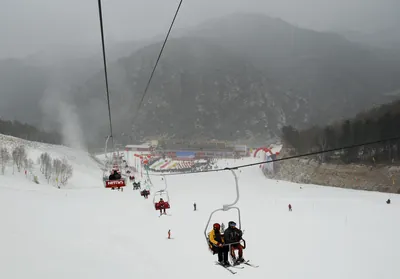
The mountain events, 36 of the 97, are not in Changchun at all. They are at Beidahu and Songhua Lake, two ski areas outside Jilin City, roughly 110 km east of Changchun. Alpine skiing, para alpine, freestyle skiing, snowboard and ski mountaineering all run there.

This is the part of the Games that rewards a night in Jilin City rather than a day trip. The intercity train is fast, 40 to 50 minutes for around ¥31 to ¥34, but the ski areas are not at the station. You add a local bus or a taxi, and you do it twice if you go back the same evening. For a single day of watching, the round trip is feasible. For two or three days of alpine and snowboard finals, stay in Jilin City and treat Changchun as the airport.
The overlap with ordinary ski travel is worth naming. The same two resorts are the reason people come to Jilin in winter anyway, and the three-region ski comparison covers what they offer outside the Games, including snow quality, terrain and pricing. If your real interest is skiing rather than spectating, the China versus Japan ski comparison is the more useful read, because it puts Chinese lift prices next to Japanese ones at current exchange rates.
Tickets: nothing is on sale yet
As of 8 November 2026, no Universiade tickets are on sale. There are no published prices, no sale date and no sales platform.
What does exist is a plan. The organisers are procuring a ticketing operator through a public tender, and the second call for bids closed in late September. The published figure is 155 ticketing sessions across the Games, which tells you the shape of the programme: sessions rather than all-day passes, the way most Chinese winter events are sold. Between November and December, three tiers of test events will run at the venues, which is also when operational systems including ticketing tend to be tested in public.
Two consequences for planning. First, do not buy from anyone who is not the official channel. The official event site is changchun2027.fisu.net, and the official WeChat account is 2027长春大冬会. Those are the two places a sales announcement will appear first, and Chinese organisers typically announce with days, not months, of notice.
Second, be careful with the “combined ticket” that is already on sale. A ¥328 Jilin-Guangdong ice and snow pass, sold through the 君至长春 mini-programme, includes priority reservation for Universiade side events. It is a tourism pass covering scenic areas in two provinces. It is not a Games ticket, and buying it does not get you into a venue.
If you have watched how Chinese attraction ticketing works, this is familiar ground. Real-name booking, release windows and instant sell-outs are the norm at popular sites, and the guide to sold-out attractions and passport booking explains the mechanics. Whether the Universiade will sell out is unknown. Winter sport is not a mass-spectator product in China, and a 97-event programme across ten venues is a lot of seats. My guess is that most sessions will be available on the day, with the ceremonies and short track finals as the exceptions. That is a guess, not a published fact, and I would still register on the official channels.
Getting there
Changchun Longjia International Airport (CGQ) is the entry point, 30 km northeast of the city. For the 2026-27 winter season it lists 114 routes to 76 destinations, but the international list is short: Hong Kong, Seoul with three flights a day, Tokyo, Singapore, Kuala Lumpur and Bangkok. From Europe or North America you will connect through Beijing, Shanghai or Seoul.
The airport rail link is the best arrival in China you can get for the money. A train from Longjia station to Changchun station takes 14 to 15 minutes and costs ¥8.5 to ¥10. The airport bus is ¥20 to ¥25 depending on the route, and a taxi to the centre runs about ¥100. If you land late, take the taxi; if you land in daylight with a suitcase, the train drops you at the main station, which is on the metro.
By rail, Changchun is on the Harbin-Beijing high-speed corridor. Direct trains from Beijing take roughly 3.5 to 4.5 hours, with second class around ¥435 to ¥554. Trains from Harbin are under an hour. The China high-speed rail guide covers booking with a passport, which you will need to do in advance: January is a busy month on this line, and the Games add demand on top of ordinary winter traffic.
Where to stay
The organisers have named 41 official reception hotels, along with 27 designated hospitals and 29 food supply bases. Those hotels are contracted for teams, officials and media. Some of them are named in Chinese reporting, including the Hyatt Regency on Renmin Dajie and Holiday Inn properties near Jingyue Lake that will house cross-country athletes. Do not plan around staying in them; availability for spectators is a separate question and, as of November, unanswered.
Instead, pick a district by venue. Three make sense.
Nanhu and Ziyou Dalu, near the speed skating and ice skating halls, puts two of the best indoor venues within walking distance and the city centre 15 minutes away. Yatai Dajie has the Wuhuan gymnasium and the densest concentration of restaurants and hotels. Jingyuetan, in the southeast, is the quietest option and the closest to cross-country skiing, the aerials venue and the lake, but you will be taking taxis for everything else. If ice hockey is your priority, Beihu is a long way north of all three and worth a separate booking.
Hotel rates in Changchun are low by international standards, and January is not peak season for domestic tourism until the ice festival crowds arrive. The China hotel booking guide covers which platforms accept foreign cards and how registration at check-in works.
What else January in Changchun gives you
The Games are not the only reason to be in Jilin in January.
Changchun Ice and Snow New World, the city’s winter theme park, is running its eighth edition with seven themed zones, 72 days of operation and about 420 scheduled performances. The opening date and this season’s prices had not been announced as of early November; last season it opened on 19 December, with tickets at ¥268 and a student rate of ¥99. Treat those as reference, not as this year’s prices.
Jingyue Lake, which doubles as a competition venue, is a national forest park with a ¥30 entry and a frozen lake you can walk across in January. On 4 January 2027 it hosts the 25th Vasaloppet China, with 50 km, 25 km and 1.5 km cross-country races on the same trails the Universiade will use eleven days later. If you want to watch one event before the Games begin, that is the one.
In the city, the Museum of the Imperial Palace of Manchukuo costs ¥70 and the Changchun Film Studio Museum ¥90, with a combined ticket at ¥129. The palace is the more substantial visit: the seat of the Japanese-backed state from 1932 to 1945, preserved largely as it was, and a strange, quiet place in winter.
And Harbin is next door. The Harbin ice festival guide covers the scale of it, and the two cities are close enough by train to combine: Harbin first, then south to Changchun for the Games, or the reverse.
The visa question is the real planning risk
Here is the detail that catches people. China’s unilateral visa-free entry for ordinary passport holders of 48 countries is currently valid until 31 December 2026 at midnight. The Universiade runs in January 2027. As of early November, no extension had been announced.
That does not mean the scheme will lapse. It has been extended before, and an international event is exactly the kind of occasion that prompts an extension. But you cannot book a January trip on the assumption that it will. If you are travelling in December, the scheme covers you. If you are travelling for the Games, plan for a tourist visa, and check the visa-free entry guide and the tourist visa application guide for the current rules before you pay for flights.
The 240-hour transit visa-free route is not a reliable substitute. Jilin has been lobbying to have Changchun Longjia added to the designated port list, but the published national list as of November did not include it. Confirm with the airport or the immigration service before you build an itinerary on it.
Cold, queues and the security perimeter
Changchun in January has a mean temperature around minus 15°C, daytime highs near minus 10 and nights near minus 21. Snowfall is modest, but the wind across open ground is what people remember. The China packing guide covers layers for this climate; the short version is a real coat, boots with grip, and gloves you can use a phone in.
Two practical notes for event days. Indoor venues are heated, so you will be carrying your coat rather than wearing it for two hours, and there is usually no cloakroom queue worth joining at a university games. Outdoor venues, including the aerials site and the cross-country trails, are the opposite: standing still at minus 15 for an afternoon is a different experience from walking around a city, and a thermos of hot water is normal, not eccentric.
Expect a security perimeter at every venue. Chinese event security is thorough and slow: bag checks, ID checks, sometimes a ban on professional cameras and always a ban on drones. Arrive an hour before the session rather than twenty minutes. Bring your passport, because it is the ID that will be checked.
Frequently asked questions
Are tickets for the Changchun 2027 Winter Universiade on sale?
Not as of 8 November 2026. The organising committee was still procuring a ticketing operator in the autumn, and the published plan is for 155 ticketing sessions across the Games. No prices, sale date or sales platform have been announced. The two channels that will announce them first are the official event site at changchun2027.fisu.net and the official WeChat account 2027长春大冬会. Anyone offering Universiade tickets before those two publish a sales notice is selling something else.
Where exactly is the 2027 Winter Universiade being held?
In two cities in Jilin province, about 110 km apart. Changchun hosts the ice events and the stadium-based snow events, with eight of the ten competition venues. Jilin City hosts the mountain snow events at Beidahu and Songhua Lake ski areas, which is 36 of the 97 medal events. The opening ceremony is on 15 January 2027 and competition starts earlier, on 12 January with curling mixed doubles.
Which sports can I watch in Changchun and which are in Jilin City?
Changchun has short track and long track speed skating, figure skating, ice hockey, curling, cross-country skiing, freestyle aerials, ski orienteering and winter trail running, 61 events in total. Jilin City has alpine skiing, para alpine, freestyle skiing, snowboard and ski mountaineering, 36 events. If you want to see skiing on a mountain, you are booking a train to Jilin City, not a ticket in Changchun.
How do I get from Changchun to Jilin City during the Games?
Intercity trains run between Changchun and Jilin City in 40 to 50 minutes for about ¥31 to ¥34, and they leave through the day. Changchun’s stations are on the metro, so the trip is station to station rather than door to door. The alternative is a taxi or hired car, roughly 1.5 hours each way depending on the weather. During competition days, allow for a shuttle from Jilin City station to the ski areas, which sit outside the city.
What is the weather like in Changchun in January?
Cold and dry. The January mean sits around minus 15°C, with daytime highs near minus 10 and nights near minus 21. Snowfall is light, but wind on open ground makes it feel worse. Indoor venues are heated, so the practical outfit is a heavy outer layer you take off at the door and thin layers underneath. A hat, gloves and boots with grip matter more than a fashion coat.
Can I enter China visa-free to attend the Games?
Check this one close to departure rather than assuming. The unilateral visa-free entry scheme for 48 countries is currently valid until 31 December 2026 at midnight, and the Games fall after that date. No extension covering January 2027 had been announced as of early November. If you hold a passport from one of those countries and you are travelling in December, the scheme covers you. For January, apply for a tourist visa unless a new announcement says otherwise.