China in April: Weather, Crowds and Where to Go

April is the first month of the Chinese year that asks you to choose. March was a gap: no holiday, no crowds, prices at their floor. April has a public holiday inside it, two flower seasons with dates attached, and weather that in the south has stopped being a transition and become a season of its own.
That makes April better than March for some trips and worse for others. The first three days are a national travel window. The two weeks after it are the last cheap stretch before May Day. And the country is still split in two: Harbin averages 14.0°C by day, while Guangzhou averages 26.4°C and takes almost twice the rain it had in March.
Every temperature and rainfall figure below is the 1991–2020 climate normal from the China Meteorological Administration. They describe what April usually does, not what it will do this year.
What April actually feels like
| City | Average high | Average low | Rain days | The short version |
|---|---|---|---|---|
| Harbin | 14.0°C | 1.9°C | 6.6 | Ice gone, days mild, nights still near freezing |
| Beijing | 21.0°C | 9.0°C | 4.7 | Warm, dry, dust in the air |
| Xi’an | 22.1°C | 9.2°C | 7.8 | The best month of its spring |
| Lhasa | 16.5°C | 3.1°C | 5.2 | Sunny, dry, cold after dark |
| Chengdu | 22.5°C | 12.9°C | 13.2 | Mild and grey, rain most weeks |
| Shanghai | 20.9°C | 12.6°C | 11.3 | Green, comfortable, fewer rain days than March |
| Kunming | 24.3°C | 12.0°C | 6.5 | Warm days, cool nights, dry season ending |
| Guangzhou | 26.4°C | 19.6°C | 15.3 | Hot, humid, the wet season arrives |
Rain days means days with at least 0.1 mm of precipitation. The number to watch in April is not the total but the direction of travel. Guangzhou nearly doubles its March rainfall, from 101.0 mm to 193.8 mm, and records the most rain days of any city in the table. Kunming stays dry at 25.4 mm, but its wet season begins in May, when the figure jumps to 80.1 mm. Shanghai is the exception: its rain days fall slightly, from 12.7 in March to 11.3, which is why the delta feels like it is drying out even as the south floods.
The country catches up
April is the month the north closes the gap. Harbin gains 10.8 degrees by day and 10.1 by night over March, taking it from 3.2°C to 14.0°C. Beijing adds 7.8 and 7.1, Xi’an 6.6 and 5.3, Shanghai 6.0 and 5.0, Chengdu 5.7 and 4.5. Guangzhou adds 4.1 and 4.1; Kunming, already warm, adds 2.5 and 3.1.
The effect on the national temperature spread is the reverse of March’s. In March, Harbin and Guangzhou were 19.1 degrees apart by day. In April they are 12.4 apart. The gap has been closing by roughly six or seven degrees a month since February, and April is when the northern end stops being a different climate and becomes a cold version of the same one.
Two practical consequences follow. The first is that Harbin is now a city rather than an ice park. Its 14.0°C average high is a real spring afternoon, though the 1.9°C average low means a morning walk still needs a coat. Its municipal heating runs to 20 April, so rooms stay warm even when the street does not. The second is that Beijing’s 21.0°C is the first figure since October that needs no qualifier. The catch is the nights at 9.0°C and the dust, which peaks in April.
Qingming: three days that set the month’s price
The State Council published the 2027 calendar on 5 November 2026. Qingming falls on 3 to 5 April, three days with no make-up workday. It is the first public holiday since Spring Festival and the only one before May Day, which runs from 1 to 5 May.
Qingming is a tomb-sweeping festival. Most domestic travelers go home or to family graves rather than to the Forbidden City, so the headline sights are not as bad as the holiday name suggests. What does tighten is transport: trains and flights on 3 April and 5 April fill weeks ahead, and hotels in secondary cities and around cemeteries raise rates for two or three nights. If you are moving between cities on those dates, book at least a month out.
The pricing effect lasts longer than the holiday. Rates fall back on 6 April and stay low through the third week, then climb as May Day demand builds from around 25 April. The sweet spot is 7 to 24 April: after the tomb-sweeping traffic has cleared and before the May holiday crowd arrives. If your dates are flexible, that is the window to take. What happens on the other side of it is the subject of the China in May guide, which covers the five-day holiday and the three quiet weeks that follow.
Where April works best
Luoyang and the peony month
Luoyang’s Peony Cultural Festival is the closest thing China has to a national flower season. The 2026 edition, the 43rd, ran from 1 to 30 April, with the peak bloom around 9 to 25 April; the 2027 dates are announced in the spring. The main venues are Wangcheng Park, the China National Flower Garden, the Sui-Tang City Ruins Botanical Garden and several smaller peony gardens.

The first week is the quietest and the cheapest, with early varieties such as Fengdan White in flower. The middle two weeks are the peak, when the classic Luoyang Red and Yao Huang are out and the parks fill at weekends. The last few days bring the rare late varieties and the smallest crowds. Luoyang is two to three and a half hours from Beijing or Xi’an by high-speed rail, which makes it an easy two-night add-on, and the city is also the start of the Henan ancient-capitals route if you want to continue to Kaifeng or Zhengzhou.
Qingdao and the second cherry season
Qingdao’s cherry fair is the other dated flower event of the month. In 2026 it ran from 1 April to 5 May at Zhongshan Park, whose 660-metre cherry avenue runs from the south gate to the zoo. Single-petal Somei Yoshino cherries peaked around 5 to 15 April, with double-petal varieties following into late April. Admission is free, which is why the park is busiest at weekends and over Qingming; a weekday morning is a different experience.
The 2027 dates follow the same pattern but are confirmed closer to the season. Qingdao is also a good base for the coast: the sea is still cold for swimming, but the old German concession, the beer museum and the seafood are at their best before the summer crowds. It is four to five hours from Beijing by high-speed rail and about three from Shanghai.
Guilin and Yunnan: water in the terraces, dry skies in Kunming
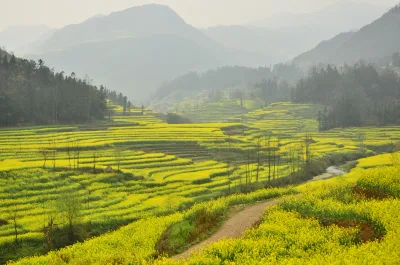
April is when the southern terraces fill. The Longji rice terraces in Guangxi are flooded and reflecting sky from April into May, with the Yao and Zhuang villages on the ridges above them. It is a working agricultural landscape rather than a park, so the water levels depend on the planting schedule, but the second half of April is usually the safe window.
Kunming, the only Yunnan city in the table, averages 24.3°C by day and 12.0°C at night, with 25.4 mm across 6.5 rain days. That is still dry by southern standards, but the wet season begins in May, when rainfall jumps to 80.1 mm. April is the last month of clean light and reliable dry days, and the countryside around the city is at its most comfortable. The rapeseed around Luoping has gone over by now; this is terrace and tea season instead.
Lhasa and the plateau
Lhasa records 16.5°C by day, 3.1°C at night and 8.3 mm across 5.2 rain days in April. It is warmer than March, still dry, and bright enough that the Potala is at its most photogenic. The nights remain cold and the UV is fierce, but the tourist season has not yet peaked.
April is also the tail of the Nyingchi peach blossom season, which usually runs from late March into mid-April in the Yarlung Tsangpo valley. Permits are still required and must be arranged through a registered agency. Snow can close mountain roads without much warning, so build a spare day into any itinerary that crosses a pass.
Beijing and the north
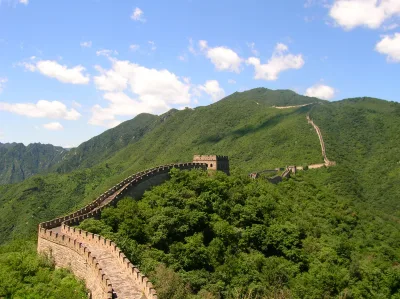
Beijing averages 21.0°C by day and 9.0°C at night, with 21.7 mm across 4.7 rain days. The heating season ended on 15 March, so rooms are no longer overheated, and the parks are green without the summer crowds. The Great Wall is at its best before the trees fully leaf: the hills still show their shape and the sky is often clear.
April is also the busiest month of the northern dust season, which runs from March to May. Most dust comes from southern Mongolia and rarely closes anything, but it turns the sky yellow and flattens photographs. Check the air quality index in the morning; above 200, move a museum day forward. The Beijing first-timer guide covers the booking mechanics, and the Great Wall section guide explains which stretches are worth the drive in spring wind.
Shanghai and the delta
Shanghai averages 20.9°C by day and 12.6°C at night, with 84.2 mm across 11.3 rain days. The rain days are slightly fewer than in March, and the light is better. This is the delta’s best window before the plum rains of June: the water towns are green but not yet crowded, the gardens are at their peak, and walking between sights does not leave you soaked.

It is also the last cheap window. Hotel rates climb through late April and stay high across May Day. The three-day Shanghai itinerary works better now than in summer, and the Jiangnan water town guide explains which of the nearby towns are worth the trip.
What April does not do
April is a bad month for two things people still book it for.
The first is ice. Harbin’s Ice and Snow World closes in late February or early March, and by April the sculptures are gone and the river ice has broken up. What is left is a pleasant, inexpensive northern city with good architecture and no winter spectacle. If the ice is the reason for the trip, go in December or January; the Harbin ice festival guide covers the season.
The second is peak skiing. Low-altitude resorts near Beijing typically close in late March, while Changbaishan and the Xinjiang areas can hold snow into April. Conditions are spring conditions: firm in the morning, soft by noon. If snow quality matters, go high and go early in the month. The ski resort comparison sets out altitude and snow reliability.
April also does not mean warm everywhere. Harbin’s average night is 1.9°C and Lhasa’s is 3.1°C. A trip that combines the north and the south in one week still means packing for two different climates.
The visa question
The 30-day visa-free scheme for 50 countries runs only to 31 December 2026. As of 19 November 2026 the foreign ministry had announced no extension, saying only that it was studying the policy. Unless that changes before you fly, an April 2027 arrival needs a visa.
The exceptions are narrow. Russian passport holders travel under a bilateral arrangement extended to 31 December 2027. Brunei’s arrangement has no stated end date. Everyone else is back to a tourist visa, a 240-hour transit if they are passing through to a third country, or Hainan’s island-only entry.
Apply early. Visa centres in Europe and North America fill in the weeks before Qingming, and an appointment booked late is the most common reason a spring trip slips to autumn. The visa-free entry guide tracks the country lists and any renewal; the application guide covers the paperwork.
Who April suits
It suits anyone who wants spring without March’s uncertainty. The days are longer, the north is genuinely warm, and the flowers have dates you can plan around. It suits travelers who can move in the 7 to 24 April window, when the holiday traffic has gone and May Day has not yet arrived.
It suits flower chasers, photographers working the green-up in the north, and anyone heading to the plateau before the summer season. It suits travelers who pick one region and stay in it, because the country is still two climates in April.
It does not suit anyone who wants ice, anyone who assumed the visa-free scheme would be extended, or anyone treating April as a guarantee of dry weather. Guangzhou’s 15.3 rain days are the highest in the table, and Shanghai’s 11.3 still means an umbrella.
Pack for the coldest point on the route and add a waterproof layer. A warm jacket is still right for Harbin and Lhasa nights, a light coat for Beijing mornings, and a shell for the south. Add sunglasses and high-factor sunscreen for the plateau, and an N95 mask for the northern dust. The full packing list has the layer-by-layer version.
The honest summary: April is the month the Chinese spring becomes usable everywhere at once, with one crowded long weekend in the middle of it. Go after Qingming and before May Day. Book the visa before you book anything else.
Frequently asked questions
Is April a good time to visit China?
It is one of the two best months of the Chinese spring, and the more reliable of them. April has a holiday in it, Qingming from 3 to 5 April 2027, but the three days are a domestic travel window rather than a national shutdown. Outside those dates the weather is warm across most of the country and prices sit well below May Day levels. Choose the second half of the month if you want the calm and the lower rates.
What is the weather like in China in April?
In the 1991–2020 normals, average daily highs run from 14.0°C in Harbin to 26.4°C in Guangzhou. Beijing averages 21.0°C by day and 9.0°C at night, Shanghai 20.9°C and 12.6°C, Xi’an 22.1°C and 9.2°C, Chengdu 22.5°C and 12.9°C, Kunming 24.3°C and 12.0°C, Lhasa 16.5°C and 3.1°C. The rain is heaviest in the south: Guangzhou records 193.8 mm across 15.3 rain days, while Beijing sees 21.7 mm across 4.7 days and Lhasa 8.3 mm across 5.2 days.
Is April crowded in China?
The Qingming holiday from 3 to 5 April 2027 is the busiest stretch, with short-haul trains and hotels filling for tomb-sweeping visits. Weekend flower parks in Luoyang, Qingdao and Beijing are also busy. The rest of the month is ordinary: mid-April weekdays are calm almost everywhere, and the last week starts to tighten only as May Day demand builds.
When is Qingming in 2027 and what does it affect?
Qingming runs from 3 to 5 April 2027, three days with no make-up workday, according to the State Council calendar published on 5 November 2026. It is a tomb-sweeping holiday, so domestic travelers head to hometowns and cemeteries rather than to major sights, but rail and air capacity tightens for two or three days and hotels in secondary cities raise rates. Book transport at least a month ahead if you are moving during that window.
Where can I see peonies and cherry blossoms in April?
Luoyang’s Peony Cultural Festival ran from 1 to 30 April in 2026, with the peak bloom around 9 to 25 April; the 2027 dates are announced in the spring. Qingdao’s cherry fair ran from 1 April to 5 May in 2026, with single-petal cherries peaking around 5 to 15 April and double-petal varieties following to late April. Both are free or low-cost and both are busiest at weekends and over Qingming.
Can I enter China visa-free in April 2027?
Not under the 30-day scheme unless it has been renewed. The arrangement covering 50 countries runs only to 31 December 2026, and as of 19 November 2026 the foreign ministry had announced no extension, saying it was studying the policy. Russian passport holders remain covered to 31 December 2027 under a bilateral deal. Everyone else needs a tourist visa, the 240-hour transit scheme or Hainan’s island-only entry.