China in June 2027: Weather, Crowds and Where to Go

June is the month China stops being a country of contrasts. In April the eight cities in the table below sat 12.4 degrees apart by day. By June the gap is 8.1, the tightest of the year, and Guangzhou at 32.0°C and Lhasa at 23.9°C are as far apart as the country gets.
The catch is water. June is when the monsoon reaches its full width: the plum rains settle over the lower Yangtze, the South China flood season peaks, and even Lhasa doubles its rainfall. The country is the same temperature almost everywhere and the rain divides it more sharply than in any other month.
Two dates shape June, and neither is a holiday week. Dragon Boat falls on Wednesday 9 June in 2027, one day off with no make-up workday attached. The national college entrance exam runs on 7 and 8 June, which is why the first ten days are the quietest travel days of the summer half. After that the school year ends and July takes over.
Every temperature and rainfall figure below is the 1991–2020 climate normal from the China Meteorological Administration. They describe what June usually does, not what it will do this year.
What June actually feels like
| City | Average high | Average low | Rain days | The short version |
|---|---|---|---|---|
| Harbin | 26.6°C | 16.0°C | 13.8 | Warm and green, the rainy season arriving |
| Beijing | 30.8°C | 20.0°C | 10.0 | Hot and dry, thunderstorms in the afternoon |
| Xi’an | 31.7°C | 18.7°C | 9.1 | Hot days, cool nights, fewer wet days than May |
| Lhasa | 23.9°C | 11.1°C | 14.4 | Clear mornings, afternoon cloud, strong sun |
| Chengdu | 28.3°C | 20.5°C | 15.1 | Humid, grey, rain most weeks |
| Shanghai | 28.6°C | 22.0°C | 14.3 | Plum rains, heavy air, wet stone |
| Kunming | 25.4°C | 17.3°C | 16.5 | Warm, wet, at its greenest |
| Guangzhou | 32.0°C | 25.1°C | 19.4 | Hot, soaked, rain two days in three |
Rain days means days with at least 0.1 mm of precipitation. The temperature side of June is simple: everything converges. Harbin gains 5.0 degrees by day and 6.4 by night over May, the largest jump in the table, and Beijing adds 3.6 and 4.9. Guangzhou adds 2.0 and 2.0. Kunming, which has been within three degrees of 25°C since April and will stay there until September, adds 0.2.
The rain story is the opposite: everything spreads out. Beijing goes from 6.0 rain days in May to 10.0, and from 36.1 mm to 72.4 mm. Shanghai raises its rain days to 14.3 and multiplies its rainfall by 2.5, to 224.9 mm. Guangzhou records 364.9 mm across 19.4 days, the wettest month of its year: it rains on two days out of three. Lhasa climbs from 31.1 mm to 84.0 and Kunming from 80.1 to 173.1. Harbin crosses 100 mm for the first time in the year.
Xi’an is the exception in the other direction. Its rain days fall from 9.8 to 9.1 even as the total rises 26 percent, which means fewer and harder showers rather than a wet month. That is one reason Xi’an is a workable June stop: the weather is hot and the interruptions are short.
The spread matters for planning. In May, the same eight cities ranged 9.5 degrees apart by day; in July they widen to 10.0 and by October to 16.7. June is the one month when a single packing list covers the whole country, with one addition: an umbrella.
Dragon Boat: one day, not a long weekend
Most Chinese public holidays are either long or awkward. Dragon Boat 2027 is neither. The State Council calendar published on 5 November 2026 gives Wednesday 9 June as a single day off, with no working Saturday before or after it, and Mid-Autumn in September gets the same treatment. It is the only public holiday in the year that adds a day without rearranging the week around it.
That changes what the festival does to travel. There is no five-day block to absorb demand, so trains and hotels do not move to holiday pricing the way they do in May or October. The 9th is a Wednesday and the weekends either side are ordinary. This is the main reason June is the cheapest month of the summer half: the calendar gives it one day and no bridge.
The festival itself is worth planning around if you want to see it. Dragon boat races are local rather than national. Village and company teams race on rivers and lakes, and the biggest concentrations are in the Pearl River delta around Guangzhou and Foshan, along the rivers of Hunan around Miluo, and in Fujian and Zhejiang. Zongzi, the leaf-wrapped sticky rice dumplings, appear in shops a fortnight beforehand and everywhere on the day.

The Dragon Boat festival guide has the race calendar and the story behind the date, and the holiday calendar guide shows how it compares with the holidays worth avoiding.
Because it is a single weekday, the festival does not create the hotel surcharge or the transport lottery of a three-day weekend. If you want the atmosphere without the crush, this is the year to take it.
The plum rains arrive
The Chinese word is meiyu, plum rain, and it describes the band of persistent rain that parks over the lower Yangtze from the second half of June into early July. It is not a storm. It is two weeks of grey sky, high humidity, sudden downpours, and wet stone, which is either the best or the worst thing about the region depending on your tolerance for damp.
Shanghai’s numbers show the scale. The city records 224.9 mm in June across 14.3 rain days, against 91.0 mm and 11.2 days in May. Only August is wetter. The rain is warm, the air is heavy, and laundry does not dry on a balcony.
South of the delta, the same weeks are the peak of the South China flood season, the pre-flood period that begins in April and peaks in June. Guangzhou’s 364.9 mm over 19.4 days is the highest monthly total in the table, and it is why Cantonese cities schedule their outdoor life around mornings.
The practical response is not to cancel the delta but to change the shape of the day. Mornings are the reliable window. Afternoons bring an hour of hard rain and then clear. Build the trip around indoor anchors: museums, gardens with covered walkways, teahouses, and the water towns, which are at their most atmospheric in this weather. The Jiangnan water towns guide covers which of them handle rain well and which turn into a wet car park.
There is an upside. The plum rains are why the region is green, and why the gardens look the way they do in paintings. If you have seen Suzhou in a dry April and found it dusty, June is the correction.
Where June works best
Beijing and the north
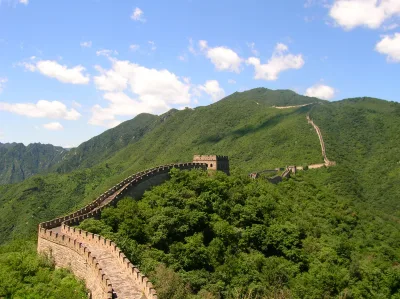
Beijing averages 30.8°C by day and 20.0°C at night in June, with 72.4 mm across 10.0 rain days. That is hot, but it is dry heat with cool nights, and the rain comes as short thunderstorms rather than the all-day drizzle of the south. The Great Wall is at its greenest; the catch is haze and heat by midday. Start early, finish by two, and keep the afternoon for a museum or a hutong. The Beijing first-timer guide has the booking rules, and the Great Wall section guide explains which stretch works for a half day.
Xi’an is the other northern option: 31.7°C by day, 18.7°C at night, and fewer rain days than in May. It is hot in the afternoon and pleasant after dark, which suits the city wall and the night markets.
Harbin reaches 26.6°C by day and 16.0°C at night, which is close to ideal, though its rain roughly doubles to 100.4 mm. It is a good month to see the city without ice and without the -25°C, and the ice festival guide explains why the winter version is a different trip entirely.
The northwest, where the window opens
The clearest June recommendation in the country is the northwest. Gansu, Qinghai and northern Xinjiang are warm rather than hot, the grasslands are green, and the high passes are open. By July the same places are hotter, busier and, in the case of the deserts, genuinely punishing.
Qinghai Lake sits above 3,000 metres and takes most of a day to drive around. The Gansu corridor from Lanzhou to Zhangye and Dunhuang works in June because the days are long and the light is good. The Qinghai and Gansu loop sets out the route, and the Xinjiang grasslands guide covers the Ili valley, which is at its best now.

Two caveats. Nights are cold at altitude even in June, and the UV is severe. And the northwest is a long way from everything: internal flights and long rail legs are part of the trip, not an inconvenience to be optimised away. The high-speed rail guide covers the booking mechanics.
Lhasa and the plateau
Lhasa records 23.9°C by day and 11.1°C at night in June, with 84.0 mm across 14.4 rain days. That is 2.7 times May’s rainfall, and it has settled into an afternoon pattern: clear mornings, cloud building after lunch, a shower, then clearing. The days are the longest of the year, and the solstice falls on 21 June at 22:11 Beijing time.
June is the start of the plateau’s wet season, not the end of the dry one. Go early in the month for the clearest skies; go later and accept that the mountains may be in cloud. Permits are still required and still have to be arranged through a registered agency as part of a tour. The Tibet travel guide covers the paperwork and the altitude plan.
Yunnan
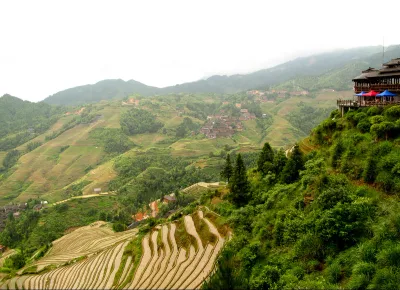
Kunming averages 25.4°C by day and 17.3°C at night, with 173.1 mm over 16.5 days. The wet season is fully established, which means rain most weeks and a landscape at its greenest. Dali, Lijiang and the terraces south of Kunming all work, with the same rule as the delta: mornings out, afternoons flexible.
It is not the month for a trek with fixed huts, and it is not the month for the high passes. It is the month for slow travel, and for the towns that look better wet. The Yunnan first-timer route sets out the standard loop.
The delta and the south
Shanghai and the delta are covered above: 224.9 mm, 14.3 rain days, the plum rains. Guangzhou is 32.0°C by day and 25.1°C at night, with 364.9 mm over 19.4 days. That is the wettest month of the year in the south, and unless you have a reason to be there, June is the month to skip it.
If you are there anyway, the indoor city is genuinely good: the Chen Clan Ancestral Hall, the museums, the teahouses, the dim sum. The heat breaks for an hour after each storm, which is when the city comes out.
Gaokao week
The national college entrance exam, the gaokao, runs on 7 and 8 June. In 2027 those are a Monday and a Tuesday. It is not a public holiday and nothing closes, but it rearranges the country for two days.
Millions of students sit it, and the logistics are national. In smaller cities, hotels within walking distance of exam centres fill weeks ahead, and traffic near schools is controlled on the mornings of the 7th and 8th. Those two weekdays are among the quietest of the early summer at the big sights, because the whole country is focused on something else.
From the 9th, graduation trips begin. The school year ends in early July, and prices climb from late June as families start moving. The last week of June is the shoulder: still cheap, still quiet, but visibly filling up. If you can travel in the first ten days, you get June’s weather without July’s prices.
What June does not do
June is a bad month for three things people still book it for.
Ice, first. Harbin’s Ice and Snow World comes down in late February or early March, and by June the river is open water. No northern latitude makes the season longer.
Skiing, second. The last resorts close in April or the first days of May, and what remains at altitude is spring snow: firm before noon, slush after. The ski resort comparison sets out which areas hold snow longest.
Autumn colour, third. The northern forests turn in late September and October. June is the green-up, not the turn.
There is a fourth, quieter mistake: expecting a dry south. If you want guaranteed sun in June, the dry options are the northwest and the mornings on the plateau. Everything south of the Yangtze is in a wet season.
And the sea is not as warm as the air. Off Hainan it is, at 32°C air temperature and 25°C nights. Off Qingdao and Dalian the water lags the air by weeks, and most people stay on the beach.
The visa question
The 30-day visa-free scheme for 50 countries runs only to 31 December 2026. As of late November 2026 the foreign ministry had announced no extension, saying only that it was studying the policy. Unless that changes before you fly, a June 2027 arrival needs a visa.
The exceptions are narrow. Russian passport holders travel under a bilateral arrangement extended to 31 December 2027. Brunei’s arrangement has no stated end date. Everyone else is back to a tourist visa, a 240-hour transit if they are passing through to a third country, or Hainan’s island-only entry.
Apply in spring, not in May. Visa centres in Europe and North America fill before the summer, and an appointment booked late is the most common reason a June trip slips to September. The visa-free entry guide tracks the country lists and any renewal, and the application guide covers the paperwork.
Who June suits
It suits anyone heading to the northwest or the plateau. It suits travelers who want the Great Wall green and the days long. It suits anyone with flexible dates who wants the cheapest weeks of the summer half, which are the first ten days.
It does not suit anyone who wants a dry south, a guaranteed view from a mountain, or ice and snow. It does not suit an itinerary that needs every afternoon outdoors, and it does not suit a plan built around beach weather north of Fujian.
Pack for heat and rain in the same bag. A light shell, shoes that grip wet stone, a second pair of walking shoes, and sunscreen for the plateau. Beijing’s average night is 20.0°C and Lhasa’s is 11.1°C, so a layer for the evening earns its place. The full packing list has the version by season.
The honest summary: June is the most even month on the Chinese calendar and the wettest in the south. Go northwest or high, go early in the month, and treat the rain as a scheduling problem rather than a reason to cancel. The May guide explains what the Labor Day block does to the weeks before, and the holiday calendar shows why June has no equivalent.
Frequently asked questions
Is June a good time to visit China?
It is the best month for the northwest and the plateau, and a wet month almost everywhere south of the Yangtze. The eight cities in this guide sit within 8.1°C of each other by day, the narrowest spread of the year, but rainfall ranges from 72.4 mm in Beijing to 364.9 mm in Guangzhou. June also has no long holiday, which makes the first ten days the cheapest stretch of the summer half.
What is the weather like in China in June?
In the 1991–2020 normals, average daily highs run from 23.9°C in Lhasa to 32.0°C in Guangzhou. Beijing averages 30.8°C by day and 20.0°C at night, Shanghai 28.6°C and 22.0°C, Xi’an 31.7°C and 18.7°C, Chengdu 28.3°C and 20.5°C, Kunming 25.4°C and 17.3°C, Harbin 26.6°C and 16.0°C. Rain is the bigger variable: Guangzhou records 364.9 mm over 19.4 days, Shanghai 224.9 mm over 14.3, and Beijing 72.4 mm over 10.0.
Is June crowded in China?
Less than most months. Dragon Boat 2027 falls on Wednesday 9 June as a single day off, with no make-up workday, so it creates no travel window. The gaokao on 7 and 8 June keeps the country quiet for two weekdays. Crowds build from late June as schools finish and summer travel starts.
When is Dragon Boat Festival in 2027?
Wednesday 9 June 2027, the fifth day of the fifth lunar month. It is one day off with no adjusted working weekend, unlike the three-day versions in most years. Races are local and concentrated in the Pearl River delta, Hunan, Fujian and Zhejiang.
Where should I go in China in June?
The northwest first: Gansu, Qinghai and northern Xinjiang are warm rather than hot and the grasslands are green. Lhasa and the plateau are at their clearest early in the month. Beijing and Harbin work if you start early. The south and the Yangtze delta are in the plum rains, so plan mornings outdoors and afternoons inside.
Can I enter China visa-free in June 2027?
Not under the 30-day scheme unless it has been renewed. The arrangement covering 50 countries runs only to 31 December 2026, and as of late November 2026 no extension had been announced. Russian passport holders are covered to 31 December 2027 under a bilateral deal, and Brunei’s arrangement has no stated end date.