China in May: Weather, Crowds and Where to Go

May is the month China stops being two countries. In April, Harbin and Guangzhou were 12.4 degrees apart by day. In May they are 8.4 apart, among the narrowest of the year. The north catches up in a single month, and the trip you can plan in May is a trip that does not have to choose a climate.
The catch is at the start. May opens with a five-day public holiday, the third-biggest travel window of the Chinese year, and the first five days behave nothing like the other twenty-six. There is also a fixed date in the middle of the month, 19 May, when hundreds of scenic areas halve or drop their admission, which is the closest thing China has to a national discount day.
Every temperature and rainfall figure below is the 1991–2020 climate normal from the China Meteorological Administration. They describe what May usually does, not what it will do this year.
What May actually feels like
| City | Average high | Average low | Rain days | The short version |
|---|---|---|---|---|
| Harbin | 21.6°C | 9.6°C | 10.5 | Warm days, cold nights, the best month before summer |
| Beijing | 27.2°C | 15.1°C | 6.0 | Dry heat, long evenings, the last comfortable month |
| Xi’an | 26.9°C | 13.9°C | 9.8 | Warm and green, good for the city wall at night |
| Lhasa | 20.5°C | 7.1°C | 9.5 | Bright days, cold nights, the dry season ending |
| Chengdu | 26.3°C | 17.2°C | 14.2 | Humid, cloudy, rain most weeks |
| Shanghai | 25.8°C | 17.9°C | 11.2 | Pleasant, heavier showers, plum rains still a month off |
| Kunming | 25.2°C | 14.9°C | 11.1 | Warm, mild, the wet season arriving |
| Guangzhou | 30.0°C | 23.1°C | 17.4 | Hot, humid, rain on more than half the days |
Rain days means days with at least 0.1 mm of precipitation. The number that matters in May is not the annual total but the turn. Guangzhou goes from 193.8 mm in April to 329.0 mm, the second-wettest month of its year, and records 17.4 rain days out of 31. Kunming triples from 25.4 mm to 80.1 mm and raises its rain days from 6.5 to 11.1. Lhasa nearly quadruples, from 8.3 mm to 31.1 mm, across 9.5 days instead of 5.2.
Shanghai is the exception in the other direction. Its rain days dip slightly, from 11.3 to 11.2, while its rainfall rises about 8 percent, from 84.2 mm to 91.0 mm. The delta is not getting wetter in the sense of more wet days. It is getting fewer, heavier ones. The plum rains that soak the region for weeks do not arrive until June, when Shanghai jumps to 224.9 mm.
The temperature side is simpler. Harbin gains 7.6 degrees by day and 7.7 by night over April, the biggest jump of any city in the table. Beijing adds 6.2 and 6.1, Shanghai 4.9 and 5.3, Xi’an 4.8 and 4.7. Kunming adds almost nothing, 0.9 by day and 2.9 by night, because it has been within three degrees of that since April and will stay there until September. For the north, May is the payoff month: the first one since September when an evening outside needs no jacket.
Labor Day and the five-day squeeze
The State Council published the 2027 calendar on 5 November 2026. Labor Day runs from 1 to 5 May, five days, with 8 May as a working Saturday. That detail is worth more attention than it usually gets.
The five days themselves are busy. Domestic travelers treat the block as a compressed Golden Week: rail tickets on the first and last days sell out within minutes of release, hotels in Chengdu, Xi’an, Chongqing and the coastal cities move to holiday rates, and the headline sights hit capacity by mid-morning. It is not Spring Festival, when the country goes home, and it is not Golden Week, when every ticket is gone a week ahead, but it is the third red flag on the calendar. The holiday calendar guide sets out how the three compare.
What the working Saturday does is thin out the week after. The 6th to the 8th are ordinary working days, and 8 May is a workday for everyone, which leaves Sunday 9 May as the only day off that weekend. Domestic day trips compress into that single Sunday. If you are moving between cities on 9 May, expect the crowd of a holiday on a date that looks like a normal weekend.
Then it stops. From 10 May there is no public holiday until Dragon Boat on 9 June, and the country returns to ordinary spring. The second half of May is the cheapest and calmest stretch between the spring holidays and the summer peak, and it is where flexible travelers should aim. The China in June 2027 guide picks up from the Dragon Boat date and explains what the rest of the month does.
Two practical notes. Train tickets go on sale 15 days before departure, usually around 2 PM China time, so a 2 May train opens for sale on 17 April and a 20 May train on 5 May. The high-speed rail guide explains the booking flow and the passport check at the gate. And if your dates are fixed inside 1 to 5 May, book the hotel before the transport: rooms in the main tourist cities sell out before the trains do, and a room you can cancel is worth more than a seat you cannot.
Where May works best
Beijing and the north: the best month before the heat
Beijing averages 27.2°C by day and 15.1°C at night in May, with 36.1 mm of rain across 6.0 days. That combination is the best the city offers all year. June pushes the average high to 30.8°C with 10 rain days, July to 31.8°C with 169.7 mm. May is the last month when a full day outdoors is comfortable rather than a test of endurance.
The poplar catkins that drift through the capital usually finish by mid-May, so the second half of the month is the cleaner window. The parks are green, the evenings run past 7 PM, and the Great Wall is at its best: the hills are fully leafed, the light is clear, and the summer haze has not set in. The Beijing first-timer guide covers bookings and transport, and the Great Wall section guide explains which stretch to pick if you only have one day for it.
Xi’an is the other northern city worth naming. At 26.9°C by day and 13.9°C at night it is warm without being oppressive, and the city wall is at its best after dark. It is also the gateway to Huashan and the Henan rail route if you are building a longer loop.
Harbin, finally a city
Harbin in May is a different place from the one in the winter photographs. The average high is 21.6°C, the average low 9.6°C, and there are 51.4 mm of rain across 10.5 days. The ice came off the Songhua in April, the heating season ended on 20 April, and the city is now cheap, walkable and almost free of tourists.
That is the point. Central Street, the Orthodox churches, the old Jewish quarter and the food are all still there, at a fraction of January prices and without the -25°C. If you want the ice, this is the wrong month by three months, and the Harbin ice festival guide explains why the season runs when it does.
Lhasa and the plateau, before the rains
Lhasa averages 20.5°C by day and 7.1°C at night in May, with 31.1 mm across 9.5 rain days. That is nearly four times April’s rainfall, and it is the first sign of the summer monsoon reaching the plateau. Go in the first half of the month if you can: the days are long, the sky is still mostly clear, and the rain has not settled into an afternoon pattern.

Two things do not change with the season. Nights are cold enough for a jacket, and the UV at 3,650 metres is strong enough to burn through cloud. Permits are still required for Tibet and must be arranged through a registered agency as part of a tour; the Tibet travel guide covers the paperwork and the altitude plan.
Kunming and Yunnan at the edge of the wet season
Kunming records 25.2°C by day and 14.9°C at night in May, with 80.1 mm across 11.1 rain days. The rain days more than double from April’s 6.5, and the wet season runs from now until October. May is the transition month: warm, green, and wet enough that you plan around the afternoons rather than the days.
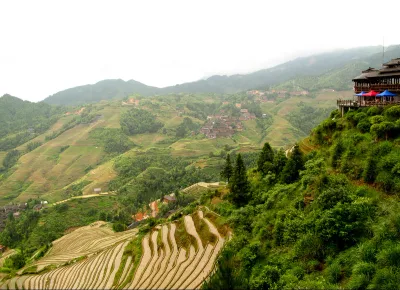
It is still the most comfortable large city in the country in this month, and the surrounding countryside is at its best before the summer downpours. Dali, Lijiang and the rice terraces south of Kunming all work in May, with the caveat that a road trip needs slack for afternoon storms. The Yunnan first-timer route sets out the standard loop and how long each leg takes.
Shanghai and the delta: fewer rain days, heavier rain
Shanghai averages 25.8°C by day and 17.9°C at night, with 91.0 mm across 11.2 rain days. The days are slightly fewer than in April and the showers are heavier, which in practice means more dry mornings and more evenings you would rather spend indoors. The plum rains of June are still a month away, so the delta is in its last easy window.
This is the month for the water towns and the gardens, before the summer heat and the holiday crowds return. The Jiangnan water town guide explains which of the towns near Shanghai are worth the trip and which are a theme park with canals.
Guangzhou and the south: the price of 30°C
Guangzhou averages 30.0°C by day and 23.1°C at night in May, with 329.0 mm of rain across 17.4 days. That is rain on more than half the month, and the totals keep climbing into June. The last ten days also bring the start of what Guangdong calls dragon-boat water, the heaviest stretch of the pre-flood season, which runs into mid-June around the Dragon Boat festival.
None of that makes the south unvisitable, but it changes the shape of a day. Mornings are the reliable window. Afternoons bring thunderstorms that last an hour and drop a lot of water. Build in indoor anchors: the Chen Clan Ancestral Hall, the museums, the teahouses and the dim sum, which is a better rainy-day activity than most cities manage. Typhoon season officially runs from May, though early-season storms more often brush the coast than land on it; check the forecast if you are heading to Hainan or the islands.
19 May: the cheapest day of the year
China Tourism Day falls on 19 May, the date the Ming dynasty traveler Xu Xiake set out on his journeys, and it has been marked since 2011. It is not a public holiday. It is a promotional day, and the promotions are large: scenic areas across the country waive or halve their first ticket, and many of them require a reservation through a mini program.
The 2026 edition, the 16th, gives a sense of the scale. Guangzhou was the main venue for the first time, with 116 attractions and cruise operators taking part and about 80 waiving general admission, including the Chen Clan Ancestral Hall, Lianhua Mountain and Baomo Garden. Shanghai put 56 attractions at half price. Beijing’s Miyun district released 40,000 free tickets. Henan listed more than 100 areas with free entry on the day, and Shanxi, Jilin and Heilongjiang published similar lists that ran from the Hukou Waterfall to Changbaishan and Mohe. Nationwide, organizers counted more than 9,000 discount measures.

In 2027 the date falls on a Wednesday, which helps: a midweek discount day is quieter than one that lands on a weekend, and it does not create a travel window the way a holiday does. The lists are published in the two weeks before, by provincial tourism bureaus and the scenic areas themselves, so the workable approach is to decide where you will be in mid-May by early May, then check the local announcements a week out. Free tickets for popular sites usually need booking days in advance, and some are limited to residents of the province.
If your trip happens to overlap 19 May, it is worth rearranging two days around. A single ticket to a major Chinese scenic area often costs ¥100 to ¥200, and the discount applies to the first ticket only, so the saving is real rather than cosmetic.
What May does not do
May is a bad month for four things people still book it for.
Ice, first. Harbin’s Ice and Snow World comes down in late February or early March, and by May the river is open water. The ice season is December to February, and no amount of northern latitude makes it longer.
Skiing, second. The low resorts around Beijing close in late March. The high ones at Changbaishan and in Xinjiang hold snow into April, and the last of them shut in late April or the first days of May. What remains is spring snow: firm before noon, slush after. The ski resort comparison sets out which areas have the longest seasons.
Peonies, third. Luoyang’s festival ran from 1 to 30 April in 2026, and the peak was 9 to 25 April. Only the late varieties in the cooler gardens hold into the first days of May. The same goes for Qingdao’s cherry fair, which ended on 5 May in 2026.
And autumn colour, obviously, though every year someone asks. The northern forests turn in late September and October. May is the green-up, not the turn.
There is also a quieter mistake: assuming the sea is warm because the air is. The water off Qingdao and Dalian is still cold in May, cold enough that most people stay on the beach. Hainan is the exception, and it is also the hottest and wettest part of the country this month.
The visa question
The 30-day visa-free scheme for 50 countries runs only to 31 December 2026. As of 20 November 2026 the foreign ministry had announced no extension, saying only that it was studying the policy. Unless that changes before you fly, a May 2027 arrival needs a visa.
The exceptions are narrow. Russian passport holders travel under a bilateral arrangement extended to 31 December 2027. Brunei’s arrangement has no stated end date. Everyone else is back to a tourist visa, a 240-hour transit if they are passing through to a third country, or Hainan’s island-only entry.
Apply early. Visa centres in Europe and North America fill in the weeks before the summer, and an appointment booked late is the most common reason a spring trip slips to autumn. The visa-free entry guide tracks the country lists and any renewal, and the application guide covers the paperwork.
Who May suits
It suits anyone heading north. Beijing, Xi’an, Harbin and the Great Wall are at their best, the days are long, and the rain is light. It suits travelers who can move after 10 May, when the Labor Day block has cleared and the country is between holidays. It suits anyone who wants the plateau or Yunnan before the monsoon settles in, which means early in the month rather than late.
It does not suit anyone chasing ice, snow or autumn colour, anyone who wants a dry south, or anyone whose dates are locked to 1 to 5 May and who dislikes crowds. It also does not suit a plan that tries to cover both the north and the south in one week: the country is one climate belt in May, but the rain still divides it.
Pack for warm days and cool nights. Beijing’s average low is 15.1°C and Harbin’s is 9.6°C, so a light jacket earns its place in the bag even when the afternoon is 27°C. Add a rain shell for the south, sunglasses and high-factor sunscreen for the plateau, and shoes you can walk in on wet stone. The full packing list has the layer-by-layer version.
The honest summary: May is the best month of the year to be in northern China and the wettest to be in the south, with a five-day holiday at the front and a discount day in the middle. Go after 10 May. Book trains 15 days out. Keep 19 May in mind if the dates line up.
Frequently asked questions
Is May a good time to visit China?
It is the best month of the year for northern China and a wet month in the south. Beijing averages 27.2°C by day with only 6.0 rain days, and Harbin finally behaves like a normal city at 21.6°C. Guangzhou averages 30.0°C with 329.0 mm of rain across 17.4 days. The month also starts with a five-day public holiday, so the dates you pick matter more than the month itself.
What is the weather like in China in May?
In the 1991–2020 normals, average daily highs run from 20.5°C in Lhasa to 30.0°C in Guangzhou. Beijing averages 27.2°C by day and 15.1°C at night, Shanghai 25.8°C and 17.9°C, Xi’an 26.9°C and 13.9°C, Chengdu 26.3°C and 17.2°C, Kunming 25.2°C and 14.9°C, Harbin 21.6°C and 9.6°C. Rainfall splits the country: Guangzhou records 329.0 mm over 17.4 days, while Beijing sees 36.1 mm over 6.0 days and Lhasa 31.1 mm over 9.5 days.
Is May crowded in China?
The first five days are, badly. Labor Day runs from 1 to 5 May 2027 and is the third-biggest domestic travel window of the year after Spring Festival and Golden Week. The 8 May working Saturday means the following weekend has only one day off, so day trips pile onto Sunday 9 May. From 10 May to the end of the month there is no public holiday until Dragon Boat on 9 June, and the country is as calm as it gets in spring.
What is China Tourism Day?
It falls on 19 May every year, the date Xu Xiake began his travels, and it is the one day when hundreds of Chinese scenic areas cut or waive admission. The 2026 edition was the 16th, with Guangzhou as the main venue and more than 9,000 discount measures nationwide. It is not a public holiday, so it adds no crowds to the calendar, and the 2027 list is published in the weeks before. Check the provincial tourism accounts in early May and reserve where a free ticket requires it.
Where should I go in China in May?
North of the Yangtze. Beijing at 27.2°C with six rain days, Harbin at 21.6°C, Xi’an at 26.9°C and the Great Wall before the summer heat all work. Lhasa is warm by day and dry, and Yunnan is in its last comfortable weeks before the wet season. Shanghai is good until the plum rains of June. Guangzhou and the south are hot and wet, with rain on more than half the days.
Can I enter China visa-free in May 2027?
Not under the 30-day scheme unless it has been renewed. The arrangement covering 50 countries runs only to 31 December 2026, and as of 20 November 2026 the foreign ministry had announced no extension, saying it was studying the policy. Russian passport holders remain covered to 31 December 2027 under a bilateral deal, and Brunei’s arrangement has no stated end date. Everyone else needs a tourist visa, the 240-hour transit scheme or Hainan’s island-only entry.