CR450: China's 400 km/h High-Speed Train, Explained
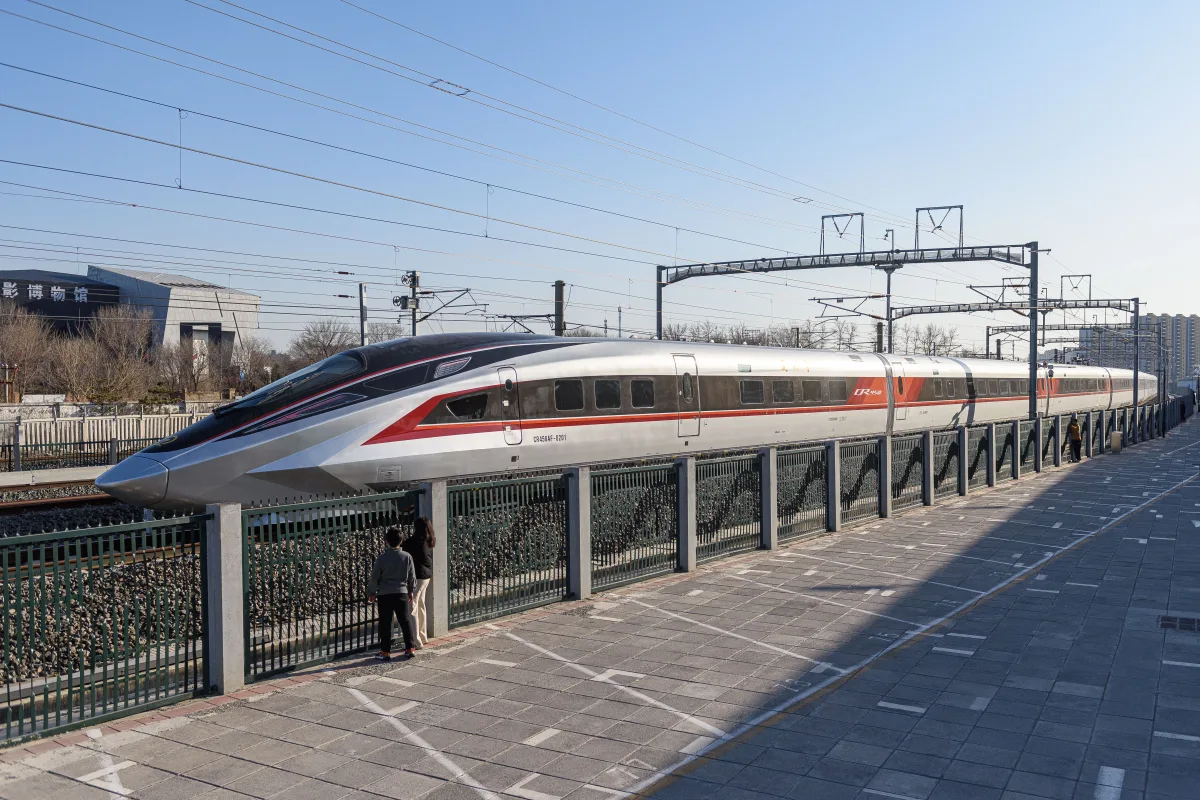
China’s CR450 is the fastest high-speed train in the world on paper, and as of September 2026 you still cannot buy a ticket for it. The two prototype trainsets have finished a 600,000-kilometer reliability assessment, passed every type test, and set a world record of 453 km/h in October 2025. What they have not done is carry paying passengers.
That gap between the headline and the timetable is what this article is about. There is a lot of noise around CR450 right now, including some claims that are simply wrong. Here is what China’s railway operator has actually confirmed, and what it means for anyone booking trains in China over the next 18 months.
What CR450 actually is
The name is a code, not a marketing label. CR stands for China Railway. The number is the target operating speed in kilometers per hour. So CR450 is the trainset designed to run at 400 km/h in commercial service, with a design test speed of 450 km/h. The Fuxing trains you have probably ridden are CR400, built for 350 km/h.
Two prototypes exist:
- CR450AF, built by CRRC Qingdao Sifang
- CR450BF, built by CRRC Changchun
Both are eight-car formations with four powered cars and four trailers, and both rolled off the production line on 29 December 2024 in Beijing.
The engineering is mostly about shedding weight and drag. Compared with CR400, the CR450 is about 10 percent lighter, has 22 percent less running resistance, uses roughly 20 percent less energy, and produces 11,000 kW of traction power. The nose is 15 meters long. The body sits 20 centimeters lower. Cabin noise dropped by 2 decibels and passenger space grew 4 percent. At 400 km/h the train has to stop from full speed in under 6,500 meters, hold interior noise at or below 68 decibels, and consume less than 22 kilowatt-hours per kilometer.
Those last three numbers are the ones railway engineers care about. Top speed is comparatively easy. Stopping, staying quiet, and staying efficient at 400 km/h are not.
The 453 km/h record, and what it does not mean
In October 2025, on the Shanghai-Chongqing-Chengdu high-speed line, a single CR450 test unit reached 453 km/h. In the same campaign, two CR450 trains passed each other in opposite directions at a combined relative speed of 896 km/h, which is the figure Chinese state media likes to quote.
Neither number is the speed you will experience.
453 km/h is a test speed, achieved on a prepared section with no passengers and no intermediate stops. It is the number that proves the design works. It is not a timetable. The same train, in service, is certified for 400 km/h and will spend most of its life below that, because accelerating out of one station and braking into the next eats into any average.
Chinese reporting on CR450 mixes these figures constantly. If you see a headline claiming the train does 450 km/h, the correct reading is that it can reach 450 km/h under test conditions and will run at 400 km/h with you on board.
Acceleration is the underrated number
The figure that will change your journey more than top speed: CR450 accelerates from a standing start to 350 km/h in 4 minutes 40 seconds, about 100 seconds quicker than CR400.
Fast acceleration matters because Chinese high-speed lines are dense. A train that gets back to line speed quickly can absorb more stops without losing much total time, and it slots into tighter gaps between other services. If you have ever looked at a Golden Week timetable and wondered why adding trains is hard, this is part of the answer.
When you can actually ride it
This is where a lot of English-language coverage gets sloppy, so here is the state of play as of September 2026.
Chinese regulations require a brand-new train type to complete 600,000 kilometers of fault-free operation assessment before it can carry passengers. That is roughly 15 trips around the equator. As of January 2026 the two prototypes had logged about 300,000 kilometers. By August 2026 they had completed the full 600,000, and testing continued on the Xiong’an-Shangqiu line to add flat-terrain endurance and coupled-formation data.
China State Railway Group’s stated goal for 2026 is to finish the operation assessment and finalize the design. Commercial service follows that, not the other way round.
So the train is not in service yet. If you are traveling to China in late 2026, you will ride a CR400 at 350 km/h, exactly as you would have last year. Book it the same way you always have, using our China high-speed rail guide, and treat the CR450 headlines as next year’s news.
Which route gets it first
Not Beijing-Shanghai. The first line built with 400 km/h running in mind is the Chengdu-Chongqing middle line, a 292-kilometer link between Chongqing North and Chengdu stations. It is designed for 350 km/h with provision for 400 km/h, and it is scheduled to open in 2027.
On that route, CR450 would cut Chengdu to Chongqing to about 50 minutes. The fastest existing trains cover Chengdu East to Shapingba in about 62 minutes, and Chengdu East to Chongqing West in about 67. So the gain is real but modest, roughly 12 to 17 minutes, and the new line uses different city terminals. If you are building an itinerary around those two cities, it is worth knowing about, though not worth planning a whole trip around.
Beijing-Shanghai is the second phase and the harder one. The line already exists and carries a heavy service load at 350 km/h. Going to 400 km/h does not mean rebuilding it. It means track realignment, catenary and signal adjustments, and a great deal of precision maintenance work on a route that cannot easily be closed. Chinese sources describe a target of bringing Beijing-Shanghai under three hours, down from 4 hours 18 minutes on the fastest current service. Some reports float 2.5 hours, others 3.5. Treat any figure below three hours as unconfirmed.
Beijing to Shanghai: train or plane
The fastest train today is 4 hours 18 minutes, run by G22 and G17 with a single stop at Nanjing South. Second class on that route is dynamically priced, roughly 498 to 669 yuan depending on the train and the date.
A flight is about 2 hours 15 minutes in the air. Add the two hours you need at the airport, plus the fact that Beijing Capital, Daxing, Hongqiao and Pudong all sit well outside the city center, and door to door both options land somewhere between five and seven hours.
CR450 does not change that calculation as much as the headlines suggest. Cutting the rail leg from 4 hours 18 minutes to under three hours makes the train clearly faster door to door on this corridor, and it removes the weather-delay risk that comes with flying. But it does not make the train twice as fast, and it will not be cheap.
For a first visit, the practical advice does not change much. Our Beijing first-timer guide and Shanghai arrival guide cover the station logistics, and our China travel budget guide has current fare ranges so you can see what the premium would sit on top of.
Will CR450 tickets cost more
No fare for CR450 has been published. Anyone quoting a specific price increase is guessing.
Two things are worth watching. First, Beijing-Shanghai High-Speed Railway Co. raised published fares by around 20 percent in May 2026 on its 300 to 350 km/h services, which suggests the operator sees room to price premium trains higher. Second, Chinese high-speed fares are dynamic: the published price is a ceiling, and what you pay moves with demand, time of day, and how far ahead you book. Whatever CR450 costs at launch, the sticker price will not be what most passengers actually pay.
The safe assumption is that CR450 services will carry a premium over existing 350 km/h trains, and that booking early will matter more than it does today.
What to do with all this
Nothing changes for a 2026 trip. Ride the 350 km/h trains. They are fast, punctual, and better than most visitors expect.
For a 2027 trip, watch the Chengdu-Chongqing middle line opening, which is the real debut rather than the record attempts. If your itinerary includes that corridor, it may be worth timing around.
And if something goes wrong on the railway, whether it is a missed connection or a cancellation, our guide to high-speed rail emergencies covers what to do.
Frequently asked questions
Is the CR450 in service yet?
No. As of September 2026 the CR450 has not carried a single paying passenger. Chinese rules require a new train type to complete 600,000 kilometers of fault-free operation assessment first. Both prototypes finished that mileage in August 2026, and testing continued on the Xiong’an-Shangqiu line. China State Railway Group’s target for 2026 is to complete the assessment and finalize the design, with commercial service following after that.
How fast will the CR450 actually go with passengers on board?
400 km/h in commercial service. The 453 km/h figure that circulates in news reports was a test speed, reached in October 2025 on the Shanghai-Chongqing-Chengdu line with no passengers and no intermediate stops. The 450 km/h design figure is the certification ceiling for testing. When you buy a ticket, the train is certified for 400 km/h, and its average speed will be lower because it has to accelerate and brake between stations.
When will the CR450 run on the Beijing-Shanghai line?
No confirmed date. The Beijing-Shanghai corridor is the second phase, after the Chengdu-Chongqing middle line. Chinese sources describe a target of bringing Beijing to Shanghai under three hours, down from 4 hours 18 minutes on the fastest current service, but this depends on track realignment, catenary and signal upgrades on a line that already carries heavy traffic. Treat any specific date as unconfirmed.
Which route gets the CR450 first?
The Chengdu-Chongqing middle line, a 292-kilometer link between Chongqing North and Chengdu stations. It is designed for 350 km/h with provision for 400 km/h, making it the first Chinese line built with 400 km/h running in mind. It is scheduled to open in 2027, and on that route the CR450 would cut Chengdu to Chongqing to about 50 minutes from about 62 minutes today.
How much will a CR450 ticket cost?
No fare has been published, so any specific figure you see is speculation. Two things are clear. Beijing-Shanghai High-Speed Railway raised published fares by about 20 percent in May 2026 on its 300 to 350 km/h services, which shows the operator sees room to charge more for premium trains. And Chinese rail fares are dynamic, so the published price is a ceiling and what you actually pay moves with demand and how early you book.
Is the CR450 faster than flying from Beijing to Shanghai?
It wins door to door, not in the air. A flight is about 2 hours 15 minutes in the air, but add two hours at the airport plus transfers to and from airports well outside the city center, and both options land between five and seven hours door to door. Cutting the rail leg from 4 hours 18 minutes to under three hours makes the train the clearer choice on that corridor, and it removes weather delays.