Luoyang vs Xi'an for Hanfu Photos: Cost, Crowds and Backdrops

Two cities, one costume
Luoyang and Xi’an sell the same product. You hand over money, someone dresses you in Tang-era silk and puts your hair up, and you spend an evening being photographed in front of something old and photogenic. Both cities have built an industry around it, both have districts that exist mainly for this, and both are an hour and a half apart on the same high-speed line.
The differences are real, though, and they are not the ones you would guess. Xi’an has more shops, more backdrops and by a wide margin more people. Luoyang is cheaper, its prices are regulated by the local government, and its best backdrop is a genuine Tang-dynasty gate rather than a reconstruction. Choosing between them is mostly about which of those trade-offs bothers you.
This is the comparison. The single-city detail lives elsewhere: the Luoyang rental guide breaks down what each price tier contains, and the Xi’an guide covers the Xi’an circuit in full.
What a hanfu package costs in each city
The headline number first, because it is the biggest single difference.
A typical Luoyang package, meaning the costume, styling, headwear and same-day touch-ups, sits at around ¥132 according to provincial reporting. The consumer authority in the old city describes ¥100-odd as the price most visitors accept, with photography or a higher-grade costume pushing you to ¥200 to ¥400.
The equivalent mainstream Xi’an package runs ¥160 to ¥300, and Xi’an’s premium tier, the studios with restoration-grade costumes and trained stylists, goes past ¥500.

Xi’an: a wide range with little oversight
Xi’an’s market is bigger and looser. The cluster around Yizhou Mall on West Street sells packages covering garment, hair and makeup mostly between ¥100 and ¥300, and those shops serve something over a thousand customers a day between them. Above that the market keeps going: ¥500, ¥800, and on up.
What Xi’an does not have is an enforced price structure. The city’s hanfu association issued an industry initiative in December 2025 asking shops to publish their rental fees, styling charges, photo packages, deposits and overtime rates, and to label sizes. It is an initiative. A shop that ignores it is not breaking a rule.
Luoyang: the price board is the law
Luoyang went the other way. The old city’s market regulator requires every hanfu shop to display a standardised three-column price board: the service, what is included, and the price. The board has to list the rental, the makeup, the hair, any photographer package, prop hire, the deposit and the return time. If a photographer package is offered, the board must state how many digital images and how many retouched images you get.
Shops still set their own prices. They cannot add undisclosed charges, and the complaints line is 12315. Roughly 800 shops went through the training programme, and the regulator runs warnings and a compensation-first policy for disputes.
That is the practical difference between the two cities. In Luoyang the price you are quoted has to be on the wall. In Xi’an it is worth asking.
Crowds: the numbers behind the atmosphere
Both cities are busy. The gap is larger than most guides admit.
The Grand Tang Mall in Xi’an, the 2.1 km pedestrian street south of the Big Wild Goose Pagoda, recorded just under 75 million visits in 2024. Provincial reporting puts 2025 above 86 million, an average of more than 230,000 people a day, and the single-day record is 573,000 on 3 October 2025, when the metro station at the pagoda processed 320,000 entries and exits on its own.
Luoyi Ancient City in Luoyang, the free walled district where most Luoyang hanfu photos are taken, counted about 15 million visits in 2024, up 29 per cent on the year before. Its record single day, set that December, was 206,000.

Read those two paragraphs together. The Grand Tang Mall’s ordinary day is busier than Luoyi Ancient City’s all-time best day. That is the comparison that matters, and it is structural rather than seasonal: the Tang Mall is an open street with no gate, no ticket and no closing time, so nothing throttles it. Luoyi Ancient City is a walled site with a real-name reservation system that can, in principle, be capped.
In practice the cap does little on holidays. During the 2026 National Day week the Luoyang site logged about 733,000 visits across seven days, with a peak near 145,000 in a single day. Both districts are saturated at those moments, and neither is worth scheduling a photo shoot around.
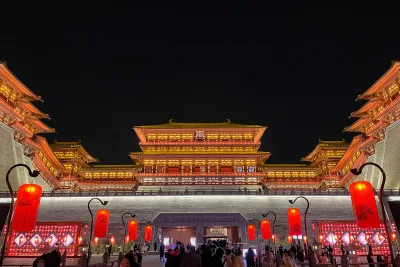
The working answer for both cities is the same. Shoot in the morning, or in the two hours before the lights come on, and treat the switch-on itself as something to watch rather than something to photograph. In Luoyang the lights go on at 18:30 and the site closes at 22:30. In Xi’an the street is at its most photogenic from about 18:00 and starts to thin after 21:00.
What you are standing in front of
Xi’an: Tang and Ming in one evening
Xi’an’s advantage is range. Within a single evening you can shoot Tang-era settings, the Tang Mall, Tang Paradise, the Big Wild Goose Pagoda and its temple, and then walk to Ming-dynasty fabric: the city wall, the Bell Tower, the lanes around the Muslim Quarter. The wall in particular is a backdrop Luoyang simply does not have.
The cost is that the Tang settings are mostly reconstructions too. Tang Paradise is a themed garden rebuilt on the site, and the mall is a purpose-built commercial street. What is genuinely old is the pagoda and the temple beneath it.
Luoyang: Tang archaeology and new-build streets
Luoyang’s strongest backdrop is not a reconstruction. Yingtianmen is the south gate of the Sui and Tang imperial city, excavated and rebuilt over the original foundations, and it is the best single piece of Tang architecture available to a photographer in either city. The tower ticket is around ¥60, the north square in front is free, and it lights up at about 19:00.
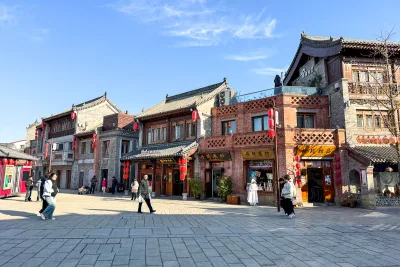
Luoyi Ancient City is the opposite: a purpose-built district of perhaps ten hectares, free to enter, with water, bridges and lanterns, and almost none of it older than a decade. It is also, for practical purposes, the best-managed photo location in either city, because entry is controlled and the whole thing is on a single evening lighting schedule.
Then there is the Longmen Grottoes, ¥90, which is not really a costume backdrop at all. It is a UNESCO World Heritage site of Northern Wei and Tang carving, and the Luoyang photo spot guide explains what is permitted there, which is less than you might assume.

Photography rules that changed in the last two years
This is the part that most English-language guides have not caught up with.
In August 2025 the Qujiang New District authorities in Xi’an ran a joint enforcement campaign around the Big Wild Goose Pagoda and the Tang Mall. Designated commercial shooting zones were marked on the ground with yellow lines. Commercial shoots were banned outright in the pagoda’s south square and around the Xuanzang statue, and commercial photography teams were placed under a registration system. Marshals in reflective vests now work the area at night.
None of that touches you if you are photographing your own group with your own camera. It targets the freelancers who turn up with a lighting rig and a client. But if you have booked a shoot through an app, it is worth knowing that the operator may be working inside a defined zone rather than wherever looks best.
On the Xi’an city wall the rules are statutory. The wall protection regulations require permits for commercial filming and set fines of up to ¥50,000 for violations. Tourist photographs are not the target, and nobody will stop you taking them. A professional crew is a different matter.
Luoyang’s equivalent happened earlier, in April 2024, when Luoyi Ancient City asserted that commercial photography is a business activity requiring authorisation and moved to license the photographers working on site. The park’s own clarification at the time is the sentence worth keeping: visitors taking photographs with their own cameras, or having a friend photograph them, are not interfered with.
Hiring a photographer
If you want the finished images rather than the raw afternoon, both cities will sell them to you.
In Xi’an a street photographer typically charges ¥100 to ¥300, often quoted per two hours. Studios doing real retouching run ¥400 to ¥900, and a themed package at the top of the market can hit ¥2,000. A common three-hour package delivers around 35 original files and five retouched ones.
In Luoyang, packages that bundle costume, styling and a photographer start near ¥399 and go to ¥1,299. Delivery is usually six to nine retouched images with 30-odd originals, and shops advertise that all the originals are handed over, which is worth confirming rather than assuming.
What you get back
The universal trap is the retouching count. Packages quote a number of retouched images, and every extra one costs money, commonly ¥60 to ¥80 in both cities. Ten extra retouched frames is a ¥600 to ¥800 surprise on top of a package you thought was complete. In Luoyang the price board has to state the number up front, which is one more reason that city is easier to buy in.
Booking from abroad
Luoyang’s entry system takes a passport. The reservation is free and real-name, made through the official account or the Xiangyou Luoyang mini-program, and international visitors check in on their passport at the gate. Xi’an needs none of this: the Tang Mall has no ticket, no booking and no ID check, so it is the easier of the two to simply walk into.
Sizes are the honest gap. There is no published sizing data for hanfu rental in either city, and anyone quoting you a size range is guessing. What can be said is that hanfu are generally wrap-and-tie garments with adjustable sashes, and a Shanghai paper reported in June 2025 that one Xi’an merchant now counts international visitors as at least 30 per cent of customers and stocks larger sizes to match. Ask the shop for its measurements and send your height and weight before you book.
Getting there is easy in both cities. In Xi’an, Metro Line 3 or 4 to Dayan Pagoda station puts you at the north end of the Tang Mall, and Line 4 to Tang Paradise station puts you at the south end. In Luoyang, Metro Line 1 runs to stations named after the two main photo districts, Luoyi Ancient City and Yingtianmen, one stop apart. Luoyang also runs free metro travel all day in summer for passengers in full hanfu, which is either a nice touch or a marketing stunt depending on your tolerance.
Doing both cities in one trip
The high-speed line between Xi’an North and Luoyang Longmen is 324 km and takes 1 hour 15 minutes to 1 hour 40 minutes on a G train, with second class at ¥174 to ¥209. There are departures roughly every half hour through the middle of the day, so this is not a journey you need to plan around.
The sensible order is to do the photographs in Luoyang and the city in Xi’an. Luoyang is cheaper, its prices are on the wall, and its best backdrop is the excavated one. Xi’an gives you the wall, the towers and the food, and you can enjoy all of it without a rental deadline. Note that Luoyang’s high-speed station is Luoyang Longmen, not Luoyang, and the two are a dozen kilometres apart; the station comparison explains which one you want. If Luoyang is part of a longer circuit, the four ancient capitals rail route sequences it with Zhengzhou, Kaifeng and Anyang.
Which one to pick
Luoyang, if the photographs are the point. It is cheaper at every tier, the pricing is regulated rather than voluntary, the site is smaller and more controllable, Yingtianmen is the only backdrop in either city that is both Tang and genuinely excavated, and the whole evening is walkable from two metro stations.
Xi’an, if the trip is the point. You get more shops, a much wider luxury tier, the city wall, and a street where the scale of the costume phenomenon is itself the attraction. You also get five times the footfall, which is the price of all of it.
Do both if you have three days. They are close enough that the question of which city is better is less useful than the question of which city is better for what, and the answer is different for each.
Frequently asked questions
Is hanfu rental cheaper in Luoyang or Xi’an?
Luoyang, and by a clear margin at the mainstream level. The Henan provincial figure for a typical Luoyang package, meaning styling, headwear, the costume and same-day touch-ups, is around ¥132. Shaanxi provincial reporting puts the mainstream Xi’an package at ¥160 to ¥300. Xi’an also has a much deeper luxury tier above ¥500 that Luoyang largely does not.
Which city is less crowded for hanfu photos?
Luoyang, but only in relative terms. The Grand Tang Mall in Xi’an drew over 74 million visits in 2024 and its average day is busier than the Luoyang record. Luoyi Ancient City counted about 15 million visits in 2024 and its best single day was 206,000. Both fill up after dark, and both are effectively impossible to shoot clean on a public holiday.
Do I need a reservation for Luoyi Ancient City?
Yes, and it is free. Entry is a real-name reservation through the official Luoyi Ancient City account or the Xiangyou Luoyang mini-program. International visitors can use a passport. The daily allocation does run out on public holidays, so book the day before rather than on the day. The Grand Tang Mall in Xi’an needs no ticket, no reservation and no ID at all.
Can you hire a photographer in both cities?
Yes, and the price gap is wide. In Xi’an a street photographer is commonly ¥100 to ¥300, while a studio with real retouching runs ¥400 to ¥900. In Luoyang a package with the costume, styling and a photographer starts around ¥399 and reaches ¥1,299. In both cities the trap is the same: extra retouched images beyond the package are charged individually, usually ¥60 to ¥80 each.
Are there rules about commercial photography?
There are, and they tightened in 2025. In Xi’an, Qujiang New District marked designated commercial shooting zones with yellow lines near the Big Wild Goose Pagoda and banned commercial shoots outright in the south square, with commercial teams required to register. Luoyang’s Luoyi Ancient City requires authorisation for commercial shoots, and its management has publicly stated that visitors photographing each other with their own cameras are not affected.
Can you do both cities on one trip?
Easily, and it is the best answer. The high-speed line from Xi’an North to Luoyang Longmen takes 1 hour 15 minutes to 1 hour 40 minutes, second class is ¥174 to ¥209, and there is roughly a train every half hour through the middle of the day. Rent the costume in Luoyang where it is cheaper, then spend the evening in Xi’an in ordinary clothes.