Tianmen Mountain Routes A, B and C: Which One to Book
Tianmen Mountain is not a place you walk up. You buy a route, and the route decides how you get to the top, how you come down, how long it takes, and how much of the mountain you actually see. There are three of them, they are all priced the same, and one of them disappears whenever part of the cableway system goes offline.
That last part is why this page exists. Almost every English guide describes Tianmen as it worked before November 2025, and several still describe it as it worked in 2019. The mountain has been under a rolling upgrade since then, and the routes have been rewritten around it.
If you have not yet worked out how Tianmen, the forest park and the Grand Canyon fit together, read our overview of the three Zhangjiajie areas first. This piece assumes you have picked Tianmen and now have to choose a line.
What is actually up there
Tianmen is the mountain in Zhangjiajie city itself, about 2 km from the centre, and it is the highest thing in the region at 1,518.6 m. The reason people go is a hole.
Tianmen Cave is a natural arch punched clean through the cliff at around 1,300 m: 131.5 m high, 57 m wide, 60 m deep, open to the sky on both sides. It sits above a road with 99 hairpin bends and below a set of 999 steps, and it is the single most photographed hole in China.
| Feature | Figure |
|---|---|
| Summit elevation | 1,518.6 m |
| Tianmen Cave | 131.5 m high, 57 m wide, 60 m deep |
| Steps to the cave | 999 |
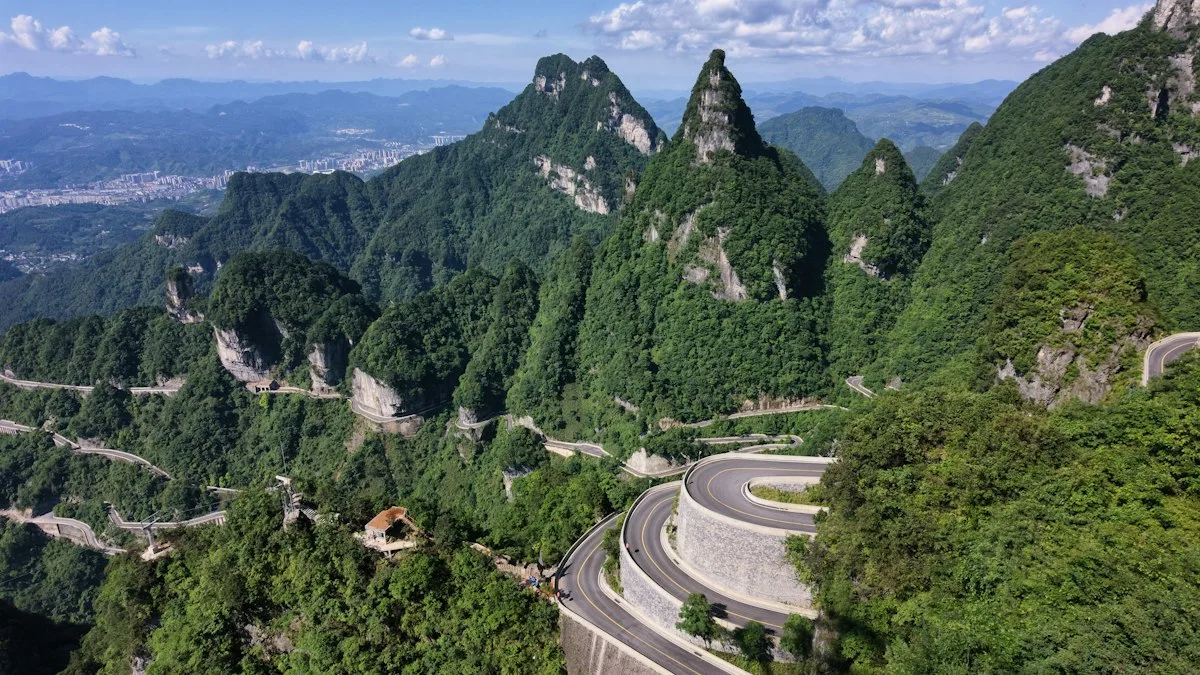
| Tongtian Avenue, the 99-bend road | 10.77 km, 99 bends, about 1,100 m of climbing |
| Main cableway | 7,455 m, 1,277 m vertical, about 28 to 30 minutes |
| Ghost Path boardwalk | 1,600 m, cut into the cliff at around 1,400 m |
The summit is not one viewpoint. It is a loop of engineered walkways and paths around the top: the Coiling Dragon Cliff glass walk, the East and West glass lines, the Ghost Path boardwalk pinned to a vertical face, and a temple. Five to eight hours is the honest allowance. This is a full day, not a half one, whatever the itinerary sites tell you.
The two cableways decide everything
Here is the mental model that makes the rest of this page obvious.
Tianmen has two separate cableways, and they do different jobs.
The main cableway is the big one: 7,455 m of line and 1,277 m of vertical rise, about 28 to 30 minutes in the air, originally running all the way from a station in the city to the summit. It is one of the longest passenger cableways ever built, and the ride over the city, the farmland and then the cliff face is a large part of why people come.
The Express Cableway is the short one, running from the mountain gate up to Tianmen Cave. It is not a sightseeing ride. It is the way in from the gate side.
Since 6 November 2025, the upper section of the main cableway, mid-station to summit, has been closed and dismantled as part of a long upgrade. The lower section, city station to mid-station, roughly 5,300 m and about 70 percent of the original line, still carries passengers. There is no reopening date, and the construction has been described as running for years, not months.
That single fact reorganises the mountain:
- Routes A and B both depend on the main cableway.
- Route C never touches it.
So when the main cableway is out, C is not the compromise option. It is the only option.
Route A: start in the city, come down the other side
A is the route for people who want the cableway ride and the road.
You board at the downtown lower station and ride the main cableway up to the mid-station, which is where the line currently ends. From there a sightseeing bus takes you up the 99 bends to Tianmen Cave. Then the seven-section through-mountain escalator carries you up to the summit, you walk the top, and you come back down the escalator to the cave. From the cave you take the Express Cableway down to the mountain gate, and a shuttle brings you back to the city.
That is the shape of it: cableway up, road up, escalator up, then out through the gate side. You get the city-to-mountain panorama and the 99 bends in the same day.
Route B: the mirror image
B runs the same pieces in the opposite order, and it exists mostly because up and down have different queues.
You start at the mountain gate, take the Express Cableway up to Tianmen Cave, ride the escalator to the summit, walk the top, come back to the cave, take the bus down the 99 bends to the mid-station, and then ride the main cableway down into the city.
Same components, same price, reversed. The practical difference is where you begin: B starts at the gate, which is where drivers and shuttle buses arrive, and it ends downtown. A starts downtown and ends at the gate.
Route C: the short version, and the survivor
C skips the main cableway and the 99-bend road entirely. Gate, Express Cableway up to the cave, escalator up, summit, escalator down, Express Cableway back to the gate. Out the way you came in.
Two things follow from that. It has the fewest moving parts of the three, which makes it the one to choose if you are travelling with someone who gets motion sick, or with small children, or if you simply want to be back in the city by mid-afternoon. And it is the route the park falls back on: in ice, heavy fog or rain, when the mountain road is judged unsafe, A and B are converted into a C-style pattern and C is what actually operates.
What you give up is the long cableway ride and the 99 bends. If those are the reason you came, C is the wrong ticket.
Which one should you book
Pick by where you are sleeping and by how much you care about the cableway.
Staying in Zhangjiajie city, or arriving by train and heading out the same evening? Route A starts a few minutes from your hotel and gives you the full ride. It is the cleanest fit for a city base.
Driving, or coming in on a tour shuttle with a car waiting at the gate? Route B means you finish downtown instead of walking back to a car park, and you take the cableway down rather than up, which is the direction with the view behind you.
Travelling with people who will not enjoy a 30-minute cableway, or short on time, or here in weather that is already marginal? Route C. It is also the answer if you are visiting on a day when the main cableway is offline, because then it is not a choice at all.
One thing worth knowing before you commit: the route letters were also assigned on a per-day basis during the 2025 and 2026 works, so the same letter can mean a slightly different sequence of vehicles a month apart. Read the transport sequence, not the letter, when you book. Our Zhangjiajie tickets guide covers the booking channels, the passport rules and the manual window for anyone without a working Chinese phone number, and those mechanics apply to Tianmen as much as to the forest park.
What changes in October 2026
This is the part that is moving, so here it is with the sourcing attached.
Two independent sources report that the lower section of the main cableway stops carrying passengers from 13 October 2026, which would suspend Routes A and B and leave Route C as the only line running. The same reporting has the Express Cableway closed for maintenance for a few days immediately before that, from 8 October, which would leave only Route A during that window.
Neither has been confirmed in a notice I could find from the park itself. Treat both dates as a warning that the pattern is about to change, not as a fact you can plan around, and check the operating notice in the official booking mini program for your actual date. This is not paranoia: the park has done exactly this before. The Express Cableway was closed for maintenance from 9 to 20 March 2026, and during that window only Route A operated.
The useful habit is to check the day before you travel, not the week before. Assignments are made by the park, they can change with the weather, and the information propagates to third-party booking sites last.
What costs extra once you are through the gate
The route ticket covers more than people expect: admission, the cableway legs your route uses, the seven-section through-mountain escalator between the cave and the summit, the sightseeing buses and the shuttle back to the city. Adult admission on its own has been 72 yuan since August 2025; the route package visitors actually buy runs about 285 yuan, or 288 with insurance, and the price is the same whichever route you choose.
Discounts, if they apply to you: visitors aged 60 to 65, students, and 14 to 18 year olds pay about 149 yuan. Over 65s, people with disabilities and military personnel pay about 113. Children under 14 pay nothing, transport included. Documentation is checked at a window and needs to be original.
Then there are the extras, and they are genuinely optional:
| Extra | Price | Notes |
|---|---|---|
| Stair-bypass escalator beside the 999 steps | about 32 yuan | Bought on site. Not the same thing as the through-mountain escalator, which is already in your ticket |
| Glass walkway shoe covers | about 5 yuan per section | Charged per glass walkway, cash or phone |
| VIP fast pass | 100 to 150 yuan | Sold at local ticket windows only, capped per day, not online |
| Forest chairlift on the summit | about 25 yuan | A short scenic hop, not transport you need |
The stair-bypass escalator is the one that confuses people. The 999 steps are optional: the through-mountain escalator takes you between the cave and the summit as part of your ticket. The bypass is a separate, shorter escalator that saves you the steps if you want to walk down and ride up, or the reverse. If you are fine with stairs, you can spend nothing extra at all.
Hours, booking and what the day costs you in effort
Entry runs on timed slots from 07:00 to 16:00, with ticket sales listed at 07:30 to 16:00 and the mountain opening at 07:30 or 08:00 depending on the season. Tickets are released 15 days ahead, and popular morning slots go quickly in peak periods. Book one to three days out as a rule, and five or more if your dates fall on Golden Week or another public holiday.
Plan for a full day. Tianmen is 1,518 m, which is not high enough for altitude to matter, so ignore anything you read about altitude sickness. What does matter is that the summit runs 5 to 8 degrees colder than the city, that the walkways are exposed, and that a surprising amount of the day is spent queueing for cableways, buses and escalators rather than walking. Grippy shoes, a layer, water at city prices before you go up rather than summit prices once you are there.
The weather rule is blunt. In ice, heavy fog or heavy rain, the mountain road may close, the sightseeing buses stop, and A and B collapse into a C-style route. On those days the cave and the summit still work, the 99 bends and the long cableway ride do not, and no amount of rebooking fixes it.
One last thing, since it catches people: Tianmen is not the forest park. The sandstone pillars and the Avatar mountains are at Wulingyuan, 30 km north, on a completely separate ticket system. Tianzi Mountain, which sounds almost identical in English, is also in the forest park, not here. If the glass walkways are what you are after, note that the Grand Canyon’s glass bridge is a third park again, an hour east, and its bridge is a different experience from the cliff paths bolted to Tianmen’s summit. Budget time for it separately, and check what a Zhangjiajie trip actually costs before you decide how many of the three you are doing.
Frequently asked questions
Which route is best for Tianmen Mountain?
Route C if you want the fewest transfers, Route A if you are staying in the city and want the long cableway ride, Route B if you arrive at the mountain gate by car and want to finish downtown. All three cost the same.
Is the Tianmen Mountain cable car running?
The upper section of the main cableway, from the mid-station to the summit, has been closed since 6 November 2025 for a long upgrade. The lower section, from the city station to the mid-station, still runs. The Express Cableway from the mountain gate to Tianmen Cave is separate and normally operates.
Do I have to walk the 999 steps?
No. The 999 steps are optional and lead up to Tianmen Cave. A seven-section through-mountain escalator connects the cave and the summit and is included in the route ticket. A separate stair-bypass escalator beside the steps costs about 32 yuan if you want to skip them.
How long does Tianmen Mountain take?
Five to eight hours, including queues. Most of that is cableway, bus and escalator time rather than walking. It is a full day, and pairing it with the forest park on the same day does not work.
Do I need to book Tianmen Mountain in advance?
Yes. Entry is real-name and timed, with slots from 07:00 to 16:00, and tickets are released 15 days ahead. One to three days in advance is the practical minimum, and a week or more around Chinese public holidays.
Which route operates when the cableway is closed?
Route C. It uses the Express Cableway from the mountain gate and never touches the main cableway, so it survives whenever the main line is out. That is also why the park converts Routes A and B into a C-style pattern in ice, fog or heavy rain.