Zhangjiajie Glass Bridge: Tickets, Routes and Timed Slots
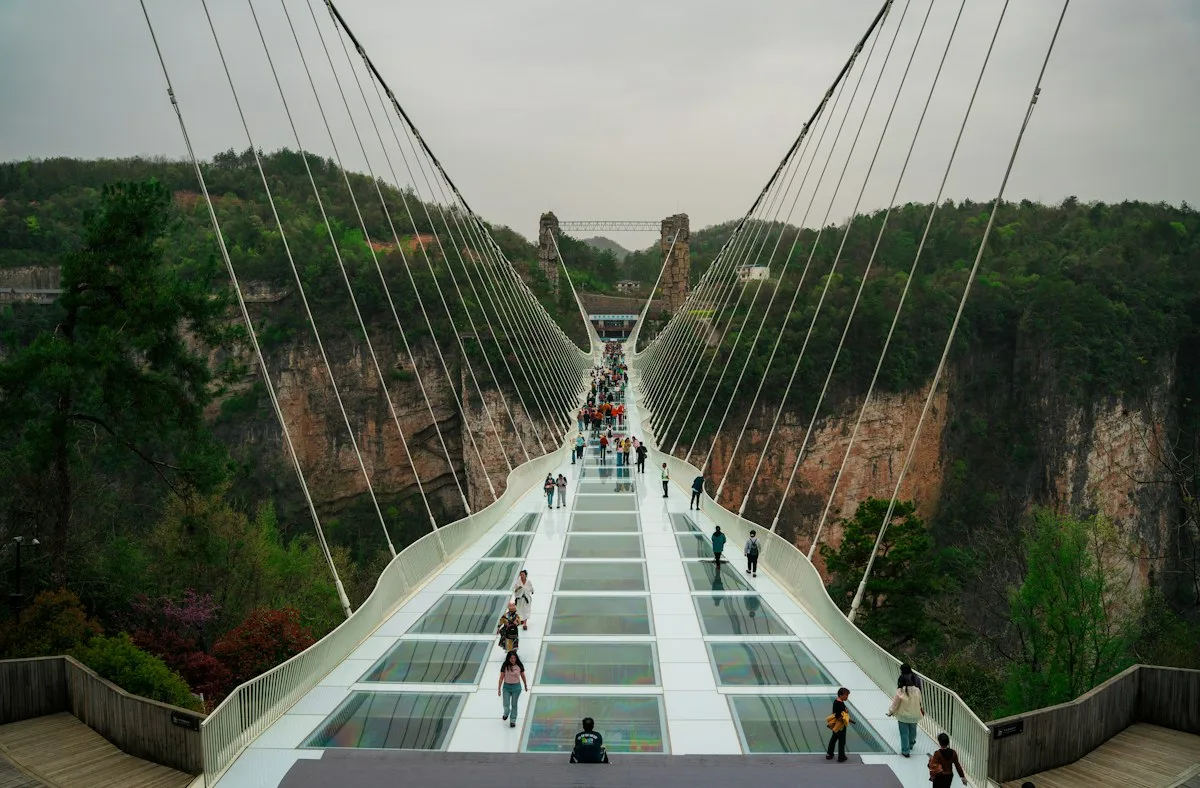
The Zhangjiajie glass bridge is not on Tianmen Mountain, it is not inside the national forest park, and it is not covered by any ticket you have already bought. It is a third, separate park about an hour east of the city, and it has its own booking system, its own daily cap, and its own opening hours.
That single fact causes more wasted days in Zhangjiajie than anything else. If you are still working out how the three areas relate, start with our Zhangjiajie overview and come back.
This piece covers only the Grand Canyon side: what the bridge is, which of the three ticket lines to buy, what the bungee and zipline actually cost, and how to reserve as an international traveler without a Chinese booking app habit. If you have not sorted out payments and a working phone yet, do that first: our first-timer’s guide covers the setup that every Chinese booking system assumes.
What the bridge actually is
The bridge spans a gorge in Cili county, connecting two cliff tops. Haim Dotan, an Israeli architect, designed it, and it opened in August 2016.
| Specification | Figure |
|---|---|
| Main span | 430 m |
| Deck length | 375 m |
| Width | 6 m |
| Height above the gorge floor | about 300 m |
| Glass panels | 99, each a triple layer of tempered laminated glass |
| Design load | 800 people on the deck at once |
| Daily visitor cap | 8,000 |
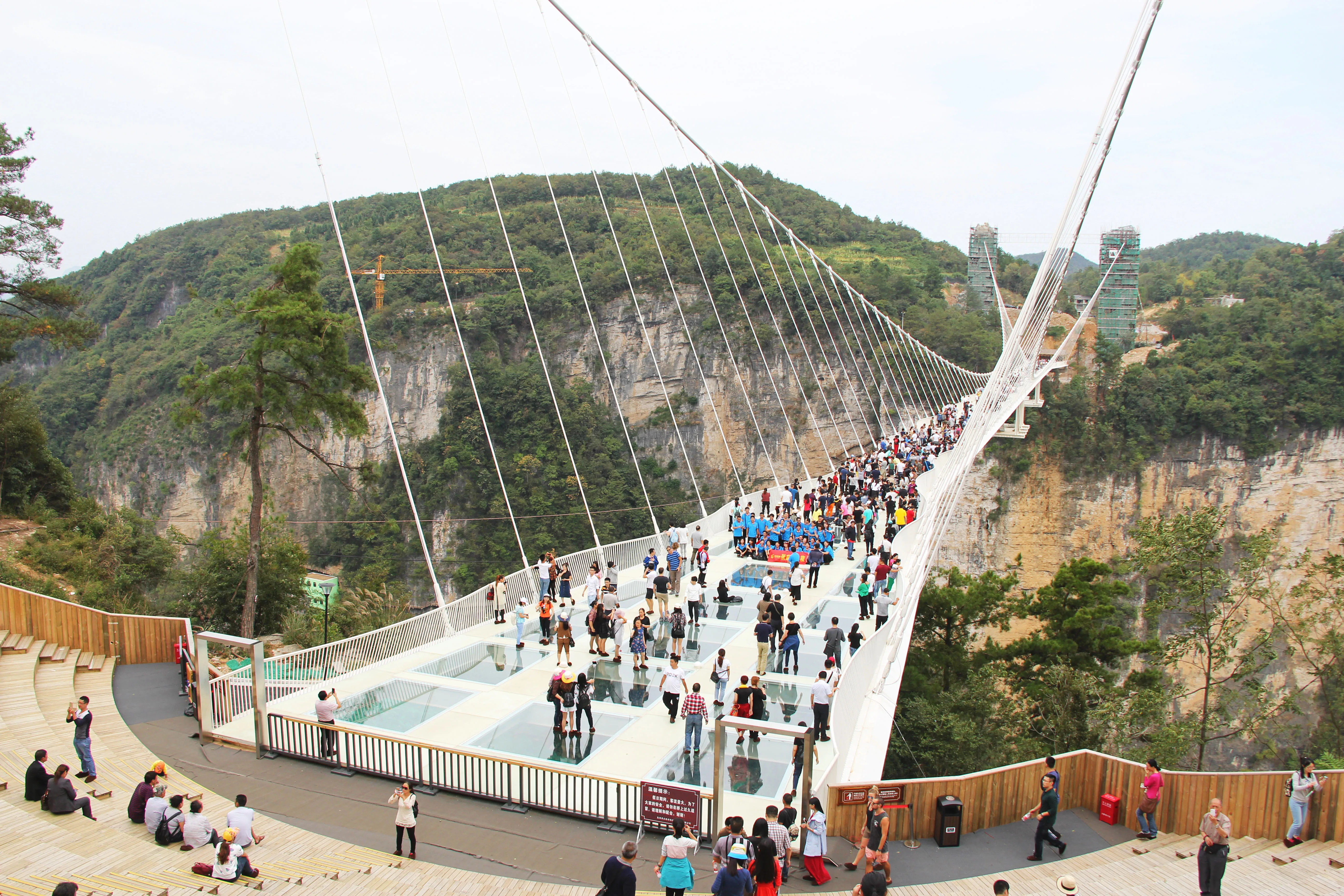
It is a cable-stayed structure rather than a suspension bridge, and at opening it was both the longest and the highest glass-bottomed bridge in the world, picking up ten records in the process.
The record that quietly moved
Almost every English guide still calls this the world’s longest glass bridge. That stopped being true.
A 488 m glass bridge opened in Hebei province in September 2026, and at least one source now places the longest span in Vietnam instead. The length title has moved on. The height is a different story: at roughly 300 m above the valley floor, Zhangjiajie is still widely described as the highest glass-bottomed bridge, though a circular glass bridge over the Fuxi Grand Canyon in Henan sits higher at about 360 m and claims a different category of record.
None of this changes whether the bridge is worth your day. It does mean the line you will read on most websites was written in 2016 and never updated, which tells you something about how carefully those pages are maintained.
Which line to buy
Three lines, three different experiences, and the price gap is wide.
| Line | What you get | Price | Time |
|---|---|---|---|
| A | The canyon only, no bridge. Hiking and the boat | about ¥50, down from a ¥91 list price | 2 hours |
| B | Bridge plus canyon plus the Shenquan Lake boat | ¥219 official, often about ¥178 on booking platforms | 3 to 4 hours |
| C | The bridge only, out and back the same way | ¥128 to ¥141 | about 1 hour |
Roughly nine in ten visitors buy B, and it is the right call unless you are short on time or genuinely only want the bridge. The canyon walk underneath is what makes the day feel like more than a photo stop, and the boat at the end is a genuine rest rather than filler.
Line C exists for people who are passing through or who want the bridge and nothing else. You walk out, you walk back, you leave. There is no shame in it, but you will have spent a two-hour drive each way for an hour on a bridge.
Line A is for hikers and for anyone who has already done the bridge on a previous trip. It skips the glass entirely.
The add-ons, and what they really cost
The bridge is the headline. The activities bolted onto it are where the day gets expensive, and where the published prices disagree with each other more than anywhere else in Zhangjiajie.
Bungee jumping. About 260 m of freefall from the centre of the bridge, run by a commercial operator and billed as one of the highest bungee jumps in the world. The standard price is ¥2,998. Several sources report a promotional rate of ¥1,998 running since 2025. It is never included in any line ticket.
Zipline. A crossing of the gorge, with weight and age limits (roughly 35 to 95 kg, ages 10 to 60). Sources quote wildly different prices, from around ¥50 to several hundred yuan, which is a strong hint that what you get differs by package. Ask at the counter before you commit.
Via ferrata. A clipped-in climbing route on the canyon wall. It is sold as part of a multi-activity combo rather than on its own, and a package of eight activities has been quoted at around ¥120 per person.
Also on site: a slide down the narrow gorge section, a sightseeing elevator, and a VR flight experience. Each is charged separately from the bridge ticket.
None of the add-ons can be booked reliably through English-language platforms. Treat the prices above as planning figures, and expect to settle them at the gate.
Booking it as an international traveler
The booking system is the part that trips people up, so here it is in order.
Reservations are real-name and timed. You book a date and an entry slot against your passport, and the same passport has to be presented at the gate. Bring the physical document, not a photo.
Book one to three days ahead. In peak season the on-site windows routinely have nothing left. The daily cap of 8,000 is split between individual visitors and tour groups, and the individual allocation is the smaller share of the two.
The official channel is the Zhangjiajie Grand Canyon WeChat account, in Chinese, or one of the Chinese booking platforms. English-language platforms such as Trip.com and Klook resell the same tickets at a markup, which is often worth paying for the interface alone. Our guide to setting up WeChat Pay and Alipay covers the payment side, since Chinese booking apps assume a working mobile wallet.
One detail that matters more than it sounds: the on-site ticket window sells discount tickets only. Standard adult tickets are meant to be bought online in advance. Turning up and expecting to buy a normal ticket at the counter is not a plan.
Discounts, if they apply to you: under 14s and over 65s enter free and pay only a small insurance fee. Full-time students and visitors aged 60 to 64 pay half price, which brings line B to roughly ¥110. Documentation has to be original and verified at the window, and discount tickets generally cannot be bought through the online channels.
Getting there
The Grand Canyon is about 60 km east of Zhangjiajie city, in Cili county. Expect 60 to 90 minutes by road, longer in traffic.
Most visitors go by organised shuttle from Wulingyuan or the city, usually bundled with the ticket. Independent travelers take a taxi or a hired car for the day. There is no metro and no convenient public bus route for a first-time visitor.
The practical question is where you are staying. If you are based in Wulingyuan for the forest park, the canyon sits on the far side of the city and eats most of a day. If you are in Zhangjiajie city, it is a straightforward half-day run. Our overview of where to base yourself covers the two options, and the short version is that the canyon pairs badly with a Wulingyuan-only itinerary.
When it closes, and what you cannot bring
Opening hours are 08:00 to 16:00, with ticket sales and entry stopping at 16:00. Crowds build through the late morning, so the 08:00 to 10:00 window is the one to aim for.
The bridge closes in bad weather. Heavy rain, dense fog, or winds above force six will shut it, sometimes for the day and sometimes for an hour. If your itinerary hinges on the bridge, call 0744-8363888 on the morning of your visit to confirm it is operating.
Rules at the gate:
- No selfie sticks and no backpacks on the deck. Free storage is available.
- Non-slip sports shoes only. High heels and slippers get turned away.
- Glass panels are walked on in provided shoe covers in some conditions, bare or with socks in others. Follow what staff tell you on the day.
- If you are afraid of heights, the middle of the deck is the calmest place to stand. The edges are where the glass feels thinnest.
Peak dates make everything worse. If your trip lands on Golden Week or the May holiday, book further ahead and expect the morning slots to vanish first.
Is it worth it
For most people, yes, with one condition: go for the whole B line, not just the bridge.
The bridge itself takes about twenty minutes to cross if you walk slowly, and the sensation is real rather than hyped. But twenty minutes is not a day. What makes the trip work is the canyon underneath, the descent to the water, and the boat at the end. The bridge is the hook; the gorge is the actual visit.
If your Zhangjiajie time is tight, the honest ranking is the forest park first, the canyon second, Tianmen third. The forest park is the reason people fly here. The bridge is a good half-day that happens to be the most photographed structure in Hunan.
Budget for it properly, too. Between the B line, transport, and one add-on activity, you can spend more on this day than on two days in the forest park. Our city-by-city cost comparison puts the numbers in perspective.
Frequently asked questions
Is the glass bridge the same as Tianmen Mountain?
No. The glass bridge spans a gorge in Zhangjiajie Grand Canyon, about 60 km east of the city. Tianmen Mountain’s glass walkways are narrow paths attached to a cliff near the summit, in the city itself. Separate parks, separate tickets, no connection.
How much does the glass bridge cost?
Line B, which includes the bridge, the canyon walk and the Shenquan Lake boat, is ¥219 at the official price or around ¥178 through booking platforms. Line C, the bridge alone, runs ¥128 to ¥141. Line A skips the bridge entirely and costs about ¥50.
Do I need to book in advance?
Yes, and one to three days ahead is the sensible minimum. Entry is real-name and timed against your passport, the park caps visitors at 8,000 a day, and the on-site window sells discount tickets only rather than standard adult tickets.
Is the bungee jump included in the ticket?
No. The bungee is charged separately at ¥2,998, with a promotional rate of ¥1,998 reported since 2025. It is a 260 m jump from the centre of the bridge and is not part of any of the three line tickets.
What happens if it rains?
The bridge closes in heavy rain, dense fog, or strong wind. Call 0744-8363888 on the morning of your visit to check. Light rain is usually fine, and the canyon walk underneath stays open more often than the bridge does.