Xi'an Airport Museum: Booking the Free T5 Museum with a Passport

The museum in the middle of the terminal
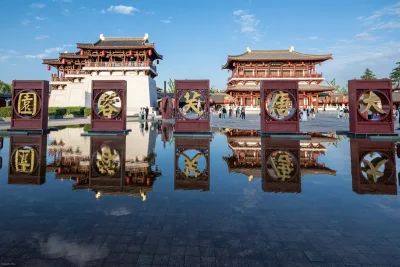
Xi’an Xianyang International Airport opened Terminal 5 on 20 February 2025, a building of 705,500 square metres with a projection-mapped ceiling that runs the length of the departures hall. In the middle of that hall, on the fourth floor, under a lit-up Tang-style pavilion with gold eaves and a bear statue beside it, is a museum. It is called the Western Airport Museum, 西部机场博物馆, and it opened on 26 February 2025, six days after the terminal did.
The collection is not decorative. It is made of objects dug up when the airport was built: 121 of them in the main gallery, ranging from Tang pottery to Song coins, arranged around a single idea, that this flat patch of ground between Xi’an and Xianyang has been a place people passed through for two thousand years. The terminal is the newest layer of that, which is either a nice thought or an architectural joke, depending on how long your queue for security was.
Two details make it unusual, and both are useful. It is free. And it sits on the public side of security, which means you do not need a flight, a boarding pass or even a ticket to walk in.
Free, and outside security
Most airport museums are airside, which makes them a perk for people already trapped in the departure lounge. This one is landside, on the public concourse, and the Xi’an municipal government says so explicitly: visitors without a boarding pass are welcome. That single fact changes who can use it.
If you are arriving in Xi’an and waiting for a train from the station downstairs, you can visit before you leave the airport. If you are seeing someone off, you can visit while they check in. If you have a long connection and no interest in sitting in a lounge for five hours, you can come out through arrivals, spend 40 minutes among the pots, and go back through security. The last one is the genuinely useful case, and it is also the one that requires planning, because you have to clear immigration and customs to get out.
The opening hours are fixed rather than tied to the flight board: 09:00 to 19:00, with the last entry at 18:30. It closes on Mondays, except during statutory holidays, and it closes on Chinese New Year’s Eve. A 23:00 arrival gets nothing. A 22:00 departure connection gets nothing.

Two galleries, and what is actually in them
The museum is small, and it is honest about being small. There are two rooms that need a booking and a public area that does not.
The main gallery, the Four Directions Hall, holds the permanent display of objects excavated during construction, 121 pieces covering the airport site’s long life as a place on the road west. The second room, the Treasure Hall, shows exactly one first-class relic at a time and swaps it every three to six months. That rotation means the single most impressive object in the building is a moving target: exhibitions that English listings still advertise may have closed weeks ago, so check what is currently on before you build a visit around one piece. The temporary exhibitions and the gift shop are open without any reservation at all.
Everything is labelled in Chinese, and the museum lends four-language audio guides covering Chinese, English, Japanese and Russian, with matching four-language display screens. There is a digital docent as well, which is a nice touch if you are travelling with children and a waste of time if you are not.
Give it 40 minutes. Give it an hour if you read every panel and want to watch the ceiling projection change. The scale is the point: it is a small museum with a specific story, not a branch of the Shaanxi History Museum.
Booking it, or not booking it
Here is where most English-language information about this museum is out of date, and where the answer is simpler than the internet suggests.
Booking runs through WeChat, on the official account of the airport group’s travel service. Inside the account, the path is check-in and services, then museum ticket reservation. Slots are released three days ahead and, since early 2026, at 09:00 rather than at midnight, with the day split into three windows: roughly 09:00 to 12:00, 12:00 to 15:00, and 15:00 to 18:30. Each window carries a few hundred tickets, and each room caps the number of people inside it at any one time. If you have a WeChat account and a Chinese payment card this takes two minutes, and if you are in Xi’an for a while it is worth doing. The WeChat wallet guide covers the setup if you have not done it yet.
If you do not have WeChat, and this is the part the English guides miss, you do not need it. The museum’s notices list the passport and the foreign permanent-residence permit among the accepted identity documents, and international visitors are routed to the non-reservation channel, where staff check the original document and let you in. Bring the physical passport, not a photograph of it. Expect a queue of 10 to 30 minutes at busy periods, which for a free museum in a Chinese airport is nothing.
One half-verified shortcut: the notices also mention same-day T5 boarding passes as a route through the non-reservation channel. Sources disagree about whether that covers departures only or arrivals and transfers as well, so treat it as a bonus rather than a plan.

Getting there on Line 14
The metro reaches the museum, which is not true of most airport museums. Line 14 runs from the airport into the city’s north, and the station called Airport (T5) opened on 18 February 2025, two days before the terminal itself. The line’s other airport station, Airport West, serves terminals 1, 2 and 3.
Riding it is straightforward. From Xi’an North railway station, take Line 14 west: the station called Qin’gong is two stops and about 14 minutes away, and Airport (T5) is six stops further on, about 20 minutes past Qin’gong. A full end-to-end run on the line takes about 54 minutes across 18 stations. Trains from Airport (T5) start at 06:04 and the last one leaves at 22:24, with a second branch of the line running later, to 23:22. Headways are short for an airport line: about five and a half minutes at the weekday peak, seven and a half at the weekend peak, and eight and a half off-peak.
Fares are distance-based. Xi’an North to the airport area runs around ¥7 to ¥8, and a trip from the airport into the centre comes in around ¥8 to ¥9. You do not need ID to ride. Ticket machines have an English interface and take cash, WeChat Pay and Alipay, and there is an Alipay transit code if you prefer your phone; the T5 station also has card readers that accept foreign bank cards, which is not something you can assume elsewhere in the system. How mobile payment works in China is worth ten minutes before you fly if you have never set up either app.
The alternatives are slower or dearer. The airport bus costs ¥25, takes 50 minutes to an hour and a half depending on traffic and destination, and cannot be booked online. A taxi or a ride-hailing car into the city centre runs ¥90 to ¥160 and 30 to 60 minutes. On a metro line that costs a tenth of that and does not care about traffic, the train wins unless you are carrying more luggage than you can wheel.
The Qinhan Gallery, two stops away
The reason to think about the airport museum and the Shaanxi History Museum’s Qinhan Gallery as one trip rather than two is that they are on the same metro line, two stops and about 14 minutes apart, and both are free.
The Qinhan Gallery, officially the Shaanxi History Museum (Qinhan Gallery), sits in the Qinhan New City district and covers the Qin and Han dynasties across five halls, in a building laid out as the Big Dipper with a water feature underneath. The objects are the ones you have seen in photographs: paired tiger tallies inlaid with gold, a Han empress’s jade seal, painted goose-and-fish bronze lamps, and a room of gold cakes. It has been reservation-free since October 2025 for individual visitors, and the passport is on the list of accepted documents, so you walk up with your passport and go in.
Getting there is easier than its address suggests. The gallery is 666 metres from the Line 14 station at Qin’gong, which is the official figure, and there is a shuttle from exit A for a yuan or two if you would rather not walk it. The station concourse also has luggage storage, which solves the bag problem for a stopover visit.
Hours change by season, so check before you go. For the long window from 6 May to 14 November 2026 the gallery runs 08:30 to 18:00 with the last entry at 17:00 and no weekly closing day, which is a longer day than most museums in China and a better fit for a morning arrival. Earlier and later windows have used different hours and have reinstated the Tuesday closure, so a guide written for last winter will be wrong now.
If this is your first time in the city, the two-day Xi’an itinerary handles the Terracotta Army and the city wall, and the Xi’an history guide explains what you are looking at once you get there.
Fitting it into a departure day
The structural problem with this museum, and the reason guides get it wrong, is that it is on the wrong side of security for the people most likely to have spare time. If your flight leaves at 15:00 and you want to see both museums, the sequence has to be: Qinhan Gallery first thing in the morning, metro two stops, museum at T5, then security. The gallery opens at 08:30, which gives you roughly two hours there, 20 minutes on the train, and 40 minutes in the airport museum before you need to be at check-in.
That works for a mid-afternoon flight. It does not work for a morning one. Airport guidance is to arrive two hours before departure, T5 closes check-in 40 minutes before, and international airlines advise two and a half to three hours. On a 10:00 flight, one museum is the maximum, and realistically the airport one, because it is in the building you are already standing in.
One practical note on bags. The airport has no self-service lockers, only staffed counters, and the published price regulation is ¥10 per item per day for small bags and ¥15 for the next size up, charged in 24-hour blocks. Terminal 3’s counter is on the second floor of the departures hall. For T5 the reports are thinner and describe a counter on the second floor behind the premium check-in area rather than a signed facility, so treat it as a possibility and call the airport on 029-96788 before you rely on it. Transit passengers with a layover of six to 48 hours can get one bag stored free for 24 hours by booking through the airport group’s mini-program, which is a real benefit and one almost nobody claims.
For the wider picture on flying domestically, the domestic flights guide covers the terminal-by-terminal practicalities, and the Xi’an first-timer guide covers the rest of the city. If this is the start of a longer trip, the two-day itinerary is the better place to begin.
Frequently asked questions
Do you need a boarding pass to visit the museum?
No. The museum is on the landside of Terminal 5, the public side, before security. Anyone can walk in from the check-in hall, and that includes travellers arriving in Xi’an, people meeting a flight, and anyone with a long connection who wants to leave the secure area. You only need the boarding pass if you are trying to visit between security and your gate, which is not where this museum is.
Can you get in with a passport instead of a WeChat reservation?
Yes. The museum’s own notices list the passport and the foreign permanent-residence permit among the accepted documents, and international visitors are directed to the non-reservation channel with the original document for on-site verification. No Chinese ID and no WeChat account required. Expect to queue 10 to 30 minutes at busy times.
How far in advance do reservations open?
Slots are released three days ahead and, since early 2026, at 09:00 rather than at midnight. The day is split into three windows, roughly 09:00 to 12:00, 12:00 to 15:00 and 15:00 to 18:30, with a few hundred tickets in each. If you want a specific window on a weekend, book the moment the slots open.
How much time should you allow?
About 40 minutes for the museum itself. The main gallery is a single floor of airport-excavated objects and the treasure hall holds one piece at a time, so it rewards a short visit rather than a long one. Add 20 minutes if you want to read everything, and add the queue.
Is it worth a special trip to the airport?
No. It is a good museum that happens to be in an airport, not a reason to cross the city. Go if you are flying out of T5, arriving with time to spare, or if you are already combining it with the Shaanxi History Museum’s Qinhan Gallery, which is two stops away on the same metro line.
Can you bring luggage into the museum?
There are no self-service lockers at the airport, only staffed left-luggage counters, so the practical route is to drop your bag first. The counter in Terminal 3 is on the second floor of the departures hall, and travellers report a counter in T5 on the second floor near the premium check-in area. Budget about ¥10 to ¥20 per bag per day and call the airport on 029-96788 to confirm.