Zhangjiajie: Avatar Mountains and the Two Other Parks

Most people arrive in Zhangjiajie with one picture in their head: floating stone pillars in the mist. Then they discover the booking they made is for a place 90 minutes away from the one they wanted.
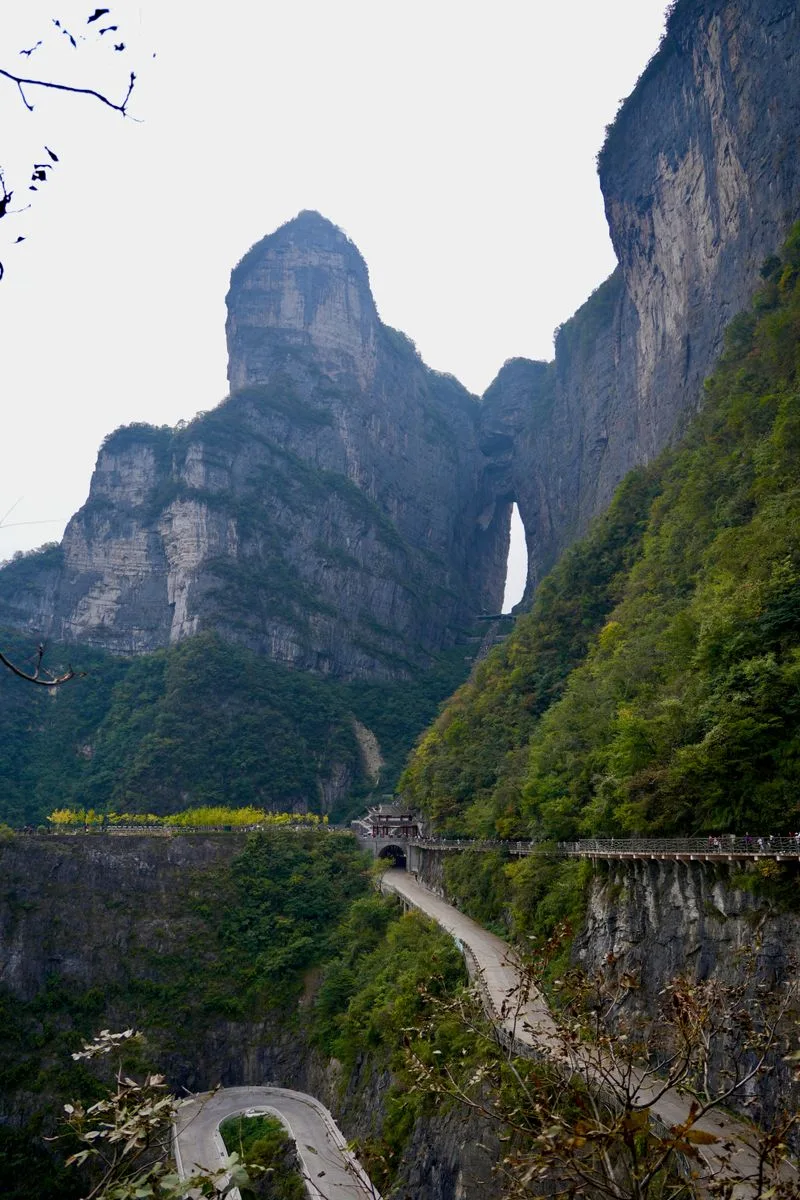
Zhangjiajie is not a park. It is three separate scenic areas with separate tickets, separate entrances, and separate transport. The Avatar mountains sit in one of them. The famous glass bridge is in another. Tianmen Mountain, the one with the cable car and the hole in the rock, is in a third, right beside the city.
Pick the wrong hotel and you will spend your holiday on a bus.
This guide sorts the three out, then covers the parts that actually decide whether the trip works: which area suits you, how many days you need, which base to sleep in, and the entry rules that have turned people away at the gate. It is written for international travelers: no Chinese assumed, no tour group required. If this is your first trip to China at all, start with our first-timer’s guide for visas, payments, and the things that surprise people in week one.
Zhangjiajie is three places, not one
| Area | What it is | Where it is | Time needed |
|---|---|---|---|
| Zhangjiajie National Forest Park (Wulingyuan) | The sandstone pillar forest. Avatar country, the Bailong elevator, Golden Whip Stream | About 30 km north of the city | 2 full days |
| Tianmen Mountain | The 131.5 m natural arch, cliff glass walkways, the cable car from downtown | In Zhangjiajie city itself | Half a day |
| Zhangjiajie Grand Canyon | The 430 m glass-bottom bridge over the gorge, plus bungee, zipline and via ferrata | About 60 km east, near Cili county | Half to full day |
Three separate tickets. Three separate booking systems. The 4-day pass for the forest park does nothing for Tianmen, and the glass bridge is not on Tianmen either. That last one catches out a surprising number of people, because both involve glass and both are in Zhangjiajie.
The two places are also different in kind. The bridge at the Grand Canyon is a structure you walk across, 300 m above the gorge floor. The glass walkways on Tianmen are narrow paths bolted to a cliff face near the summit. Different views, different fear, different ticket.
Which of the three fits your trip
Different travelers want different things here, and the areas are good at different ones.
Classic scenery, first visit, traveling with parents. Base yourself in Wulingyuan and spend both days in the forest park. The Bailong elevator, the Yuanjiajie clifftop path and Tianzi Mountain are all reachable by shuttle bus and cable car, with short walks between them. You do not need to be fit. You do need to start early.
Thrill-seeking. The Grand Canyon is the day for this. Beyond the glass bridge there is a 260 m bungee jump, a zipline across the gorge, and a via ferrata route on the canyon wall. All charged separately, all requiring advance booking. If you want the via ferrata to be the whole day rather than an add-on, Qixing Mountain runs its own clipped-in route with a 168 m ladder, covered in our guide to the Qixing Mountain via ferrata. Tianmen adds the cliff glass walkway and the Ghost Path boardwalk, which some people find worse than the bridge. Tianmen’s own routes have been rewritten while its cableway is rebuilt, so the line you can book depends on the month; our guide to the A, B and C routes covers which one runs.
Hiking and quiet trails. Most visitors never leave the shuttle-bus circuit. Golden Whip Stream at the base of the pillars, the Huangshizhai loop, and the Yangjiajie side, including the Wulong Village climb, are where the crowds thin out. Our guide to the park’s walking trails breaks every route down by distance, step count and how empty it stays. For walking in rural China more generally, our country walk guide covers that.
Evenings. After the gates close, Wulingyuan town and downtown Zhangjiajie both have old-street districts, and large-scale Tujia performances run nightly. Which one you can actually get to depends on which half of the city you are sleeping in, so we put the whole evening question in its own guide, sorted by base.
How many days you need
Two days is the realistic minimum: one for the forest park’s two halves, one for Tianmen. Three days is comfortable and lets you add Golden Whip Stream or the Grand Canyon. Four lets you do all three areas without rushing.
The honest caveats:
- The forest park is far bigger than it looks on a map. People routinely plan one day for it and end up sprinting between shuttle buses. Two days is not padding.
- In the off-season, on a weekday, fit travelers do compress the classic circuit into a single long day. That is a choice, not a recommendation.
- Add a day if you plan to continue to Furong or Fenghuang, both reachable by high-speed train and covered under getting there.
If you are weighing Zhangjiajie against other nature destinations in China, our Jiuzhaigou guide covers the other big park-and-valley trip, and the Yangshuo cycling guide covers the karst-and-river alternative.
Where to sleep: two bases, not one
This is the decision that ruins trips. The three areas are not walkable from each other, and the distances are not small.
| Base | Good for | Getting to the rest |
|---|---|---|
| Zhangjiajie city (downtown) | Tianmen Mountain, airport, train station | 40 minutes to Wulingyuan East Gate by bus or taxi |
| Wulingyuan town | The forest park, both park days | 40 minutes back to the city for Tianmen |
The sensible split for a three-day trip is one night downtown for Tianmen, then two nights in Wulingyuan. If you are only doing the forest park, skip the city entirely and go straight to Wulingyuan from the station.
Wulingyuan town is walkable, has fruit stalls and cheap foot massages, and sits about five minutes from the East Gate. Downtown is a normal Chinese city with better hospitals and easier transport connections. Neither is a resort town.
Staying inside the park is possible but limited and expensive, and you are stuck after the shuttle buses stop.
The entry rules that turn people away
Two rules cause most of the failures, and neither is obvious from the booking sites.
Every entry needs its own reservation. You cannot buy a 4-day pass and walk in four times. Since June 2025 the forest park has run timed, station-specific reservations: the first entry is completed automatically when you book, but days two and three need a fresh slot booked in advance. Arrive outside your slot and the gate rejects you. The park also caps daily visitors, and once the cap is hit for a date, it is hit.
The entrance you book is the entrance you must use. The East Gate runs two lines, and your ticket is bound to the one you selected. People have been refused entry, passports rejected at the turnstile, for turning up at the wrong one. It is not a preference. Check which line your booking says before you travel that morning.
There is one useful relaxation: if you leave and want back in on the same day, re-entry within an hour of your ticket check at the same gate is allowed without a new booking. Past that hour, or at a different gate, book again.
If you do not have a working Chinese phone number or a smartphone that can run the booking mini-program, there is a manual counter option at the gate. This matters more than it sounds: the official channel is a WeChat mini-program that is Chinese-language only. The full booking walkthrough, including which channels work with an international passport, is in our Zhangjiajie tickets and booking guide.
The Avatar mountains themselves

The pillars people come for are in Yuanjiajie, the northwestern part of the forest park. The route along the cliff edge is mostly flat and paved, about two hours at an easy pace, and it holds the three set pieces:
- Hallelujah Mountain, the 1,074 m column known in Chinese as Qiankun Pillar. The best angle is from the left side of Lianxin Bridge. It is mobbed by mid-morning.
- No. 1 Bridge Under Heaven, a natural rock arch connecting two peaks. Walk across it, then photograph it from the far platform.
- Mihuntai (迷魂台), the wide panorama over the pillar field, best when mist is moving through.
Tianzi Mountain, reached by shuttle from Yuanjiajie, has the other big view: Helong Park looks out across the West Sea stone forest, hundreds of peaks to the horizon. Late afternoon light is the reason to time it there.
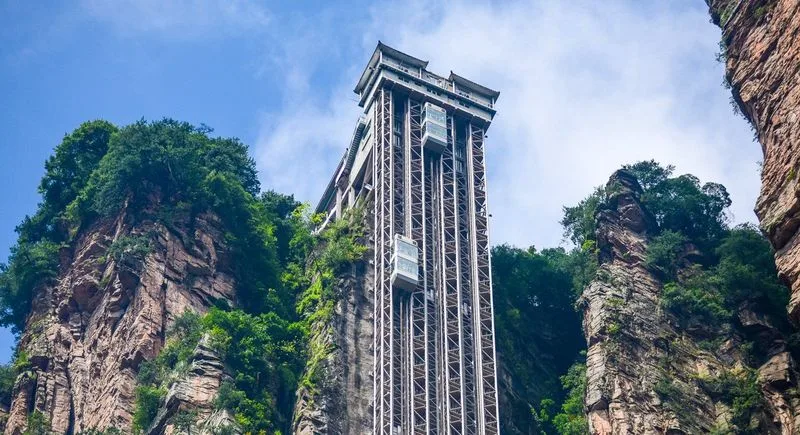
The Bailong elevator is the park’s signature piece of engineering: 326 m up a cliff face in 88 seconds, in a glass shaft. It is also the worst bottleneck in the park. Arrive by 8:30 AM and the wait is under half an hour. Arrive at 10 and it can be two hours. There is a paid queue-skip option at the ticket window.
Below all of it, Golden Whip Stream is a flat 5.7 km walk along the valley floor, looking up at the pillars instead of down from them. Monkeys along the trail are used to people and will go through an open bag. Do not feed them and do not carry food in a visible plastic bag.
Getting there
By air, Zhangjiajie Hehua Airport (DYG) has domestic flights from Beijing, Shanghai, Guangzhou and Chengdu. International connections are limited, so most people connect through a major Chinese city.
By rail, Zhangjiajie West Station connects to Changsha in about two hours, Chongqing in four, and Shanghai in six to seven. From the station it is roughly 20 minutes to downtown, or about 40 minutes to Wulingyuan by direct bus. If Chinese train booking is new to you, our high-speed rail guide covers the passport rules and station flow.

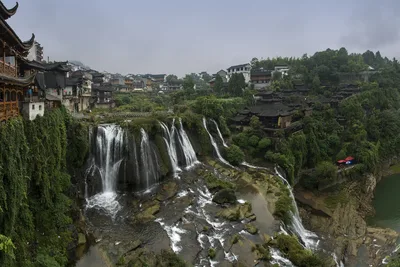
One useful connection most guides bury: Zhangjiajie West to Fenghuang Ancient Town is about 51 minutes by high-speed train, around 20 departures a day, and that service can be booked in English. Furong Town, the waterfall settlement, is 20 to 30 minutes from Zhangjiajie West. Both make a natural extension, and they are different trips, so read up before you decide: Fenghuang is a restored riverside town that is busy and photogenic; Furong is smaller and less visited, and its ticket rules and the “free after 8pm” story are worth knowing before you book. If you would rather string the two together than choose between them, the four-day rail loop through both covers the order, the nights and the connections that decide it. If you have already done the ancient towns of Yunnan, our Dali and Lijiang guide explains what makes the Xiangxi versions different.
Best time to go
| Season | Months | What you get |
|---|---|---|
| Autumn | September to October | The best window. Clear skies, 15 to 25°C, colour in the trees |
| Spring | April to May | Mist, wildflowers, moderate temperatures, more rain |
| Summer | June to August | Hot and humid, afternoon storms, peak domestic crowds |
| Winter | December to February | Cold, occasional snow, some trails and glass walkways close |
Avoid Golden Week (October 1 to 7) and Labor Day (May 1 to 5). The parks hit their visitor caps, and the Bailong elevator queue can reach three to four hours. If your dates are locked and fall in a holiday, our Golden Week survival guide covers how to work around it.
Rain is not automatically a reason to cancel. Mist is what makes the pillars look like the photographs, and wet days empty the trails. You trade visibility for crowds, and plenty of people come away preferring the fog.
What it costs
| Item | Per person (¥) |
|---|---|
| Forest park 4-day pass | 228 peak, about 115 off-peak |
| Tianmen Mountain combo ticket | about 285 |
| Grand Canyon glass bridge line | about 178 to 219 |
| Bailong elevator, one way | about 65 to 72 |
| Cable cars (Tianzi, Yangjiajie, Huangshizhai) | 65 to 76 each |
| Accommodation, 2 nights mid-range | 600 to 1,000 |
| Food, 3 days | 300 to 450 |
| Local transport | 100 to 200 |
A three-day trip at mid-range lands around ¥1,650 to 2,300, roughly $230 to $320. Ticket prices here shift between sources and seasons, so treat these as planning figures and confirm at the gate. Our China trip cost by city guide puts Zhangjiajie in context against the rest of the country.
The Avatar story, corrected
You will read, in a lot of places including this site until recently, that Zhangjiajie is the landscape that inspired Avatar.
That is not what James Cameron said. At the Beijing premiere he credited Huangshan, the granite mountain in Anhui, saying his team photographed it and recreated it in space. Zhangjiajie disputed this on geological grounds, arguing that Huangshan is granite while its own quartz-sandstone pillars match the film’s floating rocks more closely.
What is documented is the aftermath. In January 2010 the local government renamed Qiankun Pillar to Hallelujah Mountain in a public ceremony. It drew heavy criticism, one survey reporting 82 percent opposition, and officials then denied the rename had anything to do with the film.
So the pillars are real, spectacular in their own right, and were famous long before the film. The Avatar connection is a marketing story, not a filming location. If the comparison is what draws you, our Huangshan guide covers the mountain Cameron actually named, and it is worth knowing both.
Practical notes
Language. Park signage is bilingual, staff English is minimal. Download the offline Chinese pack in a translation app before you arrive.
Money. China runs on QR payments. Set up Alipay or WeChat Pay and link a card before you fly, because verification is easier from home. Our comparison of the two covers which to set up first. Carry a few hundred yuan cash for small vendors.
Connectivity. Install a VPN before you land. Once inside China, VPN provider sites are blocked and you cannot download one. Our digital survival guide covers the setup.
Queues. Enter at opening. The same gate that is empty at 7:30 has a 30 to 60 minute line by 9:30. Reversing the circuit, going up by Tianzi cable car first and walking Yuanjiajie in the opposite direction, avoids the worst of it.
Motion sickness. The 99-Bend Road up Tianmen is 99 genuine hairpin turns, and the park shuttle buses run on serpentine roads. Take medication before boarding and sit near the front.
Bathrooms. Western-style toilets exist at the main visitor centers and are rare on trails. Carry tissues.
Steps. Budget 15,000 to 25,000 steps a day. Wear shoes with grip, bring layers because the summit runs 5 to 10°C colder, and carry a power bank.
Frequently asked questions
Is Zhangjiajie one park?
No. It is three separate scenic areas: Zhangjiajie National Forest Park at Wulingyuan, which holds the Avatar mountains; Tianmen Mountain, in the city itself; and Zhangjiajie Grand Canyon, home of the glass bridge. They have separate tickets, separate entrances, and no direct transport between them.
Which area has the Avatar mountains?
Zhangjiajie National Forest Park, in the Wulingyuan district about 30 km north of the city. Within the park, the pillars are concentrated in Yuanjiajie, with the wider pillar field visible from Tianzi Mountain.
How many days do I need in Zhangjiajie?
Two days is the minimum, one for the forest park and one for Tianmen. Three days is comfortable and allows Golden Whip Stream or the Grand Canyon. Four days covers all three areas without rushing.
Is the glass bridge on Tianmen Mountain?
No, and this is the most common mix-up. The Grand Canyon glass bridge is a 430 m bridge over a gorge, about 60 km east of the city. Tianmen Mountain has glass walkways bolted to a cliff near its summit. Different areas, different tickets.
Do I have to book a new time slot for every day in the park?
For the forest park, yes. The first slot is completed automatically when you buy the ticket, but each following day needs its own reservation, made in advance. Within a single day, re-entry at the same gate within an hour of your ticket check does not need a new booking.
What if I cannot use the Chinese booking mini-program?
There is a manual counter option at the park gate for travelers without a working Chinese phone number. Bring your passport, since entry is tied to it, and expect the counter to be slower than the app during peak hours.