China in August 2027: Weather, Crowds and Where to Go

July was the month the heat peaked. August is the month it holds.
Six of the eight cities in the table below are cooler by day than they were in July, but only just. Guangzhou drops a tenth of a degree. Chengdu drops a tenth. Shanghai drops six tenths and keeps its nights at exactly 26.2°C, unchanged from July, which means the delta loses the daytime excuse to stay out and keeps the nighttime problem of sleeping. Kunming, alone, gets warmer.
What actually changes is the rain, and it changes in the opposite direction to July. Beijing loses a third of its July total, Harbin 18 percent, Chengdu 6 percent. Shanghai gains 38 percent and records its wettest month of the year at 225.9 mm, a millimetre more than June. Guangzhou gains 11 percent. The monsoon band that marched north in July comes back to the coast, and the typhoon season arrives behind it.
August is also the month the calendar lies to you. The solar term liqiu, the start of autumn, falls in the first ten days of the month. The thermometer does not agree. Autumn by the almanac, high summer by the pavement.
Every temperature and rainfall figure below is the 1991–2020 climate normal from the China Meteorological Administration. They describe what August usually does, not what it will do in 2027.
What August actually feels like
| City | Average high | Average low | Rain days | The short version |
|---|---|---|---|---|
| Harbin | 26.7°C | 17.4°C | 11.9 | Cooling fast, the best lowland week of summer |
| Beijing | 30.7°C | 22.0°C | 10.5 | Drier than July, still hot, storms turning violent |
| Xi’an | 30.7°C | 20.5°C | 10.4 | The lull before a wet September |
| Lhasa | 22.3°C | 11.1°C | 19.1 | Coolest days in the table, showers most afternoons |
| Chengdu | 29.9°C | 21.7°C | 15.3 | Grey, humid, rain most days |
| Shanghai | 32.6°C | 26.2°C | 12.7 | Wettest month of the year, nights that do not cool |
| Kunming | 25.0°C | 17.2°C | 18.9 | The only city warmer than in July |
| Guangzhou | 33.2°C | 25.5°C | 16.8 | Hottest, wettest, typhoon central |
Rain days means days with at least 0.1 mm of precipitation.
The spread across the eight cities widens to 10.9 degrees by day, from 22.3°C in Lhasa to 33.2°C in Guangzhou, which is larger than July’s 10.0. The country is not cooling evenly. It is separating: the north and the plateau drop away from the peak while the south sits on it.
The night numbers tell you where August is genuinely better than July and where it is not. Harbin loses 1.9 degrees at night, 19.3 to 17.4, the biggest drop in the table, and that is the difference between a sticky night and a night you can sleep with the window open. Xi’an loses 1.2, Beijing 1.0. Shanghai loses nothing. Its nights stay at 26.2°C for the second month running, and Guangzhou’s fall only from 25.8 to 25.5. In the delta and on the Pearl, August is July with more rain.
The rain turns around
Read the two coasts against each other and the month makes sense.
Shanghai goes from 163.2 mm in July to 225.9 mm in August, and from 12.2 rain days to 12.7, the only city in the table where both numbers rise. Guangzhou goes from 242.6 to 270.3 mm. Meanwhile Beijing falls from 169.7 to 113.4 mm and Harbin from 137.0 to 112.7.
The mechanism is the same one that took the rain north in July, running in reverse. The north China flood season known as qixia baxhang, “seven down, eight up”, covers the last third of July and the first third of August. Once that window closes, the main rain band retreats south and east, and the coast takes over. What falls in Shanghai in August is not the steady monsoon soak of June. It is convective: shorter, harder, often in the late afternoon, often with thunder.
The intensity figures are the useful ones. Shanghai takes 225.9 mm across 12.7 wet days, about 18 mm per wet day, the highest rate in the table. Guangzhou is at 16 mm. Lhasa takes 129.8 mm across 19.1 wet days, about 7 mm each, because plateau rain is a brief afternoon shower that clears by four. Same word, four times the water.
That has a practical consequence for packing and for planning. A Shanghai August day is not usually a washout. It is a morning that looks fine, an afternoon that dumps 30 mm in ninety minutes, and an evening that is steamy but dry. Build the day around that shape rather than cancelling it.

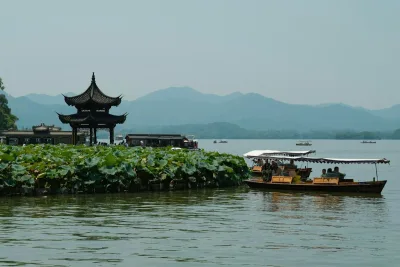
The lotus is the one thing the delta does better in August than in any other month. The ponds at West Lake in Hangzhou, the classical gardens of Suzhou and the water towns between them are at full leaf and full flower, and the crowds that come for it are Chinese families on holiday rather than tour groups. Go at seven in the morning, when the flowers are open and the light is flat, and be gone by eleven. The Jiangnan water towns guide covers which towns have covered walkways for the afternoon storm.
The last of the fu
The sanfu calendar that July introduced ends here. The first fu period begins between 11 and 21 July, and the third ends between 19 and 28 August, so August holds the final stretch and the break.
This matters more than it sounds. The last fu period is the one where the heat stops being a schedule and becomes a countdown. Chinese cities behave accordingly. The sanfutie patches are applied on the first day of each fu period, including the last, and the traditional medicine clinics that were busy in July are busy again. Cold noodle shops keep their summer menu. The evening crowds in parks and on riversides reach their peak of the year, because the flat is unbearable and the street is not.
Then it breaks, usually in the last ten days, and the city changes character within a week. The evening crowds thin. The air conditioning goes off in restaurants. The first maize and early apples appear in markets. It is the most reliable seasonal turn on the Chinese calendar, and it happens while the daytime average is still near 30°C.
For a traveler the reading is the same as July but with an expiry date. Treat the first three weeks as a heat month: start at six, be indoors or in transit from eleven to four, go out again for dinner. Treat the last week as the shoulder: the same sights, fewer people, and a real chance of a comfortable afternoon. The Beijing first-timer guide sets out which sights need the morning slot and which are better after dark.
Typhoons at their peak
August sits at the peak of the northwest Pacific typhoon season, with September close behind. Guangdong, Hainan, Fujian and Zhejiang take most of the landfalls, and the season’s tracks run from the South China Sea up to the East China Sea.
No guide can tell you where the 2027 storms will go, and this one will not pretend. It will tell you what a typhoon does to a trip, which is the part you can plan for. Flights cancel 12 to 24 hours ahead. High-speed trains stop for a day. Ferries to islands are suspended for two or three. Attractions close, including whole mountains. Then the weather comes back, cooler than before, and everything reopens at once.
The planning answer is a buffer, and in August it should be two days rather than one. If your route includes Hainan, Xiamen, Zhoushan or the Guangdong coast, leave two unbooked days at the end and buy flexible transport. If you cannot spare them, move the coast to another month. Inland routes are effectively immune: Yunnan, Sichuan, Gansu, Qinghai and Xinjiang do not get typhoons, only rain.
There is an upside, and it is not small. The two or three days after a typhoon are the clearest of the summer on the coast, with the humidity stripped out and the temperature down five degrees. Travelers who spend August in the south learn to watch the track forecasts the way skiers watch snow reports.
Where August works best
The north and the grasslands
Harbin averages 26.7°C by day and 17.4°C at night in August, which is the coolest lowland combination in the table and the best week of the lowland summer anywhere in the country. It is also the month the northern grasslands are at full height, before the first yellowing at the very end of August.

Hulunbuir, Xilingol and the grassland edges of Gansu and Qinghai are all in their working season: warm days, cold nights, long light, and the herds out. The nights are the thing people underestimate. At 17°C in Harbin and lower on the grassland, a summer sleeping bag is not optional if you are camping, and a fleece is not optional at breakfast.
The trade is that this is peak domestic season. August is when Chinese families take the trip they did not take in July, and the grassland camps, the scenic-area hotels and the trains north all fill. Book the accommodation before the transport, because the transport has more capacity. The Harbin guide explains how different the city is outside January, which is most of the reason to go now.
The plateau
Lhasa averages 22.3°C by day and 11.1°C at night in August, the coolest days of any city in the table, and it is the month the plateau is at its greenest and most reliable for travel. The 19.1 rain days sound alarming. They are not. Plateau rain arrives after lunch, dumps quickly and clears, and the mornings are the clearest of the summer.
Go early in the month if the mountains are the point. By late August the cloud has thickened and the afternoon window has narrowed. The other thing that has not improved is the paperwork: the Tibet permit process is the same as it was in July, and it still needs a guide and a group. The Tibet travel guide has the current sequence.
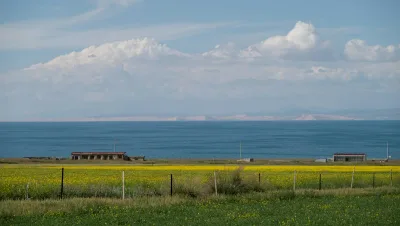
The northwest, Qinghai and Gansu and northern Xinjiang, is still good in August and slightly easier than July. The rapeseed has gone over, which removes the biggest crowd magnet, and the grasslands and the high passes remain open. If you wanted the Qinghai and Gansu loop without the July crush, this is the month.
The southwest
Kunming averages 25.0°C by day and 17.2°C at night in August, two tenths warmer than July and the only city in the table that goes up. It is also the second-wettest city by rain days at 18.9, behind only Lhasa, with 195.9 mm.
That is the wet-season rhythm at its most consistent, and it rewards a slower trip. One base, mornings out, afternoons flexible. Dali, Lijiang and the smaller towns around them are at their greenest, and the rice terraces of Yuanyang are in their densest green before the September turn. The Yunnan first-timer route covers the standard loop and where to cut it when the rain sets in.
Chengdu is the humid version of the same story: 29.9°C by day, 21.7°C at night, 15.3 rain days and 217.1 mm. The teahouse is still the correct response. The Chengdu guide explains where the old ones are.
The delta and the south
Shanghai in August is 32.6°C by day, 26.2°C at night, 12.7 rain days and 225.9 mm, its wettest month of the year. There is no morning window that fixes this, and no evening that cools. The city’s own answer is to move life indoors and later, and yours should be the same: museums and malls at midday, the Bund and the French Concession after eight, one air-conditioned day trip rather than three.
It is still a good city in August if you accept that shape. It is a bad city in August if you have booked walking tours between eleven and four. The Beijing museums guide is written for the capital but the passport booking mechanics apply to Shanghai’s museums too, and the indoor option is what makes the month work.
Guangzhou is hotter at 33.2°C, the highest daytime average in the table, with 270.3 mm of rain and typhoon risk on top. Unless you have family or business there, August is the month to skip it. Hainan is hotter again and out of season: the island’s beach season is winter and spring, and August is its wet, sticky low point. The Sanya guide explains why the peak is January.
The crowd calendar
August 2027 has no public holiday. The State Council calendar published on 5 November 2026 leaves the month empty, with the nearest public holidays being Dragon Boat on 9 June and Mid-Autumn on 15 September.
That does not make it quiet, because the school summer break does the work a holiday would do. Chinese schools close in the first week of July and reopen at the end of August, and the dates are set province by province rather than nationally. Family travel fills the gap, and the third week of August is the peak inside the peak, when every family that has not travelled yet travels at once.
What that means in practice:
Rail tickets go on sale 15 days before departure, usually around 2 PM Beijing time, and popular August routes sell out within minutes. Set an alarm and book the day the window opens. The high-speed rail guide has the mechanics.
Restricted sites release further ahead. Mogao Caves A-class tickets open 30 days before the visit date and vanish fast. The Forbidden City and the national museums run on passport booking with daily quotas.
The last week of August is the turn, and it is the single most valuable week of the Chinese summer for anyone with flexible dates. Schools reopen, family trips end, hotel rates in scenic areas drop, and the weather is between the August heat and the September rains. If you can move a trip by one week, move it later.
What August does not do
It does not cool the delta at night. Shanghai’s average low is 26.2°C for the second month running. If you are going for the heat to break, the calendar will disappoint you until September.
It does not end the rain in the south. August is Shanghai’s wettest month of the year. The rain gets shorter and harder, not rarer.
It does not bring autumn colour, whatever liqiu says. The northern forests turn in late September. The grasslands begin to yellow at the very end of August and are properly gold in September.
It does not guarantee a mountain view. The plateau and the southwest are in cloud for much of the month, and a view day is a gamble rather than a plan. Build in two nights at altitude if the view is the point.
It does not make the coast cheap. Typhoon season keeps some travelers away and does not lower the prices of the ones who come.
The visa question
The 30-day visa-free scheme for 50 countries runs only to 31 December 2026. As of late November 2026 the foreign ministry had announced no extension, saying only that the policy was under study. Unless that changes, an August 2027 arrival needs a visa.
The exceptions are narrow. Russian passport holders travel under a bilateral arrangement extended to 31 December 2027, and Brunei’s arrangement has no stated end date. Everyone else is back to a tourist visa, a 240-hour transit if they are passing through to a third country, or Hainan’s island-only entry.
August is a bad month to discover this. Summer appointment slots at visa centres in Europe and North America fill by spring, and a late appointment is the most common reason an August trip becomes an October one. The visa-free entry guide tracks the country list and any renewal, and the application guide covers the paperwork.
Who August suits
It suits families, because the school calendar leaves no choice and the north is genuinely good with children in August. It suits grassland and plateau travelers, who get the best conditions of the year. It suits anyone who can take the last week of the month, when the crowds leave and the weather is still summer.
It does not suit anyone who wants a dry, cool south, a guaranteed mountain view or a cheap beach. It does not suit a plan built on walking tours between eleven and four, and it does not suit an itinerary that needs every coastal connection to run on time.
Pack for heat, sun and rain in the same bag: a light shell, sunscreen for the plateau, shoes that grip wet stone, a fleece for grassland mornings and a layer for Lhasa’s 11.1°C nights. The packing guide has the seasonal version.
The honest summary: August is July with the rain moved back to the coast and the clock running down. The north and the plateau improve week by week, the delta and the south stay locked in the same heat with more water, and the last ten days are the best value in the Chinese summer. The July guide explains how the month got here, and the holiday calendar shows why an empty month is still an expensive one.
Frequently asked questions
Is August a good time to visit China?
It is the second-best summer month for the north and the plateau, and the worst month of the year for the lower Yangtze. August keeps most of July’s heat but moves the rain back to the coast: Beijing loses a third of its July rainfall while Shanghai gains 38 percent and records its wettest month of the year. The typhoon season is at its peak, and Chinese schools are still on holiday until the end of the month. Go north, west or high, and it works. Stay in the delta and you get 32.6°C days with nights that never drop below 26°C.
What is the weather like in China in August?
In the 1991–2020 normals, average daily highs run from 22.3°C in Lhasa to 33.2°C in Guangzhou. Beijing averages 30.7°C by day and 22.0°C at night, Shanghai 32.6°C and 26.2°C, Xi’an 30.7°C and 20.5°C, Chengdu 29.9°C and 21.7°C, Harbin 26.7°C and 17.4°C, Kunming 25.0°C and 17.2°C. Rain moves south again: Shanghai takes 225.9 mm over 12.7 days and Guangzhou 270.3 mm, while Beijing falls to 113.4 mm and Harbin to 112.7 mm.
What are the fu days and when do they end?
Sanfu, the three fu periods, is the heat calendar Chinese almanacs count from the summer solstice. The first period starts between 11 and 21 July and the third ends between 19 and 28 August, so August holds the tail of it. The final period is the one that breaks. Nothing closes and no one gets a day off, but the middle of the day stays unusable until the fu ends, which is why Chinese cities schedule outdoor life for the early morning and the evening.
Is August crowded in China?
Yes, for the first three weeks. August 2027 has no public holiday, but the school summer break runs to the end of the month, and family travel keeps trains, sights and hotels full until it ends. The last week of August is the turn: schools reopen, prices soften and the big sights become walkable again. Book rail tickets when the 15-day window opens and restricted sites such as the Mogao Caves 30 days ahead.
Where should I go in China in August?
The northeast and the northern grasslands first, where Harbin averages 26.7°C by day. The Tibetan plateau is at its coolest of the summer at 22.3°C, and Kunming is the only city in this guide that gets warmer than in July, at 25.0°C. The northwest stays good but begins to dry out. Avoid the Yangtze delta and the south coast if you can, and if you cannot, treat August as an evening city month and leave two spare days for a typhoon.
Can I enter China visa-free in August 2027?
Not under the 30-day scheme unless it has been renewed. The arrangement covering 50 countries runs only to 31 December 2026, and as of late November 2026 no extension had been announced. Russian passport holders are covered to 31 December 2027 under a bilateral deal, and Brunei’s arrangement has no stated end date. Everyone else needs a tourist visa, a 240-hour transit or Hainan’s island-only entry.