China in September: Weather, Crowds and Where to Go

August was the month the heat held. September is the month the country comes apart.
Take the eight cities in the table below and the spread of average daytime highs is exactly what it was in August: 10.9 degrees, from Lhasa at 21.1°C to Guangzhou at 32.0°C. That flat number hides the sharpest divergence of the year. Guangzhou loses 1.2 degrees of daytime heat. Harbin loses 5.1, Xi’an 5.3. The same national spread, arrived at from opposite directions.
The rain does something similar. Six of the eight cities dry out by a third or more, Beijing by 53 percent and Harbin by 54. And then there is Xi’an, 21 percent wetter than in August, in what is its rainiest month of the entire year.
September 2027 also has the strangest holiday shape of the twelve. Mid-Autumn falls on Wednesday 15 September, one day off, no bridge. The State Council calendar published on 5 November 2026 then makes Sunday 26 September a working day to pay for Golden Week, which runs 1 to 7 October. The month ends with a working Sunday and the busiest week in China sitting just past the horizon.
Every temperature and rainfall figure below is the 1991–2020 climate normal from the China Meteorological Administration. They describe what September usually does, not what it will do in 2027.
What September actually feels like
| City | Average high | Average low | Rain days | The short version |
|---|---|---|---|---|
| Harbin | 21.6°C | 10.2°C | 9.1 | The best month this city gets |
| Beijing | 26.5°C | 16.3°C | 7.1 | Dry, clear, the year’s most walkable weeks |
| Xi’an | 25.4°C | 15.8°C | 12.3 | Wettest month of the year, by both measures |
| Lhasa | 21.1°C | 9.3°C | 13.5 | Cool, clear mornings, the season closing |
| Chengdu | 25.7°C | 18.9°C | 15.8 | More rainy days than August, half the water |
| Shanghai | 28.7°C | 22.5°C | 10.1 | Finally sleeps, still warm, hot days can return |
| Kunming | 23.5°C | 15.7°C | 13.9 | The rain eases without stopping |
| Guangzhou | 32.0°C | 24.2°C | 12.0 | Still the hottest city in the table |
Rain days means days with at least 0.1 mm of precipitation.
In August one city got warmer than the month before, Kunming by two tenths of a degree. In September, none does. Every one of the eight loses ground by day and by night, and the losses are wildly uneven: Lhasa and Guangzhou each shed 1.2 degrees of daytime heat, while Xi’an sheds 5.3 and Harbin 5.1.
That is the useful way to read the month. September is not one season arriving everywhere at once. It is a line moving south, and where you are decides whether you get the best weather of the year or four more weeks of summer.
Shanghai is the clearest case. Its average low falls from 26.2°C to 22.5°C, the first real drop since May, and its rain days fall from 12.7 to 10.1. The city stops being a place you survive between air-conditioned rooms and becomes a place you walk again. Beijing goes further: 26.5°C by day, 16.3°C at night, 7.1 rain days and 53.7 mm, making September its driest month since April and, by most measures, its best month of the year.
The rain moves west
Xi’an is the anomaly and the story.
The city takes 117.2 mm in September across 12.3 wet days. Both numbers are higher than July, when it takes 103.8 mm over 10.8 days, and higher than August, at 96.7 mm over 10.4. September is Xi’an’s wettest month of the year by volume and by frequency, which is not what anyone expects of a city at the edge of the loess plateau.
The mechanism has a name: huaxi qiuyu, the autumn rain of western China. As the summer monsoon retreats, weak cold air pushing down from the north meets warm, moist air still coming up from the south, and neither displaces the other. The result is not the short violent storm of an August afternoon. It is rain that settles in for two or three days, stops, and comes back. The season typically begins in early September and can run into late October, which is why the same city that looks dry in every photograph is grey for a sixth of the year.
Chengdu runs a quieter version of the same pattern, and the split between its two rain measures is worth knowing. Its rain days rise slightly, from 15.3 in August to 15.8, the most of any city in the table. Its rainfall falls by 44 percent, from 217.1 mm to 120.8 mm. More days, half the water. That is drizzle, not downpour, and it changes what you pack: shoes that survive hours of wet pavement matter more than a storm shell.
Everywhere else the direction is the opposite one. Beijing halves its rainfall to 53.7 mm and drops 3.4 rain days. Harbin halves to 52.3 mm. Lhasa halves to 64.8 mm and loses 5.6 rain days, the largest fall in the table. Shanghai goes from 225.9 mm to 131.5 mm, Guangzhou from 270.3 to 203.2, Kunming from 195.9 to 119.3.
The intensity numbers separate the survivors. Guangzhou takes 16.9 mm per wet day and Shanghai 13.0, so a wet day in the south is still a soaking. Beijing is at 7.6, Harbin 5.7 and Lhasa 4.8, where rain remains a brief afternoon interruption that clears before dinner. If you are choosing between Beijing and Guangzhou in the same week, this is the number that decides it.
The nights fall first
In the north, the nights give way before the days do.
Harbin’s average low drops 7.2 degrees, from 17.4°C to 10.2°C, the largest single fall in the table. Its daytime high drops 5.1. Beijing loses 5.7 at night against 4.2 by day, and Lhasa 1.8 against 1.2. The mechanism is the same one that makes desert nights cold: the air dries as it cools, the cloud clears, and whatever heat the ground collected during the day radiates straight back out after dark.
Two cities break the rule, and both break it for the same reason. Xi’an’s day falls 5.3 degrees while its night falls only 4.7, and Chengdu’s day falls 4.2 against 2.8 at night. Cloud from the western autumn rain keeps the nights up while cutting the days down. The result is a narrower daily range and a month that feels damp rather than crisp, which is exactly what the Wei River valley and the Sichuan basin deliver in September.
For packing, the practical consequences are concrete. Harbin’s municipal heating does not come on until 20 October, so late September flats and hotel rooms are unheated, and a 10.2°C night outside can feel colder than the number suggests indoors. Bring a mid-layer you would wear at home in October. Lhasa at 9.3°C is the city figure; anywhere above 4,000 metres on the plateau, September nights go below freezing and a proper jacket stops being optional. Guangzhou at 24.2°C is still air-conditioning weather.
Typhoons: the last busy month
The northwest Pacific season does not end with August. September is still core season on the south coast, and landfalls can run into early October.
Autumn storms behave differently from summer ones. Many form further east and recurve, which makes their track harder to call: one year they run into Fujian and Zhejiang, the next they turn north and miss the mainland entirely. No guide can tell you which 2027 will be, and this one will not pretend.
What a typhoon does to a trip is predictable, and that is the part worth planning. Flights cancel 12 to 24 hours ahead. High-speed trains stop for a day or more. Ferries to islands such as Zhoushan and Weizhou suspend for two or three. Attractions close, sometimes whole mountains. Then the weather returns, cooler and clearer than before, and everything reopens at once.
If your route includes the Guangdong coast, Hainan, Xiamen or Zhejiang, leave two unbooked days at the end and buy flexible transport. Inland routes are effectively immune: Yunnan, Sichuan, Gansu, Qinghai and Xinjiang do not get typhoons, only rain.
Where September works best
The northeast and the grasslands
Harbin averages 21.6°C by day and 10.2°C at night in September. It is the best month the city has, better than the icy one it is famous for, and the locals use it accordingly: the riverside fills at weekends, the beer gardens stay open late, and the old streets are walkable without the January cold that makes twenty minutes outdoors a calculation.

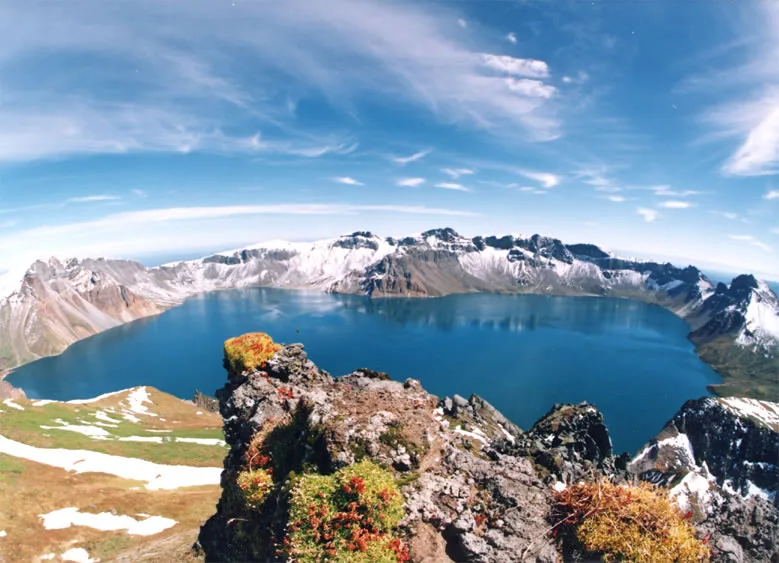
Changbai Mountain, on the Korean border, is at its most reliable in the first half of the month. The alpine tundra turns red and yellow, the summit gets its first snow, and the crater lake is as likely to be clear as at any point in the year. Go early: by the end of September the summit road closes on bad-weather days with little warning. The Harbin guide covers a city most visitors only see in January, and it is a different place in this month.
The northern grasslands turn in the second half of September. Hulunbuir goes from green to gold over about two weeks, the herds are moved to autumn pasture, and the camps that were full in August empty out. Nights on the grassland drop close to freezing by the end of the month.
The northwest and the plateau
Lhasa averages 21.1°C by day and 9.3°C at night, with 13.5 rain days but only 64.8 mm, which tells you the rain is short. The mornings are the clearest of the season, and the afternoon cloud that ruined views in July and August starts to break up.
The permit process has not changed: Tibet still needs a guide, a group and an advance permit, and the Tibet travel guide has the current sequence. What has changed is the temperature at altitude. If your route crosses a 5,000-metre pass, September is the last month it is comfortable rather than a test.
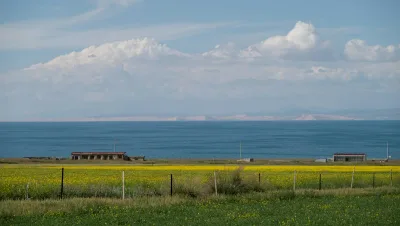
The Qinghai and Gansu loop has its last good window now. The rapeseed is long gone, the crowds have thinned, and the high passes stay open, though the nights at Qinghai Lake are close to zero by late September.
Xinjiang is where September earns its reputation. The birch and larch around Kanas and Hemu turn from the middle of the month, and the last ten days are the busiest two weeks those villages see all year. Book accommodation before transport, because the beds run out first.
The southwest
Kunming averages 23.5°C by day and 15.7°C at night, with 13.9 rain days and 119.3 mm. The wet season is easing rather than over, so the pattern is one dry morning, one wet afternoon, repeat. Dali, Lijiang and the smaller towns around them are green and quiet after the summer families leave. The Yunnan first-timer route covers the standard loop and where to cut it when the rain sets in.
Chengdu is the damp version at 25.7°C and 18.9°C, with the drizzle described above. The teahouse remains the correct response, and the Chengdu guide explains where the old ones are.
One correction worth making: the famous Sichuan autumn colour at Jiuzhaigou and Huanglong is an October event, not a September one. Going in the first week of September gets you green forest and full water, which is pleasant but not what the photographs promised.
The delta and the south
Shanghai averages 28.7°C by day and 22.5°C at night, with 10.1 rain days. It is still warm and occasionally hot, since a late spell of autumn heat can push the city back over 30°C in the first half of the month, but the nights finally cool enough to sleep. This is the best month in the delta since May, and the classical gardens and water towns are pleasant again. The Jiangnan water towns guide covers which ones handle a wet afternoon best.
Guangzhou is a different country. At 32.0°C by day and 24.2°C at night it is the hottest city in the table, it is still in typhoon season, and it takes 203.2 mm of rain. Unless you have family or business there, September is not the month to choose it. If you go anyway, treat it as an evening city: mornings and late nights outside, the middle of the day indoors.
Hainan is out of season. The island’s beach window is winter and spring, and September is hot, wet and at the tail of the typhoon track. The Sanya guide explains why the peak is January.
The crowd calendar
September is two months wearing one name.
The first half is quiet. Schools reopen around 1 September in most provinces, family travel stops within a week, and the period from 1 to 13 September is the cheapest stretch of the autumn: flights soften, scenic-area hotels drop back to normal rates and the big sights are walkable. If you have flexible dates and want the north at its best without the crowds, this is the window.
Mid-Autumn falls on Wednesday 15 September 2027, with one day off and no adjusted weekend. That single midweek day is unusual. In most years the festival creates a three-day break, and in 2026 it ran from Friday 25 to Sunday 27 September. In 2027 the effect is a short local bump on 14 to 16 September rather than a national travel wave. Mooncakes are the visible part of it: boxes appear in shops about a month before, sell at full price until the festival, and are discounted hard the day after. The festival guide covers the customs, the moon-viewing spots and which mooncakes are worth the money.
Then the calendar turns strange. Sunday 26 September 2027 is a working day, one of the make-up days that pays for Golden Week, and Saturday 9 October is another. So the weekend of 25 and 26 September is half lost for most of the country, and the last week of the month is quieter on the ground than you would expect for late September.
Do not mistake that for cheap. Prices start climbing from about 28 September as the Golden Week outflow begins, and the peak lands on 1 October. Golden Week itself runs 1 to 7 October. The month ends with the country holding its breath.
Two bookings decide whether the month works. Rail tickets go on sale 15 days before departure, usually around 2 PM Beijing time, so a 1 October train opens on 17 September and sells out in minutes on the popular routes. The high-speed rail guide has the mechanics. Restricted sites release further ahead: Mogao Caves A-class tickets open 30 days before the visit, and the Forbidden City and national museums run passport booking against daily quotas. The holiday calendar guide sets out the full 2027 schedule, including the two working weekends.
What September does not do
It does not cool the far south. Guangzhou loses 1.2 degrees of daytime heat and keeps nights at 24.2°C. If you are going to Guangdong for autumn, you are going a month early.
It does not bring peak autumn colour. The north turns in the second half of the month, but the full show, in Beijing’s hills, in Sichuan and along the Yangtze, is October. September is the start of the season, not its middle.
It does not end typhoons. September is still core season on the south coast, and the last landfalls can come in early October.
It does not dry out the west. Xi’an has its wettest month of the year, and Chengdu has more rainy days than in August. A western route in September needs a rain plan, not a rain hope.
It does not give you a long weekend for Mid-Autumn. In 2027 the festival is a single Wednesday, and the make-up day falls on 26 September.
It does not clear the plateau on demand. Lhasa’s mornings are the clearest of the season, but afternoon cloud is still normal and a view day is a gamble rather than a plan.
The visa question
The 30-day visa-free scheme for 50 countries runs only to 31 December 2026. As of late November 2026 the foreign ministry had announced no extension, saying only that the policy was under study. Unless that changes, a September 2027 arrival needs a visa.
The exceptions are narrow. Russian passport holders travel under a bilateral arrangement extended to 31 December 2027, and Brunei’s arrangement has no stated end date. Everyone else is back to a tourist visa, a 240-hour transit if they are passing through to a third country, or Hainan’s island-only entry.
September is a better month than August to discover this, but not by much. Visa appointment slots in Europe and North America fill months ahead in the summer, and a September trip booked in June may not get an appointment before departure. The visa-free entry guide tracks the country list and any renewal, and the application guide covers the paperwork.
Who September suits
It suits anyone going north or high. Harbin, Beijing, Changbai, the grasslands, Lhasa, Qinghai and Xinjiang are all at or near their best, and the difference between September and August in these places is not marginal: it is the difference between managing the heat and not thinking about it.
It suits walkers and city travellers, because Beijing and Shanghai both stop being endurance tests. It suits photographers chasing the first colour in the north and anyone with flexible dates who can take the first two weeks before prices move.
It does not suit beach holidays, since Hainan is out of season and the south coast is still hot and wet. It does not suit anyone who wants peak autumn colour, which is an October trip. It does not suit a plan that needs the far south to be cool, or one that ends in the last week of September and expects low prices.
Pack for two seasons in one bag: a light shell for the western rain, a mid-layer for Harbin’s 10.2°C nights and unheated rooms, sunscreen and a warm hat for the plateau, and shoes that handle wet pavement. The packing guide has the seasonal version.
The honest summary: September is the month the country separates, and where you stand decides which half you get. The north and the plateau improve every week, the delta becomes livable again, the far south does not change, and the west gets wet. The first two weeks are the value; the last week is the runway to Golden Week. The August guide explains how the heat got here, and the holiday calendar shows why a month with one Wednesday off still ends in the most expensive week of the year.
Frequently asked questions
Is September a good time to visit China?
It is the best month of the year for Beijing and Harbin and the first comfortable month on the Yangtze delta since May, but it is not a uniform improvement. Guangzhou loses only 1.2°C of daytime heat and keeps 24.2°C nights, while Harbin and Xi’an drop more than five degrees by day. The rain retreats almost everywhere except the Wei River valley, where Xi’an records its wettest month of the year. Go north, west or high, and September is the payoff. Go to the far south expecting autumn and you get August with a school term starting.
What is the weather like in China in September?
In the 1991–2020 normals, average daily highs run from 21.1°C in Lhasa to 32.0°C in Guangzhou. Beijing averages 26.5°C by day and 16.3°C at night, Shanghai 28.7°C and 22.5°C, Xi’an 25.4°C and 15.8°C, Chengdu 25.7°C and 18.9°C, Harbin 21.6°C and 10.2°C, Kunming 23.5°C and 15.7°C. Rain falls almost everywhere: Beijing drops from 113.4 mm to 53.7 mm and Harbin from 112.7 mm to 52.3 mm, while Xi’an rises from 96.7 mm to 117.2 mm across 12.3 wet days, its wettest month of the year.
When is Mid-Autumn Festival in 2027 and is it a holiday?
Mid-Autumn falls on Wednesday 15 September 2027, and the State Council calendar published on 5 November 2026 gives it one day off with no bridge and no adjusted weekend. That is unusual: in most years the festival creates a three-day weekend, and in 2026 it ran from 25 to 27 September. Expect short local trips on 14 to 16 September rather than a national travel wave, and expect mooncake gift boxes to be discounted sharply from 16 September.
Is September crowded in China?
Less than August for the first two weeks, then more. Schools reopen around 1 September, family travel stops, and the first half of the month is the cheapest stretch of the autumn. Mid-Autumn on 15 September produces a one-day bump. Sunday 26 September is a working day, so the last weekend of the month is half lost, but from about 28 September the Golden Week outflow begins and prices climb to the 1 October peak. Book rail tickets 15 days ahead, which means 17 September for a 1 October departure.
Where should I go in China in September?
Harbin and the northeast first, at 21.6°C by day and 10.2°C at night, the best month that region gets. Beijing is dry and clear at 26.5°C, its most walkable month of the year. Lhasa and the plateau are cooling but still open, with clear mornings and 64.8 mm of rain. The grasslands turn gold in the second half of the month and the first autumn colour appears in Xinjiang and the northeast. Skip Hainan, which is out of season, and treat Guangzhou as a city for evenings.
Can I enter China visa-free in September 2027?
Not under the 30-day scheme unless it has been renewed. The arrangement covering 50 countries runs only to 31 December 2026, and as of late November 2026 no extension had been announced. Russian passport holders are covered to 31 December 2027 under a bilateral deal, and Brunei’s arrangement has no stated end date. Everyone else needs a tourist visa, a 240-hour transit or Hainan’s island-only entry, and visa appointment slots in Europe and North America fill months ahead.