Inside a Chinese Shopping Mall: What Surprises First-Time Visitors
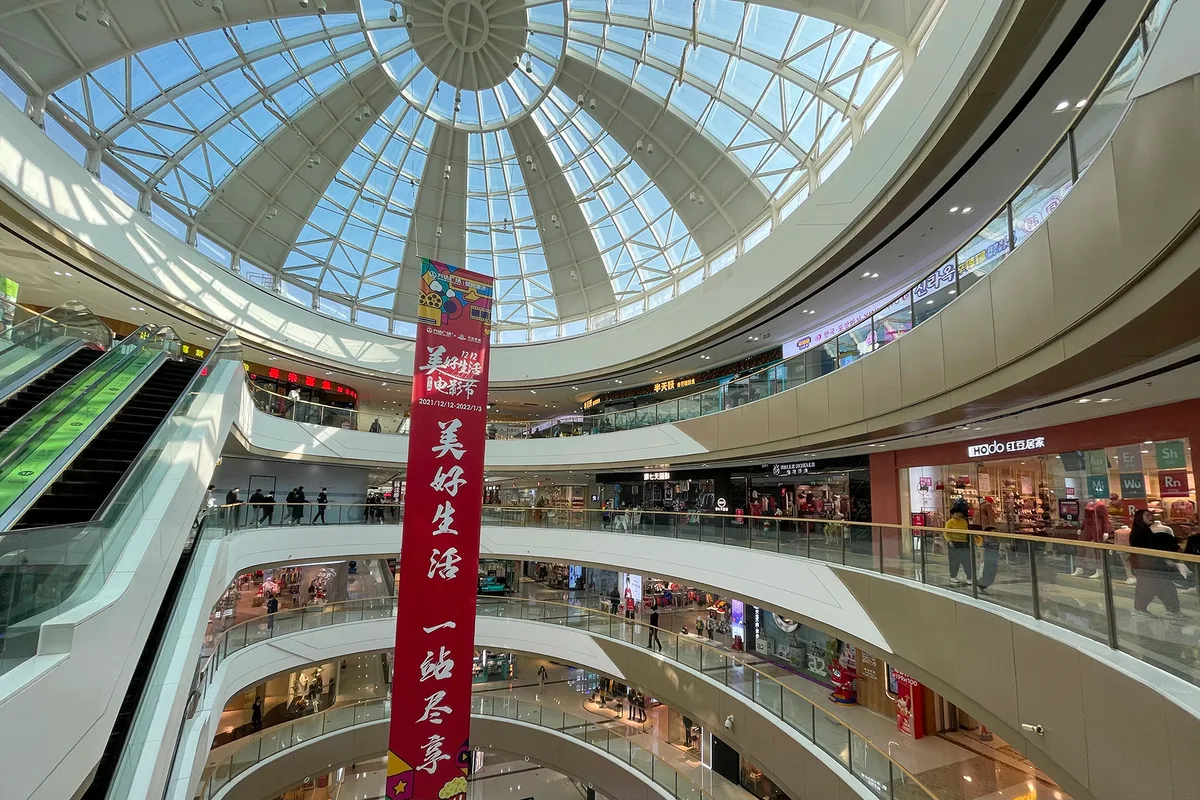
The building is upside down
Walk into a large Chinese mall and the first thing to understand is that you have entered at the middle. The real ground floor is below you.
Chinese malls stack themselves in a reliable order. Basements B1 and B2 hold the metro connection, a supermarket, and a snack street of small counters selling noodles, dumplings, skewers and milk tea. Above ground the floors climb through fashion and beauty, then children’s classes and play areas, and finish at the top with the restaurant cluster and the cinema. The logic is deliberate. Dining and film are placed high so that you have to walk past everything else to reach them.
That has made the basement the most valuable floor in the building rather than the cheapest. Chinese retail analysis calls it the money floor: lower rent, heavy metro footfall, and a mix of snacks, bubble tea, trendy goods and discount grocery that turns over fast. In plenty of malls the basement is busier than everything above it combined.
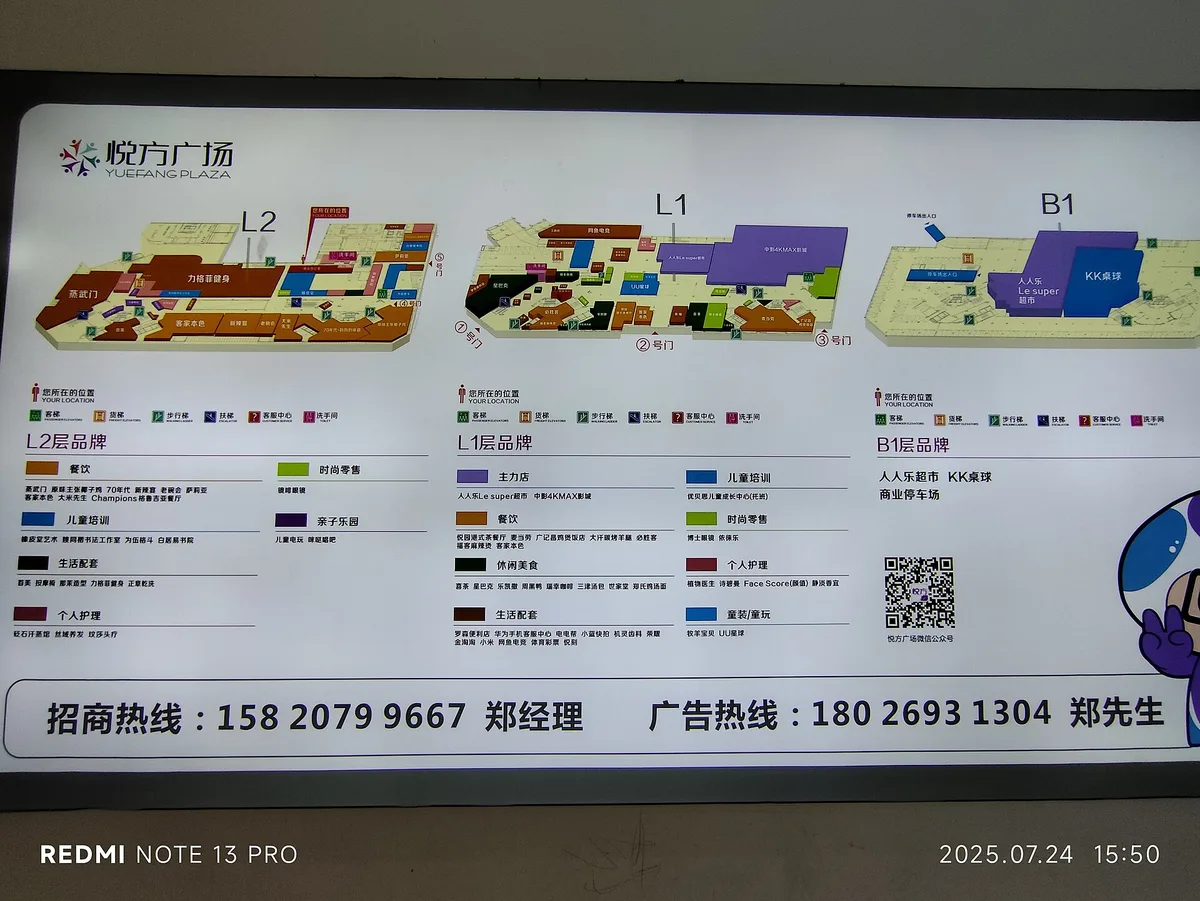
That directory board from a Shenzhen mall is worth a minute of your time, because it is the whole building in one picture. B1: supermarket, billiards, parking. L1: anchor stores, an IMAX cinema, Uniqlo. L2: fitness, restaurants, children’s classes, personal care. None of that arrangement is accidental, and once you can read it you can predict the layout of a mall you have never set foot in.
Floor one stopped being cosmetics
For twenty years the ground floor of a Chinese mall meant perfume, jewellery and fast fashion, because those categories could pay the highest rent. They have been pushed out.
What replaced them is a set of categories that Chinese retail press nicknames the four guardians, 四大金刚. Some outlets count only three. The four are new-energy car showrooms, designer toy stores, outdoor and technical apparel, and new-style tea shops.
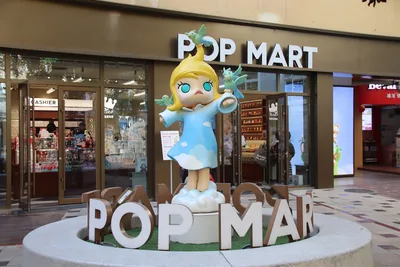
The numbers behind the swap are blunt. Shoppers spend more than fifteen minutes inside a Pop Mart store and about three minutes at the cosmetics counter next door. Sales per square metre for Labubu merchandise run one to two times the cosmetics figure. Since 2019, more than 80 percent of new Pop Mart stores have opened on a mall’s first floor, and in malls above 50,000 square metres more than 70 percent sit on the high-traffic ground level, against single digits in 2018.
Outdoor brands moved the same way. Arc’teryx’s average Chinese store grew from 217 to 313 square metres in three years, and roughly 40 percent of its stores now hold core first-floor positions, on the back of an outdoor market worth ¥1.35 trillion in 2024. As of early 2025, at least 70 percent of mall outlets for Chagee, Heytea and Starbucks were on floor one.
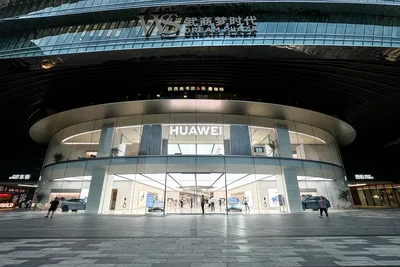
Cars are the strangest arrival and they need their own piece: Chinese cars in shopping malls covers what you can actually do in a showroom and why a Huawei store sells vehicles beside handsets. For the toy side, Labubu and Pop Mart in China goes through prices, store formats and the state of the resale market.
You order by phone and you queue by phone
Two habits will confuse you if you have not seen them before.
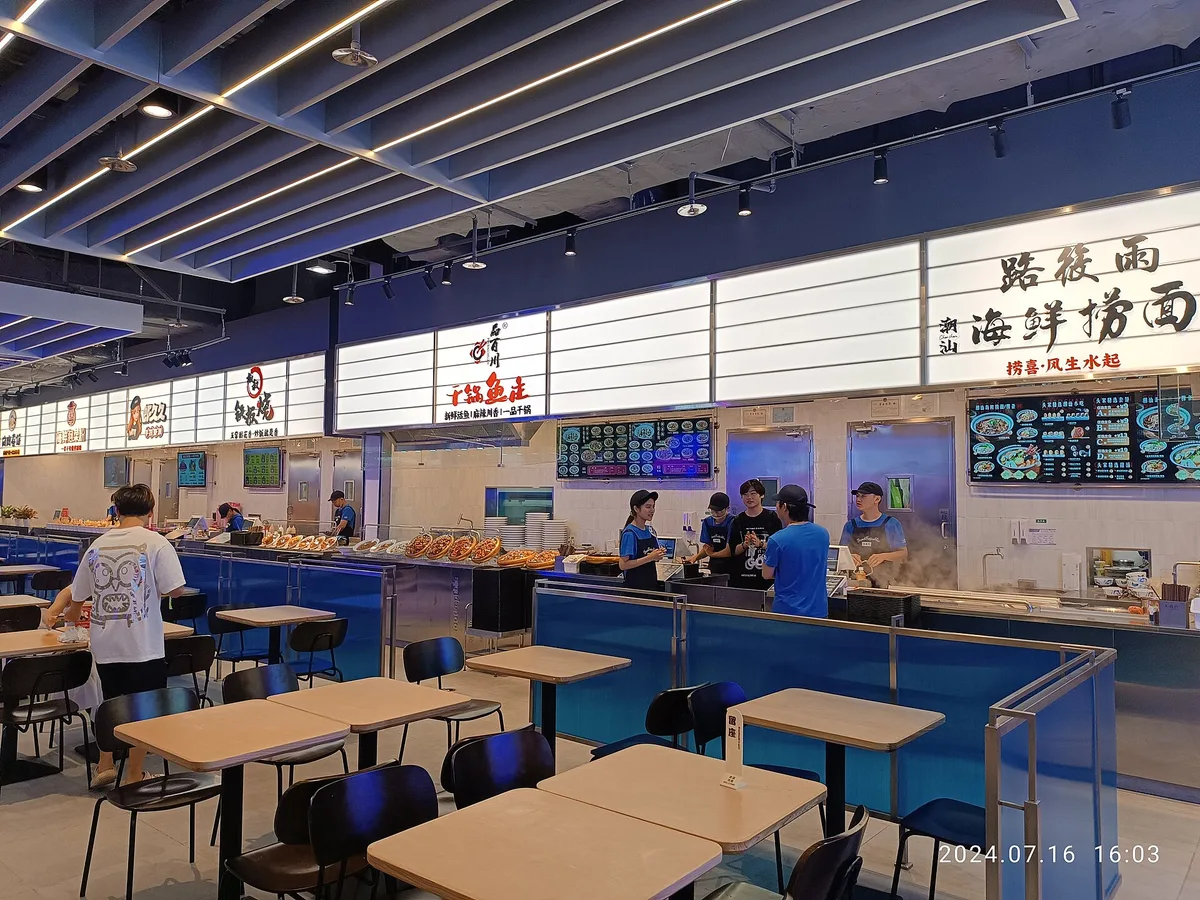
The first is ordering. In most mall restaurants you do not wait to catch anyone’s eye. You scan the QR code on the table with WeChat or Alipay, which opens the restaurant’s mini-program, and you order and pay from your own phone. No app download, no account in most cases. Food courts work the same way, sometimes with a self-service kiosk at the entrance that prints a number you collect at the counter.
The second is queuing, which for popular restaurants is now entirely digital. You take a number through a mini-program rather than standing in a line.
The systems have become strict, partly to defeat scalpers. At Sushiro’s China branches, reported in March 2026, you book through a mini-program using the last four digits of your mobile number, and seating staff may ask to see the physical SIM card to confirm the booker is present. One phone number gets one queue number per day, and screenshots are rejected. Nationwide peak queues reached 3,200 tables, a Shanghai opening meant waits over ten hours, and scalpers were reselling slots for ¥30 to ¥50, occasionally as much as ¥300.
Other chains go further. A well-known Beijing restaurant requires you to be within about 100 metres of the door before the online queue will issue you a number at all, and its summer queues pass 600 tables. One Shanghai grill house gives you a three-table grace period of 30 minutes if you miss your call, after which you start again.
The practical problem for a visitor is that these systems are built around a Chinese mobile number. Whether a foreign number works varies by restaurant and is not documented anywhere, so treat it as a coin toss and ask staff to help if the mini-program refuses you.
Ten to ten, but read the small print
The standard mall day in China is 10:00 to 22:00. That is close to universal, and some malls push to 22:30 on Fridays, Saturdays and public holidays. A handful of community malls have started opening sections early for older shoppers.
Inside that envelope, individual businesses keep their own hours, and the differences are large. Supermarkets routinely open before the mall does, sometimes by an hour or more, because they trade on morning grocery runs rather than on mall footfall. Restaurants serve past the mall’s closing time. A karaoke venue inside a mall can run until five in the morning. Public holiday schedules shift hard in both directions, and some malls close in the late afternoon on New Year’s Eve.
If you are planning around a specific shop, check that shop’s hours rather than the building’s.
The two things that will trip you up
Free Wi-Fi is the first. Chinese law requires real-name authentication on public networks, and mall captive portals generally assume a Chinese mobile number for an SMS code, or a WeChat account, with no passport fallback. Foreign numbers often fail that check. A travel eSIM is normally data-only with no number attached, so it cannot receive the code either. The documented exception is Beijing’s two airports, which have Wi-Fi dispensers where you insert or photograph your passport. Elsewhere, buy a local SIM or plan to run on your own data.
Restrooms are the second, and the honest answer has changed. Squat toilets remain the norm in China and seated stalls are the minority, so check along the row rather than assuming the first door. In many older toilets used paper goes into the bin beside the pan rather than down it. On paper itself the country has split by tier. Top-tier malls in Beijing, Shanghai, Shenzhen and Hangzhou increasingly stock free paper in the stall along with soap and dryers, and Shenzhen has required free paper in public restrooms since 2017. Some smaller-city malls have gone the opposite way and removed free paper altogether, replacing it with wet wipes sold through a QR code at ¥2.99 for three sheets.
So: carry tissues, use the bin, and check more than one door before you conclude anything.
What it costs, and what is free
The reasonable expectation is that a Chinese mall is more expensive than the phone in your pocket. Usually it is not, which surprises people.
Showrooming is normal here, and the offline price sometimes wins. In one 2025 survey around 80 percent of shoppers in a phone store compared online and offline prices before buying, and a 5G handset listed at ¥2,999 online was selling for ¥2,650 in the shop. A vivo model at ¥5,300 undercut its ¥5,999 online listing. The catch is that the products are not always the same: brands deliberately build cheaper e-commerce-only versions with reduced specifications, so a washing machine that is ¥300 cheaper online may spin slower and have a thinner drum.
Money is the bigger adjustment. Shops are legally required to accept cash, but staff rarely handle it and may struggle to give change, so mobile payment is the working default. Set it up before you arrive; our guide to paying in China walks through linking a foreign card. One figure worth correcting now, because it circulates widely: the ¥200 threshold on foreign-card mobile payments is the point above which a 3 percent service fee applies, not a spending cap. The real limits are US$5,000 per transaction and US$50,000 per year.
Foreign physical cards are accepted directly in a minority of places, concentrated in Sam’s Club, international hotels, Starbucks, Haidilao and McDonald’s. Shenzhen’s Qianhai district now certifies “international friendly” malls that must take international payment and display bilingual menus, and Shanghai has reported 14 such malls and 65,000 merchants accepting foreign cards. Outside those, route everything through Alipay or WeChat Pay. And do not try to bargain. Malls, department stores and brand shops sell at marked, fixed prices, and haggling reads as rude rather than savvy.
What is genuinely free is better than in most countries. The service desk handles lost property, first aid, gift wrapping and invoices, and lends wheelchairs, strollers and umbrellas. Luggage lockers, both staffed and self-service, usually sit on B1 or B2 near the entrances. Nursing rooms with changing tables and hot water are standard in modern malls. Power banks are rentable, though usually against a deposit paid through a Chinese payment account.
Tax refunds are the other thing worth knowing about, and many malls now run a desk for them so you can collect on the spot instead of at the airport. Where to shop in China covers the refund mechanics in detail. The short version: ¥200 minimum in one store on one day, goods unused and exported within 90 days, and roughly 9 percent back once the agency fee is taken. If you are working out what to spend it on, what is actually worth buying is the companion piece.
It is a day out, not a shopping trip
The most useful mental adjustment is that a Chinese mall is not primarily a place to buy things. It is where people go when they want to be somewhere.
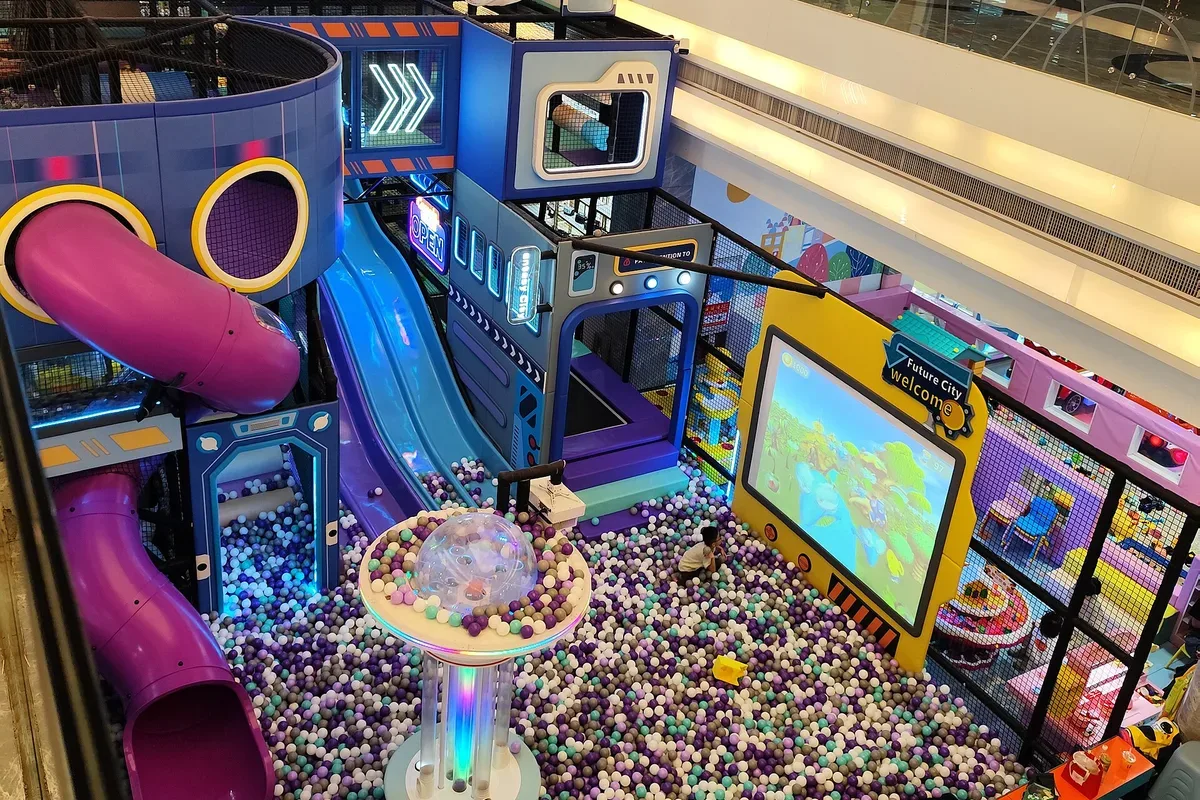
That is why the entertainment is not a sideshow. Cinemas sit on the upper floors as anchors. The 星聚会 karaoke chain signed 193 new stores in the first half of 2025, 88 percent of them inside shopping centres. Wushang Dream Mall in Wuhan contains a 25,000 square metre indoor ski resort on its eighth floor plus a 50,000 square metre indoor theme park. AEON’s mall in Changsha has a 500 square metre pet park with stroller rental; Taikoo Li Qiantan in Shanghai has a 450 metre running track on the roof; the ball pit above is a normal thing to find in a mall atrium on a Tuesday afternoon. In some leading malls, dining, kids and entertainment now take more than 35 percent of the tenants.
The commercial reality underneath is messier than the atmosphere suggests, and it is worth knowing before you read headlines about China’s retail collapse or its retail boom. Both are partly true. Average daily mall footfall rose 5.3 percent in 2025, but close to 30 percent of malls reported flat or falling sales, and 38.8 percent saw the average transaction shrink. Mall atriums draw 25 to 30 percent of a building’s traffic and convert under 20 percent of it into shop visits. Prime retail vacancy across 15 major cities sits around 11 percent. New mall openings fell to a 13-year low in 2025.
So you will walk through buildings that feel full and discover that half the people around you are there for the air conditioning, the ice rink and the bubble tea. That is not a failure of the mall. It is the business model.
Which malls are worth walking into
You do not need a special trip. The mall nearest your hotel is almost certainly representative, and if you only have time for one, pick by what is inside rather than by name.
If you do want destinations, these are the ones with a reason to go. Chengdu’s New Century Global Center is the largest commercial building in the world by floor area at around 1.7 million square metres, and it contains an indoor water park with a 5,000 square metre artificial beach. Chengdu IFS has the 15 metre climbing panda on its facade, best photographed face to face from the seventh-floor roof garden. Shanghai’s Global Harbor is the city’s largest by retail area at 480,000 square metres. Shenzhen’s MixC concentrates 63 tax-refund shops, 47 of them offering instant refund, and Shenzhen’s Joy City, opened in July 2025, has indoor tennis and a rooftop garden above a metro station. Beijing’s China World Mall has 61 tax-refund stores and self-service refund kiosks that cut the paperwork from 15 minutes to 3. Wuhan’s Wushang Dream Mall is the indoor-ski one. Hangzhou’s newest POP MART flagship, on Hubin pedestrian street beside West Lake, is the chain’s largest in the country.
One caution. Chinese retail moves fast in both directions, and specific stores and floors change within months. Treat any address here as a starting point and check the mall’s own directory board when you arrive, which is both current and reliable.
Frequently asked questions
What are the opening hours of a shopping mall in China?
Most large malls run from 10:00 to 22:00, and some extend to 22:30 on Fridays, Saturdays and public holidays. Individual businesses inside do not follow the mall. Supermarkets often open an hour or more earlier, restaurants serve later, and a karaoke venue inside a mall can run until five in the morning.
Can I use the free Wi-Fi in a Chinese shopping mall?
Often you cannot. Chinese law requires real-name authentication on public networks, and mall portals usually ask for a Chinese mobile number to receive an SMS code, or a WeChat account. A foreign number frequently fails that check. A travel eSIM is usually data-only with no phone number, so it cannot receive the code either. Buy a local SIM or rely on your roaming data.
Do I need cash in a Chinese shopping mall?
No. Shops are legally required to accept cash, but staff rarely handle it and may struggle to make change. Set up Alipay or WeChat Pay with your own card before you fly. Foreign physical cards are accepted directly only in a minority of places, mainly Sam’s Club, international hotels, Starbucks, Haidilao and McDonald’s.
Is there toilet paper in Chinese mall restrooms?
It depends on the mall. Top-tier malls in Beijing, Shanghai, Shenzhen and Hangzhou increasingly provide free paper in the stall, plus soap and hand dryers. Some smaller-city malls have gone the other way and removed free paper, selling wet wipes by QR code instead. Carry a packet of tissues.
Can I get a tax refund at a shopping mall in China?
Yes, at participating stores, and many malls now have a refund desk on site so you can claim on the spot rather than at the airport. The threshold is ¥200 in a single store on a single day, and goods must leave China unused within 90 days. Expect roughly 9 percent back after the agency fee.
Do I need to book restaurants in Chinese malls?
For popular places, yes, and booking means joining a digital queue rather than reserving a table. You take a number through the restaurant’s WeChat mini-program, then watch the screen or your phone. Some restaurants require you to be within about 100 metres of the door to take a number at all, and screenshots of a queue ticket are rejected.