China Subway Survival Guide: Tickets, Apps & Tips for 6 Cities
China has the largest collection of urban metro systems on the planet. As of 2025, more than 45 cities run metro lines. The top five (Shanghai, Beijing, Guangzhou, Shenzhen, and Chengdu) together carry north of 20 billion passengers a year. The Shanghai Metro alone moves more people annually than every subway system in the United States combined.
But here is what matters for your trip: the systems all work the same way. A ticket machine in Beijing looks like the one in Chengdu. The Alipay QR code scans at gates in Shanghai, Guangzhou, Xi’an, and everywhere in between. Security checks follow the same script in all 45 cities. Learn the system once, and you walk into any metro station in the country knowing exactly what to do.
This guide covers the common process across all Chinese metros, the city-by-city differences worth knowing, and the mistakes that trip up first-time riders. If you want a deep dive on one city, our Shanghai Metro guide covers that system in detail; Shanghai is the world’s largest and makes a good baseline.
The common process: every city, same steps
No matter which Chinese city you are in, riding the metro follows five steps.
1. Find the entrance
Look for a rectangular sign with the metro logo: usually a stylized letter in a colored circle. Beijing uses a “B” inside a square with a “G” (for 北京轨道交通). Shanghai uses an “S” and “M” inside a red circle. Most logos incorporate the city’s first letter. Signs are posted on sidewalks, inside shopping malls, and attached to railway stations.
Google Maps, Apple Maps, and Gaode Maps (高德地图) all show metro entrances in Chinese cities. Apple Maps tends to be the most reliable for entrance locations in English.
2. Security check
Every metro station in China has a security checkpoint. Place your bag on a conveyor belt. Walk through a metal detector. Pick up your bag on the other side. The whole thing takes fifteen seconds.
The rules are consistent nationwide: no pocket knives, no large scissors, no pepper spray, no spray cans larger than travel size (roughly 100ml). These are airport-lite rules. If a guard flags your bag, they will ask you to open it. They are looking for the aerosol can or the foldable knife, not your passport.
3. Pay and enter
You have three main options. They work the same in every Chinese metro system.
Alipay Transport QR code: the default choice for most travelers. Open Alipay, switch to the Transport module, select the current city. The app generates a QR code. Scan it at the gate. Walk through. At the end of the day, Alipay tallies all your rides and charges your linked card once. No ticket machine, no queue, no cash. If you have not set up Alipay yet, our mobile payment guide walks through the setup.
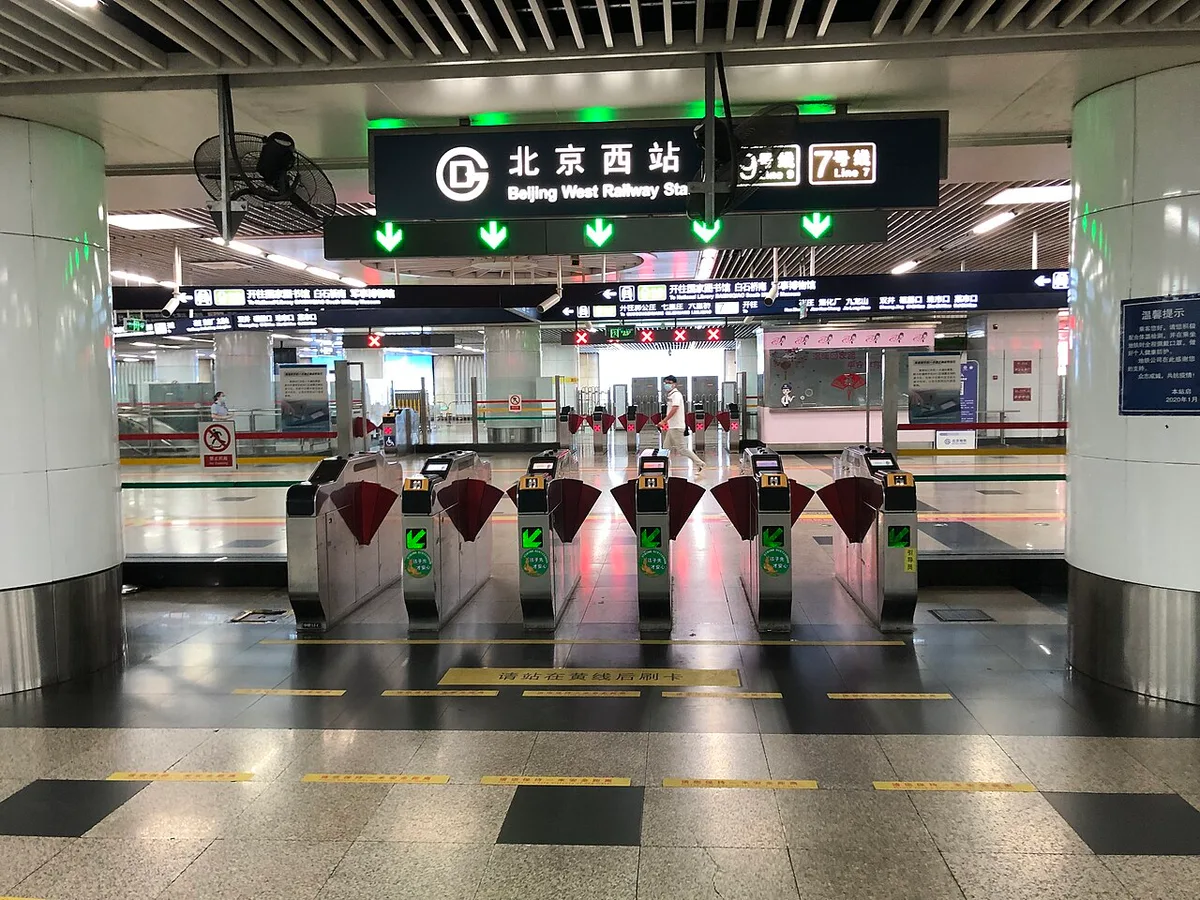
Single-journey ticket: every station has ticket vending machines with an English-language option. Select your destination, pay with cash (¥5, ¥10, ¥20 notes) or a foreign credit card at newer machines. The machine dispenses a plastic token or a contactless card. Tap it at the gate. Keep it; you feed it into the exit gate at your destination.
City transport card: a stored-value physical card sold at service counters. ¥20 deposit, top up with cash. Works on metro, buses, and sometimes taxis within that city. Worth it for stays over a week in one city. For shorter trips, the Alipay QR replaces it entirely.
Most systems also accept WeChat Pay’s transport QR. But Alipay is easier to set up for international travelers because it supports foreign card linking through the standard app. WeChat Pay sometimes requires additional verification steps for non-Chinese cards.
4. Board the train
Once through the gate, follow signs to your line. Chinese metro lines are numbered (Line 1, Line 2, etc.) and color-coded. Signs are bilingual: Chinese and English, in every city with a metro system. Some smaller cities (Luoyang, Wuhu) may have spottier English coverage on older signage, but the line numbers and colors are universal.
On the platform, look at the overhead sign. It tells you the line number, direction (named by the terminal station, not by compass), and how many minutes until the next train. Most systems run trains every 2-6 minutes during the day. During peak hours on major lines, headways drop to 90 seconds.
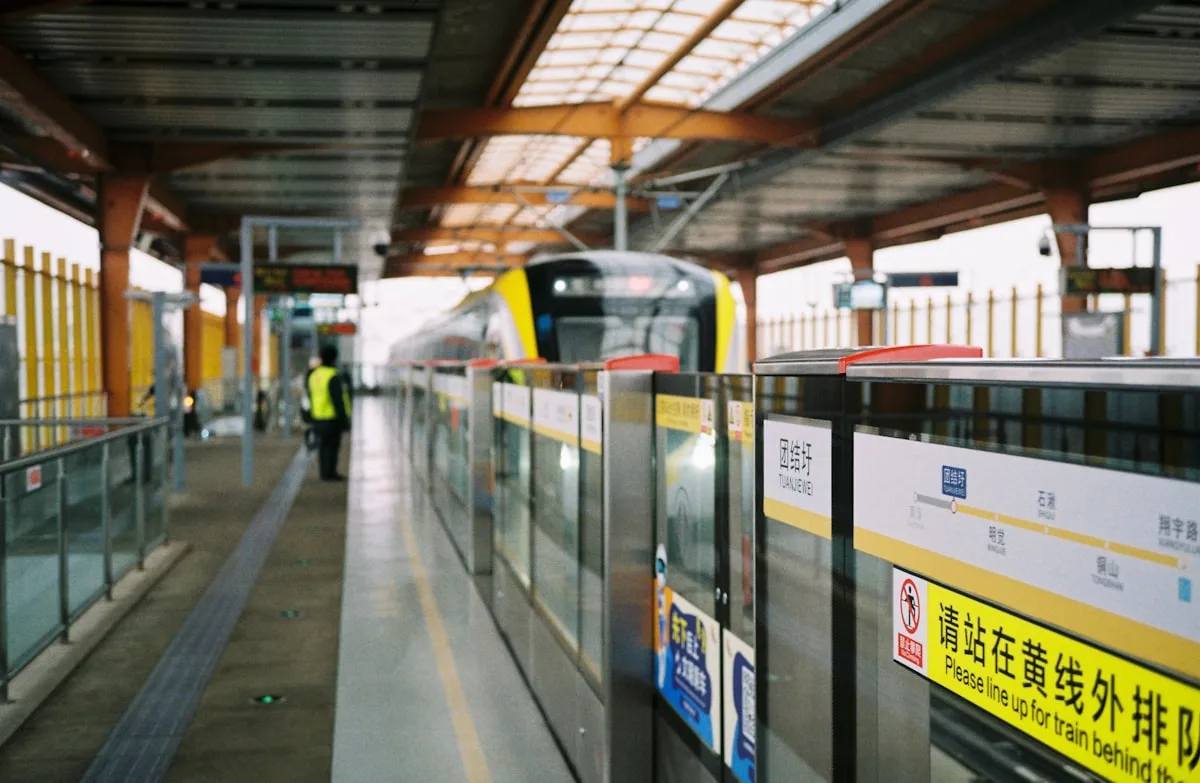
Stand behind the yellow line. Let passengers off first. Step on. The doors close on a timer: typically 15-20 seconds. They do not reopen if blocked. A recorded announcement plays in Mandarin and English at every stop: “Next station, Xizhimen. Doors will open on the left.”
5. Exit
Scan your QR code, tap your card, or feed in your token at the exit gate. Look for the exit number board: most stations have four to six exits labeled A through F, each leading to a different street corner. Check which exit you need before surfacing. Gaode Maps and Apple Maps both show exit numbers. Getting this wrong in a city like Chongqing, where one exit puts you at street level and another puts you on the sixth floor of a building, is not a small mistake.
City-by-city: what is different where
While the process is the same everywhere, each major system has its own personality. Here is what matters about the ones you are most likely to ride.
| City | Lines | Opened | Distinctive feature |
|---|---|---|---|
| Beijing | 27 | 1971 | Oldest system. Ring Line (Line 2) follows the old city wall. Line 1 runs under Chang’an Avenue. Transfers at Guomao and Xizhimen are long underground walks. |
| Shanghai | 18 | 1993 | Largest in the world by route length (729 km). Clean, quiet, efficient. People’s Square transfer is the busiest in the country. |
| Guangzhou | 16 | 1997 | The southern workhorse. Connects to Foshan Metro (the first cross-city metro integration in China). Line 3 during rush hour is shoulder-to-shoulder. |
| Shenzhen | 16 | 2004 | Newest of the big four. Air-conditioned platforms (a real benefit in summer). Connects to Hong Kong via Line 4 at Futian Checkpoint. |
| Chengdu | 13 | 2010 | Fastest-growing system in China. Line 1 is chronically crowded. Stations are spacious and well-signed. |
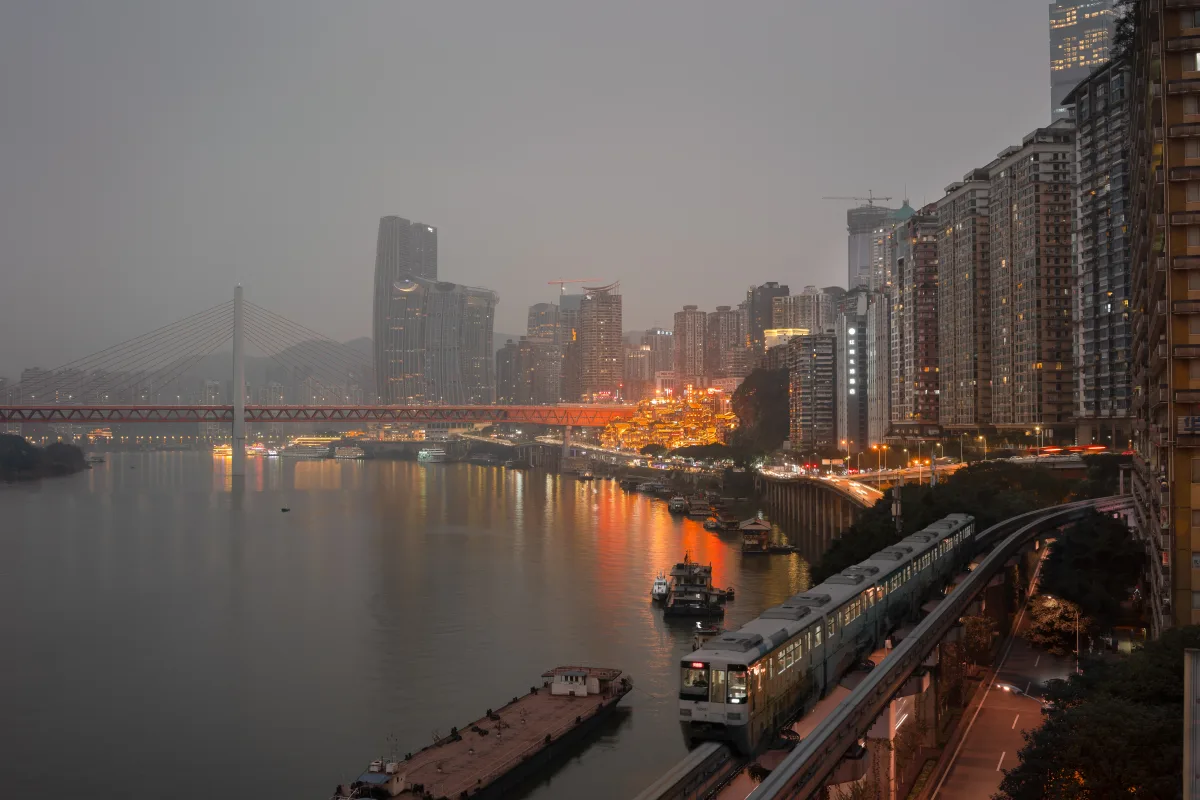
| Chongqing | 11 | 2004 | Built on a mountain. Monorail lines (Line 2 and Line 3) run elevated through buildings. Station exits are unpredictable — one puts you on a street, another on a cliffside. |
| Xi’an | 9 | 2011 | Compact and easy to navigate. Line 2 runs north-south under the ancient city wall. The logo is a stylized city wall in a rectangle. |
| Nanjing | 13 | 2005 | Clean, underused outside peak hours. Line S routes connect out to suburban and exurban stations. |
| Hangzhou | 12 | 2012 | Modern, quiet, spacious. The network grew fast for the 2022 Asian Games. Line 1 connects the East Railway Station to West Lake. |
| Wuhan | 11 | 2004 | Crosses the Yangtze River via the first metro tunnel under the river. Line 2 is one of the busiest single lines in central China. |
Beijing’s Line 2 vs. Shanghai’s Line 4: both are ring lines that circle the city center. If you are lost on a ring line, stay on the train; you will eventually come back around. This is a surprisingly useful piece of information when you are tired and unsure which direction you are facing.
Payment note for Beijing: Beijing subway gates also accept select foreign contactless cards (Visa, Mastercard) at major stations. Shanghai has been rolling this out too. But coverage is inconsistent, so treat this as a backup, not your plan.
Fares: what you actually pay
Chinese metro fares are distance-based. The cheapest ticket in any system is ¥2-3 ($0.28-0.42). The most expensive single ride, the full length of Shanghai’s Line 2 from Pudong Airport to the western edge of the city, costs about ¥9 ($1.26). Most rides in city centers run ¥3-5 ($0.42-0.70).
| System | Minimum fare | Typical center ride | Airport run |
|---|---|---|---|
| Beijing | ¥3 | ¥4-5 | ¥25 (Airport Express) |
| Shanghai | ¥3 | ¥4-5 | ¥8 (Line 2 from PVG) |
| Guangzhou | ¥2 | ¥3-5 | ¥8 (Line 3 from CAN) |
| Shenzhen | ¥2 | ¥3-5 | ¥8 (Line 11) |
| Chengdu | ¥2 | ¥3-4 | ¥7 (Line 10) |
| Xi’an | ¥2 | ¥3-4 | ¥8 (Line 14) |
Discounts: children under 1.3m ride free in most cities (one child per paying adult). Seniors over 65 with a Chinese ID ride free; this generally does not apply to international travelers. Monthly passes exist in most cities but are not useful for a trip under two weeks.
Airport connections
Nearly every major Chinese city now connects its airport to the metro. The ride is almost always cheaper than a taxi by a factor of ten or more.
| Airport | Metro line | Ride time to center | Cost |
|---|---|---|---|
| Beijing Capital (PEK) | Airport Express | 25 min to Dongzhimen | ¥25 |
| Beijing Daxing (PKX) | Daxing Airport Express | 25 min to Caoqiao | ¥35 |
| Shanghai Pudong (PVG) | Line 2 | 70 min to People’s Square | ¥8 |
| Shanghai Hongqiao (SHA) | Line 2 / Line 10 | 25 min to People’s Square | ¥5 |
| Guangzhou Baiyun (CAN) | Line 3 | 35 min to Tiyu Xilu | ¥8 |
| Shenzhen Bao’an (SZX) | Line 11 | 30 min to Futian | ¥8 |
| Chengdu Tianfu (TFU) | Line 18 | 45 min to South Railway Station | ¥9 |
| Chengdu Shuangliu (CTU) | Line 10 | 20 min to Taipingyuan | ¥4 |
| Xi’an Xianyang (XIY) | Line 14 | 40 min to North Railway Station | ¥8 |
| Chongqing Jiangbei (CKG) | Line 10 | 40 min to city center | ¥7 |
The express trains (Beijing, Daxing) are separate tickets from the regular metro. You buy them at the airport station, not through the Alipay Transport QR. Regular metro lines that serve airports (Shanghai Line 2, Guangzhou Line 3) use the standard fare structure; your Alipay QR works as usual.
Peak hours: when not to ride
Every Chinese metro has the same rhythm: morning peak 7:30-9:00 AM, evening peak 5:30-7:00 PM, weekdays only. The worst lines in the busiest cities during these windows are standing-room-only. Not “a bit crowded.” Every square meter of floor space is occupied by a person.
The hardest-hit lines: Beijing Line 1 and Line 10, Shanghai Line 1 and Line 2, Guangzhou Line 3 (particularly the section between Tiyu Xilu and Zhujiang New Town), Shenzhen Line 4, Chengdu Line 1.
If you must travel during peak: stand near the doors, hold your bag in front of you (not on your back), and step off the train briefly at major transfer stations to let people off behind you. Do not try to hold a conversation on your phone. The ambient noise level inside a packed Chinese metro car at 8:30 AM makes phone calls impossible.
Weekends and weekday middays (10 AM-4 PM) are fine on every system in the country. You can sit. You can breathe. You can look out the window.
Three city-specific quirks
Chongqing: exits are not where you think. The station is built into a hillside. Exit A puts you on the ground floor of a shopping mall. Exit C puts you on a pedestrian overpass three stories above a different street. Check the exit map or ask the station attendant. Guessing costs you a long walk up or down stairs.
Beijing: transfers can be hikes. Guomao (Line 1 ↔ Line 10) and Dongzhimen (Line 2 ↔ Line 13) involve covered walkways that take five to seven minutes. Xizhimen’s transfer from Line 2 to Line 13 is even longer. Budget extra time if your route includes one of these stations.
Shanghai: Nanjing Road East ≠ Nanjing Road West. They are 4 km apart on Line 2. Nanjing Road East is near the Bund. Nanjing Road West is near Jing’an Temple. Getting off at the wrong one means a 15-minute backtrack. Taxi drivers also confuse the two if you just say “Nanjing Road.”
How it compares to metros outside China
If you are used to the New York City Subway, the London Underground, or the Paris Métro, here are the differences that matter:
Cleanliness. Chinese metro stations and trains are cleaned continuously. You will see workers mopping platforms at 10 PM. Gum on the floor is rare. Graffiti inside trains is essentially nonexistent.
Safety. Pickpocketing exists but is uncommon. The bigger safety issue is crowding, not crime. A packed Chinese metro platform at rush hour has uniformed staff with megaphones directing pedestrian flow. You are not going to get robbed. You might get elbowed, but it is not personal; it is physics.
Price. Most rides cost less than 75 cents. The same distance in London would cost £3-5. In New York, it is a flat $2.90 regardless of distance. China’s distance-based fare means short hops are extremely cheap and long airport runs are still under $1.50.
No 24-hour service. No Chinese metro runs overnight. Last trains depart between 10:30 PM and midnight depending on the city and line. If you are out late, plan your exit in advance. A Didi ride home runs ¥30-120 depending on distance. Not expensive, but the surprise is avoidable.
No eating or drinking. Eating and drinking on trains and in station paid areas is prohibited in every Chinese metro system. This is enforced; station staff will tell you to put away your food. Water in a sealed bottle is generally fine. A steaming cup of noodles is not.
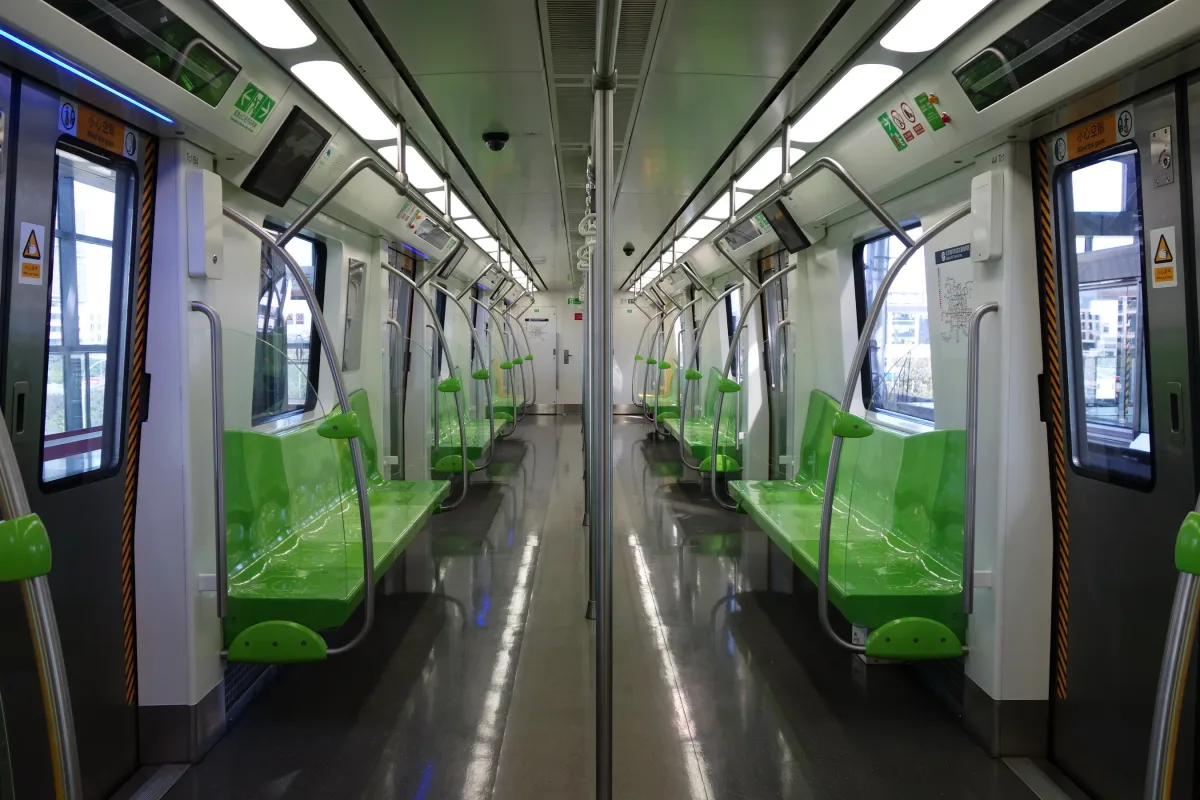
Platform screen doors. Nearly every Chinese metro station has floor-to-ceiling glass doors between the platform and the tracks. They open only when a train is in the station. You cannot fall onto the tracks, and you cannot be pushed. This is a genuine quality-of-life feature that many older systems in Europe and North America still do not have.
What to do when something goes wrong
Missed your stop: get off at the next station, cross to the opposite platform, and ride back. You do not need a new ticket or QR scan to re-enter. The return ride is free if you stay inside the paid area (just switch platforms). If you already exited through the gate, you pay again, but it costs ¥3. You will survive.
Gate rejects your QR code: take a breath. The gate screen shows an error message in Chinese. The most common reason is that your Alipay Transport module is still set to a different city. Switch it to the current city, wait three seconds, and scan again. If it still fails, find the service counter near the exit gates. The attendant will scan your phone or card manually.
Lost your single-journey token: go to the service counter at your exit station. Tell them which station you entered from. They will charge you the maximum fare from that station. This costs you a few extra yuan. Pay it and move on. Do not try to jump the gate; the gates are waist-high, the cameras are real, and the station staff are twenty meters away.
Phone battery is dead and you need to pay: find the ticket machine. Pay with cash. If you have no cash, go to the service counter. Staff cannot charge your phone, but they can sell you a ticket for cash or help you top up a transport card if you have one. Carry a ¥20 note in your phone case. This is the one piece of cash you should always have in China, and the metro is the reason.
A Chinese metro system will not charm you. It is not supposed to. It is infrastructure designed to move millions of people through dense cities with minimal friction, minimal cost, and minimal delay. It succeeds at all three. The fact that you can walk into any station in any Chinese city and know exactly what to do: same gates, same QR code, same process. That is the point.
This is one piece of the puzzle. See our complete first-timer’s guide for the full planning picture.
Frequently asked questions
Can I use Alipay to pay for every subway in China?
Yes. The Alipay Transport QR code works at gates in all major Chinese metro systems. Switch to the current city in the app, scan, and ride. At the end of the day, Alipay tallies all your rides and charges your linked card once. If you have not set up Alipay yet, our mobile payment guide walks through the setup.
How much does a subway ride cost in China?
Most city-center rides cost ¥3-5 ($0.42-0.70). The minimum fare is ¥2-3 depending on the city. An airport run costs ¥7-9 on regular metro lines that serve airports, or ¥25-35 on dedicated airport express lines in Beijing. For comparison, the same distance in London would cost £3-5, and New York charges a flat $2.90 regardless of distance.
Do I need a transit card or can I just use my phone?
Alipay’s Transport QR code is all you need. It works in every metro system covered in this guide. Single-journey tickets from vending machines accept cash and, at newer machines, foreign credit cards. A physical transit card with a ¥20 deposit is only worth it for stays over a week in one city, since it also works on buses and sometimes taxis within that city.
Are Chinese subways safe?
Extremely. Every station has security checks with bag scans and metal detectors. Nearly every platform has floor-to-ceiling screen doors that open only when a train is present. You cannot fall onto the tracks. Pickpocketing is uncommon. The biggest safety concern is crowding during peak hours (7:30-9:00 AM and 5:30-7:00 PM on weekdays), not crime.
What happens if my phone dies and I need to ride the subway?
Use a ticket vending machine with cash, or go to the service counter. Staff can sell you a ticket for cash. Carry a ¥20 note in your phone case. This is the one piece of cash you should always have in China, and the metro is the reason. Do not try to jump the gate; the cameras are real and station staff are nearby.
Do Chinese subways run 24 hours?
No. Last trains depart between 10:30 PM and midnight depending on the city and line. No Chinese metro system operates overnight. Plan your late-night return with a Didi backup, which typically costs ¥30-120 depending on distance. The surprise of finding the gates closed at 11:15 PM is entirely avoidable.