Courtyards to Tea Hills: China's Most Distinctive Places to Stay

Why you go for the room, not the city
Most countries have hotels. China has building types that do not exist anywhere else: round earthen fortresses you can sleep inside, Qing dynasty courtyards converted to boutique inns, tea plantations where the guest rooms sit inside the crop rows.
In a country where chain hotels are beige boxes with firm beds and fluorescent bathroom lights, the accommodation itself becomes the reason to book the trip. You do not go to Fujian for a standard hotel. You go to sleep inside a UNESCO World Heritage tulou. You do not go to Hangzhou just for West Lake. You go to wake up in a tea valley at Amanfayun, where the mist sits on the tea bushes at 6 AM and the only sound is birds.
These places are harder to book, harder to reach, and harder to verify. They also have the highest rejection rate for international travelers of any accommodation category. The sections below cover what is real, what costs what, and what you should know before booking.
Beijing hutong courtyard hotels
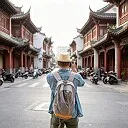
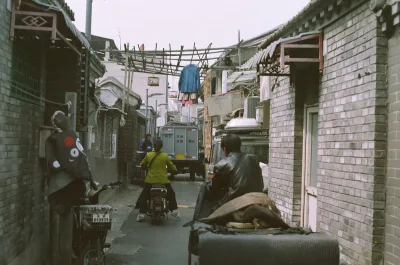
Beijing’s hutong neighborhoods are the last surviving grid of Ming and Qing dynasty alleyways. Several courtyard homes (siheyuan) have been converted to hotels. You sleep in a restored one-story compound built around a central courtyard, sometimes with a persimmon tree and a stone table where breakfast is served.

Top end: Mandarin Oriental Qianmen (王府井文华东方). Private hutong courtyard villas, voted best new hotel globally in 2025. Rooms from roughly $800 per night, and you will need to book months ahead.
Mid-range courtyard hotels ($150-300/night): The Orchid (古城老院), Blossom Hill (花间堂), and Florascent (花舍). These are restored courtyard homes with modern bathrooms retrofitted into old structures. The Orchid has 12 rooms around a central courtyard in the Baochao Hutong, a five-minute walk from the Drum Tower. Blossom Hill has multiple locations across Beijing’s hutong belt; the one near Houhai Lake puts you in walking distance of the best lakeside bars.
Budget hutong option: Peking Yard Hostel (北平小院国际青旅), a courtyard converted to a hostel. Beds from about $12 per night. You get the courtyard experience (morning coffee under a persimmon tree, red lanterns, exposed wooden beams) at dorm prices. Private rooms run $30-35. Book well ahead; this place fills up.
The reality: Courtyard hotels are old buildings. Walls are thin enough to hear your neighbor’s phone conversation. Central heating in winter is inconsistent, and some bathrooms are converted storage rooms with plumbing that gurgles at 3 AM. Summer mosquitoes are a fact of life; the courtyard is open to the sky. None of this is a dealbreaker. It just means a courtyard hotel is a different experience from a soundproofed chain hotel with blackout curtains. Go in knowing the trade-off.
For more on Beijing’s neighborhoods and which hutong is right for you, see the Beijing where to stay guide.
Tea plantation retreats
China’s tea regions double as hotel settings, and the accommodation ranges from a $1,000-a-night Aman resort to a $60 farmhouse with no English signage.
Amanfayun (法云安缦), Hangzhou: A Tang-dynasty tea village converted to an ultra-luxury resort. Forty-seven rooms spread across stone pathways, bamboo groves, and tea terraces at the base of Lingyin Temple. Rooms from $800-1,200. The tea is from the bushes you are looking at. Even if you do not stay here, the tea house is open to non-guests and is worth the trip for a morning.
Anji tea mountain guesthouses ($80-150/night): Anji County in Zhejiang, about 2.5 hours from Hangzhou, is white tea country. Guesthouses sit directly on the tea terraces, often run by tea-farming families who converted a few rooms. Breakfast includes tea harvested that morning. English is rare; offline translation apps are essential. The trade-off: you are staying on a working tea farm, not a designed resort.
Suzhou Xishan Island tea gardens: Xishan is an island in Taihu Lake, connected by bridge to Suzhou. Biluochun green tea grows here on terraces that slope toward the water. Guesthouses run $50-100/night. The island is quiet (no nightlife, limited dining), but the combination of lake views and tea fields is unlike anywhere else in Jiangsu.
Yunling Tea Estate (云岭茶庄园), Fujian: A converted 1950s state-owned tea factory, now a boutique hotel with 20 rooms. The factory’s concrete bones are still visible: exposed beams, industrial windows, fermentation troughs repurposed as planters. Rooms from $120-200. It is in the Wuyi Mountains, which means you are in rock tea (yancha) territory, and the hotel arranges tasting sessions and picking tours.
All tea plantation stays share one warning: you are in the countryside. The nearest restaurant may be a 20-minute drive. WiFi may be patchy. Staff may speak zero English. Bring a translation app, backup cash, and low expectations for connectivity. If that sounds like a vacation rather than a problem, you will love it.
Heritage and walled village stays
Fujian Tulou (福建土楼): These are the round earthen fortress-houses of the Hakka people, built between the 12th and 20th centuries, now a UNESCO World Heritage site. Several tulou accept overnight guests; you sleep in a small room carved out of the circular wall, with shared bathrooms in the central courtyard. Prices run $20-40 per night. The experience is remarkable: dinner is home-cooked Hakka food served at a communal table, and after the day-trippers leave around 4 PM, you have the building to yourself and the handful of other overnight guests. The downside is exactly what you would expect from a 300-year-old rammed-earth building: thin mattresses, cold nights, shared bathrooms with basic plumbing. The nearest tulou cluster that accepts international travelers is in Nanjing County, about 3 hours from Xiamen.

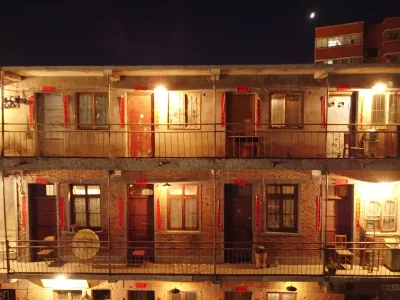
Pingyao Ancient City (平遥古城): Pingyao is a walled Ming-dynasty banking town in Shanxi province. Guesthouses inside the city walls are converted from Qing-dynasty merchant courtyards: brick beds (kang), paper windows, carved wooden screens. Prices run $30-80 per night. The best ones (Jing’s Residence, Dejuyuan) have modern plumbing retrofitted into the old structure. Winter is cold; the kang bed is heated, but the bathroom may not be.
Lei Family Courtyard (雷家大院), Hubei: A restored Qing-dynasty clan compound in the Wudang Mountains area. Fewer than 10 rooms, each in a former family wing around a series of courtyards. $50-80/night. The family still lives in part of the compound. It is not on international booking platforms; you book by calling or through a Chinese travel agent.
Ethnic and cultural immersion stays
Mongolian yurts (ger), Inner Mongolia: From June to September, yurt camps operate on the grasslands of Inner Mongolia. A yurt has a bed, a stove, and a domed felt roof that lets in starlight. Camps range from basic ($40/night, shared outhouse, no running water) to glamping ($100-150/night, private bathroom, restaurant). Most camps include meals: lamb hotpot, milk tea, and kumis (fermented mare’s milk). The grasslands near Hohhot are the most accessible; the Xilingol League, further north, has fewer tourists and darker skies. Bring warm clothes. Even in July, nights drop to 10°C.
Tibetan family guesthouses, Yunnan/Sichuan: In Tibetan areas of northern Yunnan (Shangri-La, Deqin) and western Sichuan (Ganzi, Litang), Tibetan families run guesthouses out of their homes. Rooms are simple (a bed, heavy blankets, a thermos of yak-butter tea) and cost $15-30 per night including meals. The host family typically eats with you. Hospitality is informal and generous. The altitude is the real challenge: Litang sits at 4,000 meters, and you will feel it. Spend a day acclimating before doing anything ambitious.
Yi village stays, Sichuan: The Yi minority villages in the Liangshan Mountains offer a handful of community-run guesthouses. These are the least developed of the options here: no English, no booking platform, no signage. You arrange through a Chengdu-based tour operator or a Chinese-speaking contact. Rooms run $10-20. The reward is cultural immersion at a level that tourism infrastructure usually filters out. Whether that is what you want is a personal question.
Modern architectural statement hotels
Not every distinctive stay is old. China has a recent wave of architect-designed hotels built into dramatic landscapes.
Banyan Tree Anji (安吉悦榕庄): Set in a bamboo forest in Zhejiang’s Anji County. The infinity pool faces an uninterrupted wall of bamboo-covered hills. Rooms are standalone villas with floor-to-ceiling glass. $400-700/night. The design is the point; the building dissolves into the bamboo.
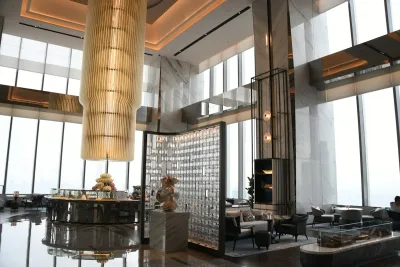
Andaz Shenzhen Bay (深圳湾安达仕): Tony Chi-designed rooms on the upper floors of a Shenzhen skyscraper, overlooking the bay toward Hong Kong. $300-500/night. More urban statement than nature retreat, but Chi’s interiors are the reason to book: layered textures, custom furniture, lighting designed to make a high-rise feel intimate.
Pei Cui Yao Liang (佩翠瑶梁), Anji: Twenty-three rooms on a hillside bamboo-and-tea estate. Extreme privacy: rooms are spread across multiple buildings connected by stone paths. $250-400/night. No kids under 12. Designed for people who want to disappear for a few days.
When character means discomfort
Unique stays come with unique problems. Old buildings lack elevators; you will carry your luggage up stone steps. Courtyard hotels in Beijing have central heating that works on a municipal schedule, not a thermostat. Tea plantation guesthouses lose WiFi during summer storms, which are frequent in Fujian and Zhejiang. Mongolian yurts have an outhouse 30 meters from your bed, and at 3 AM in 8°C weather, that walk is character-building in the least enjoyable sense.
More importantly: boutique heritage stays have the highest rejection rate for international travelers. A family-run tulou or a Tibetan guesthouse may never have hosted a non-Chinese guest and may not know they legally can. The solution is the same as for budget hotels: use Trip.com, look for the “Foreign Guests Accepted” label, and if it is missing, call or message the property before booking. The hotel booking guide covers the full verification process.
Private stays (yurts, Tibetan guesthouses, farmhouse tea rooms) also mean you handle PSB registration yourself. Hotels do it automatically at check-in. For a private stay, you go to the local police station within 24 hours of arrival. The PSB registration guide explains the paperwork, what to bring, and what happens if you skip it.
If $800 a night at Amanfayun is not your scene, the budget accommodation guide covers hostels from $7 and reliable domestic chains from $15. Same cluster, opposite end of the price spectrum.
Is it worth it?
For a one-night stopover, a Hanting near the train station is the right call. For a place you will remember in 10 years, the courtyard hotel, the tea plantation, or the tulou is the right call. The inconvenience is real. So is the experience.
That is the trade-off. Pick the one that fits your trip.
Part of our Where to Stay in China series.