Furong vs Fenghuang: Which to Add to Your Zhangjiajie Trip
Furong Town and Fenghuang appear in the same lists, sit on the same railway, and get described with the same three words in every guide. They are not the same kind of place.
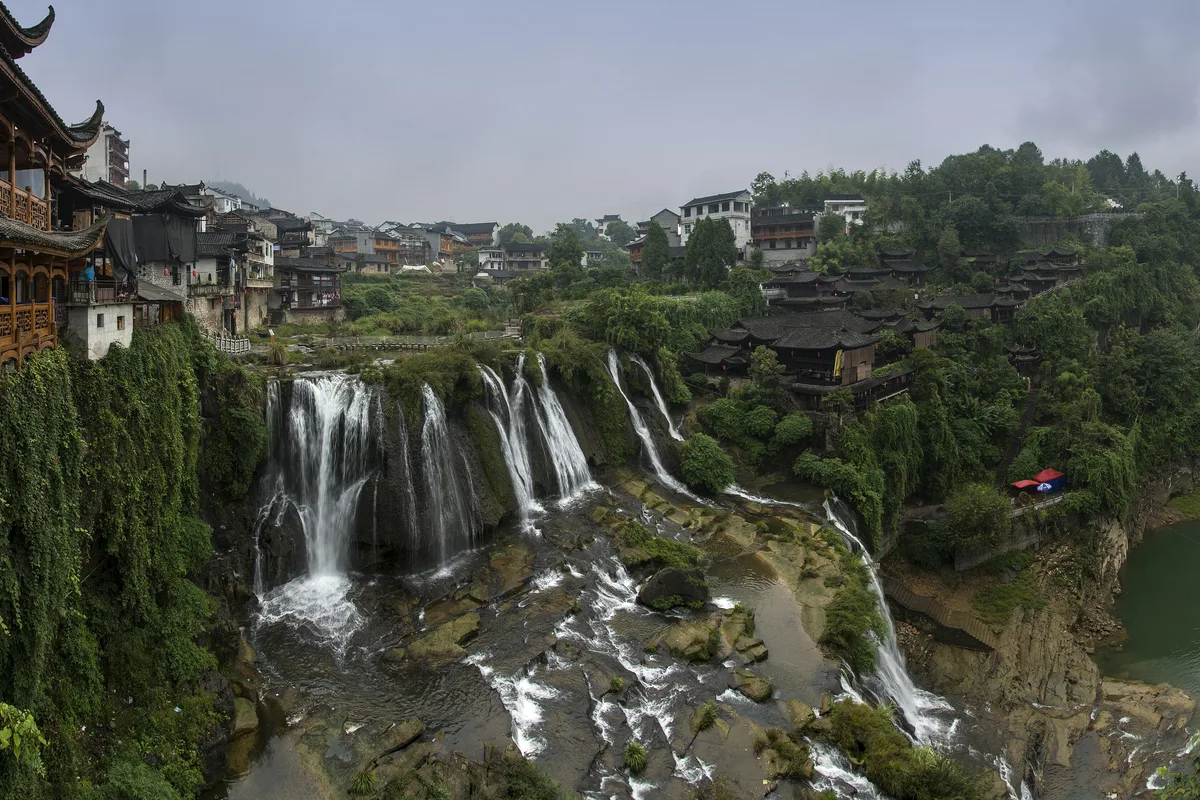
Furong Town is a village that grew around a waterfall. The part you came for is small enough to walk in an evening. Fenghuang is a river town with lanes running back from both banks, and it takes a full day and a half before you stop feeling like you are skimming it.
That difference decides more than any ranking does. Here is what actually separates them, and how to work out which one belongs in the trip you are already building.
The short version
| Furong Town | Fenghuang | |
|---|---|---|
| What it is | A village built around a two-tier waterfall | A river town spread along both banks of the Tuo |
| Time to do it justice | An afternoon and a night | Two days |
| From Zhangjiajie West | about 25 minutes, 40 yuan | 51 minutes to 1 hour 10, 75 to 93 yuan |
| Entry | 108 yuan, valid three days | free since April 2016 |
| What you came for | The waterfall, walkable behind, lit at night | The river, the stilt houses, the lanes |
| Evenings | a lit gorge, seen inside an hour | a long riverside promenade that runs late |
| Crowds | manageable even in season | heavy, heaviest after dark |
| Pick it if | you have one night and want the photographs | you have two days and want a town to wander |
Two towns, one railway line
The Zhangjihuai high-speed railway opened in December 2021 and put both towns on a single line running west out of Zhangjiajie. That is the fact that makes this a real decision rather than a hypothetical one: you are not choosing between two separate detours, you are choosing what to do with the same one or two nights on the same set of rails.
The distances are short. Zhangjiajie West to Furong Town is about 25 minutes and 40 yuan in second class. Zhangjiajie West to Fenghuang Gucheng is 51 minutes to 1 hour 10, and 75 to 93 yuan. Between the two towns it is 27 to 40 minutes, from about 53 yuan.
So the honest way to frame it is not which town is better. It is: you have a fixed number of nights, both towns want the same one or two of them, and only one of the two will fit the way you actually travel.
They are not the same kind of place
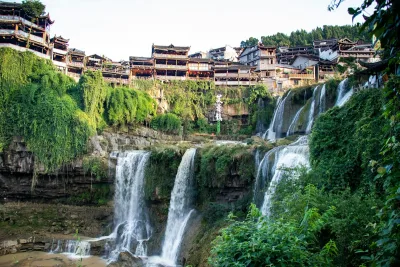
Furong Town is small, and deliberately so. The ticketed core is a gorge with a waterfall running through the middle of it, a stone street, and stilt houses stacked up the sides above the water. There are two streets worth walking and you will walk both of them twice. The whole thing is legible in an afternoon.
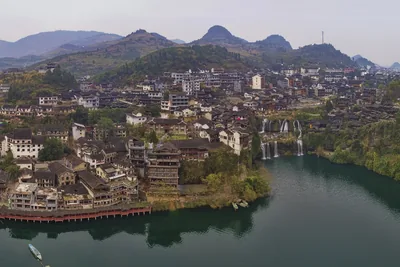
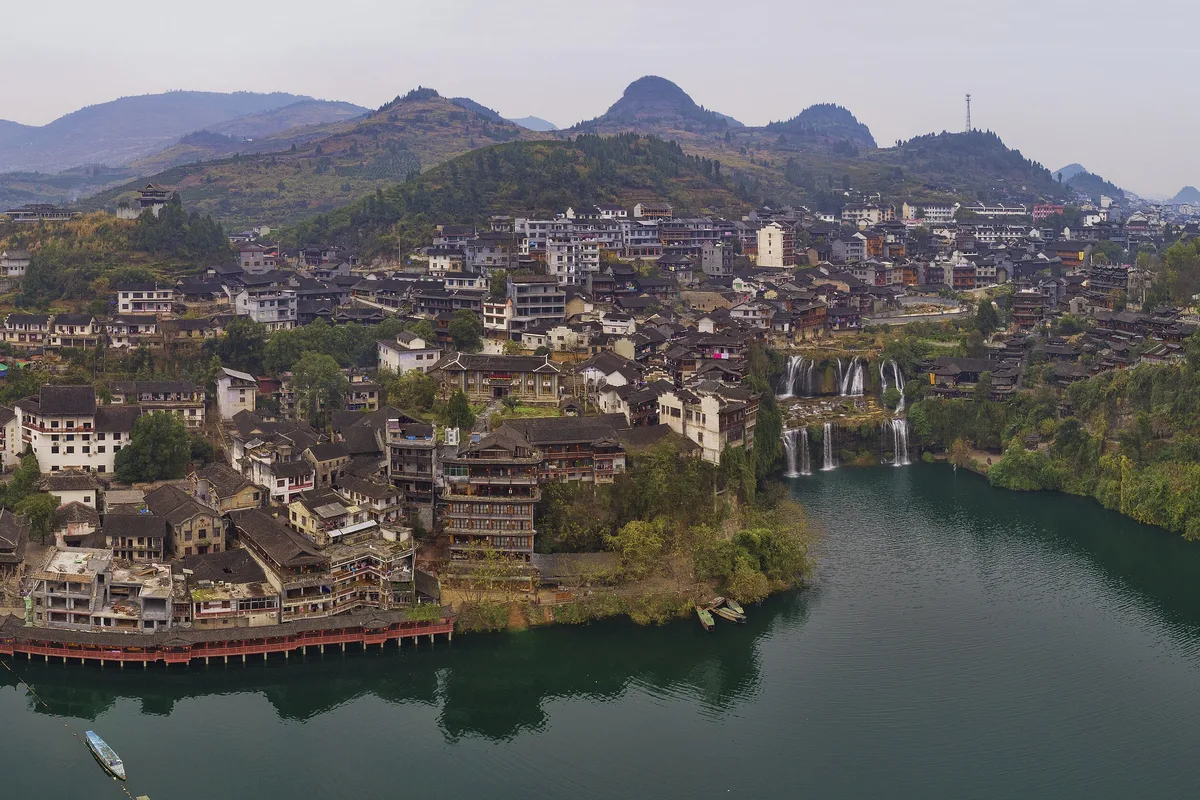
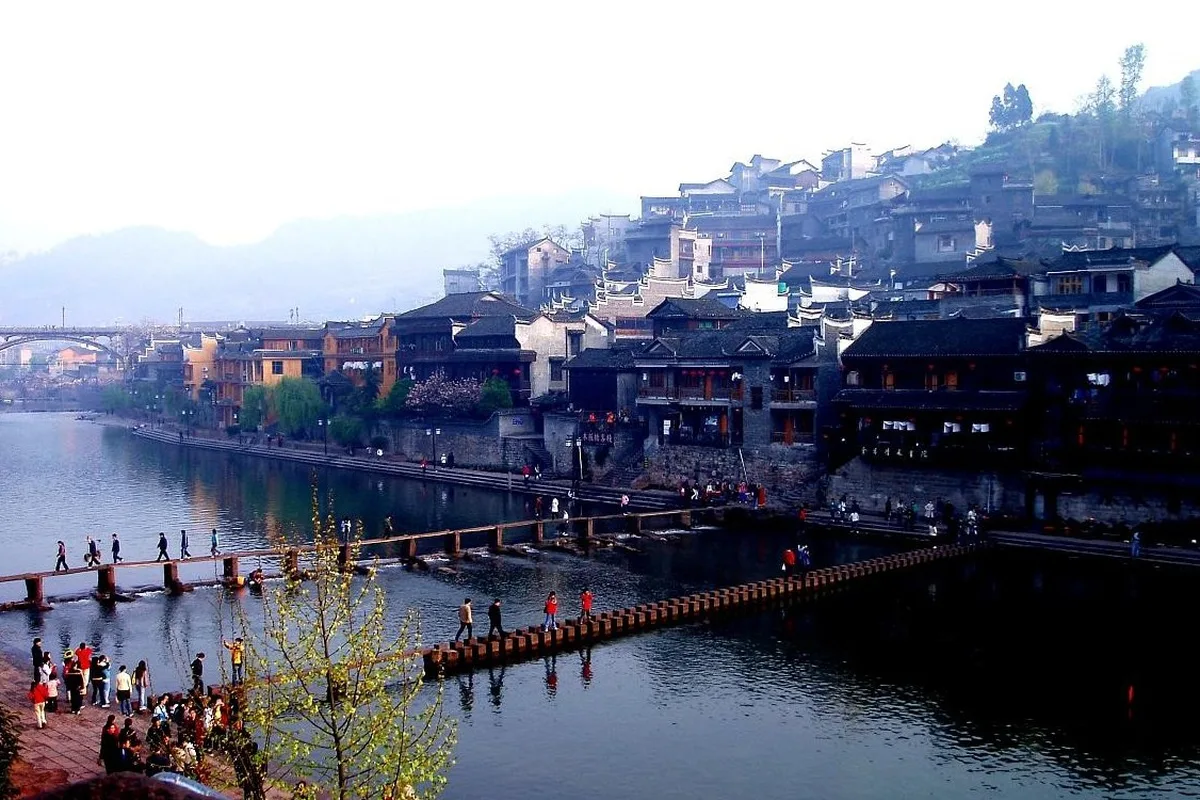
Fenghuang is a town. The Tuo River runs through the centre, the old lanes climb back from both banks, and the far side is a wall of stilt houses built out over the water. It has neighbourhoods rather than streets. It has a museum, several ancestral halls, a proper market, and lanes where the buildings are homes rather than shops. Walking it from one end of the old town to the other is a half-day on its own, before you have stopped to look at anything.
This is the point people miss when they compare the two on paper. Furong Town is a place you see. Fenghuang is a place you stay in.
The waterfall, and the river
Furong Town has one landmark and it is not subtle: a two-tier waterfall dropping through the centre of the village. You can walk behind part of it along a water-curtain walkway, which is the photograph everyone came for and also the reason the walkway is slick underfoot. When the falls are running hard after rain, the walkway closes and the town’s main attraction becomes something you look at from the side rather than walk through.
Fenghuang has a river instead. The Tuo is crossed by the jumping stones and by the Hongqiao bridge, and both banks are lined with stilt houses, some genuinely old and some rebuilt in the last twenty years. It is not one view. It is the same view repeating with variations for about a kilometre, which is why people who like Fenghuang describe it as somewhere to wander and people who do not describe it as somewhere that never ends.
Night: a short lit gorge, a long lit river
Furong Town after dark is the reason most people come at all. The lighting is aimed at the gorge: the cliff face, the waterfall, the walkway behind it. It is genuinely spectacular and it takes about an hour, because there is nowhere else for the light to go. After that the town goes quiet, and if you are the sort of traveller who wants something to do at ten in the evening, you have run out of town.
Fenghuang after dark is a different animal. The lighting runs the length of both banks, the promenade fills up, the bars along the water open, and it stays busy until late. Travellers who want a quiet evening find Fenghuang exhausting. Travellers who found Furong Town’s evening short find Fenghuang exactly right. Both reactions are correct.
Tickets: one charges, one does not
Furong Town charges 108 yuan at the gate for an adult, and the ticket is valid for three days with unlimited entries and exits. It covers the waterfall and its platforms, the water-curtain walkway, Tuwang Palace, the performance halls and the stone street. It does not cover the Youshui River cruise or the internal shuttle, which together run to about 68 yuan. Chinese booking apps commonly sell the gate ticket for 98 to 103 yuan. If you want the detail, the full breakdown of the Furong Town ticket covers what is included and what is not.
Fenghuang has not charged a town entry fee since 10 April 2016, when the 148 yuan gate ticket was scrapped after three years in force. The core old town, the riverbank, the jumping stones and the entire lit-up evening are free to walk, with no ticket window and no reservation. What is ticketed is a group of nine individual sights, sold together at about 128 yuan for three days: the former residences, the East Gate Tower, the old city museum, several ancestral halls and a boat ride. Buy it if you want those buildings. You do not need it to see the town.
That asymmetry changes how a stay feels. In Fenghuang you can arrive late, walk in, eat, and leave in the morning having paid nothing, which makes it easy to treat as a stop rather than a destination. In Furong Town the 108 yuan is already spent, and the three-day validity is an argument for staying long enough to see the place in daylight and again under lights.
Pick Furong if you want this
- One night rather than two, and no slack in the schedule.
- The waterfall is the actual reason you are here, not a bonus on the way to somewhere else.
- A place you can finish. Some travellers find a town they cannot finish stressful rather than appealing.
- Quieter evenings, and the option of being back at your guesthouse by nine.
- Photographs of one dramatic thing rather than a hundred metres of pleasant riverbank.
Pick Fenghuang if you want this
- Two nights, or you are continuing further along the line anyway and the stop costs you nothing extra.
- You would rather wander than tick off. Fenghuang rewards people with no plan.
- The evenings are the point, not the sightseeing. This is the single clearest difference between the two.
- Crowds do not bother you, or you are willing to walk ten minutes back from the river to escape them.
- You want somewhere that still functions as a town, with a market and houses and ordinary life in it.
If you have the days, do both
The two towns are 27 to 40 minutes apart by high-speed train, with second class from about 53 yuan, so treating them as alternatives is a choice rather than a necessity. The order that works is the order the line runs in: Zhangjiajie first, because it is the biggest and the furthest east, then Furong Town, then Fenghuang. Both towns have their own station, and the leg between them is short enough to do in the late evening.
The four-day and five-day shapes of that loop, with the night allocations that make it work, are set out in the Xiangxi loop itinerary. What matters here is only that doing both is available to you, and that it costs about an hour of travel.
The mistake that turns one of these into a wasted night
The failure mode is the same shape in both towns, and it is worth naming because it is the thing that most often ruins the plan.
People decide to see one of these towns as an evening bolted onto a Zhangjiajie day. The train times look fine. What they have not checked is the connection at the other end. Zhangjiajie West to Wulingyuan, where most people are sleeping, runs its last bus at about 19:00 to 19:30, and the buses stop before the trains do. The same gap exists on the Fenghuang side, where the station is 7 to 10 kilometres out of town.
The working rule is to check the last bus first and then work backwards to the train, rather than the other way round. The Furong Town day trip and last train piece works this through for Zhangjiajie specifically, including the last bus, the last train and the taxi fallback. Whichever of the two towns you pick, that is the calculation to do before you book anything.
Frequently asked questions
Is Furong Town or Fenghuang better?
They are different shapes rather than different quality. Furong Town is a small village built around a waterfall and you can see everything that matters in an afternoon and an evening. Fenghuang is a full river town that needs two days before you stop skimming the surface. If you have one night, take Furong. If you have two, take Fenghuang.
Can I visit both Furong Town and Fenghuang in one trip?
Yes, and they are close enough that it is not a stretch. The two towns are 27 to 40 minutes apart by high-speed train, with second class from about 53 yuan. Most people run Zhangjiajie, then Furong Town, then Fenghuang, because that is the order the line runs in.
Which is closer to Zhangjiajie?
Furong Town. It is about 25 minutes from Zhangjiajie West on the high-speed line, against 51 minutes to 1 hour 10 for Fenghuang Gucheng. That gap is why Furong works as an evening bolted onto a Zhangjiajie trip and Fenghuang does not.
Does Fenghuang charge an entry ticket?
Not since 10 April 2016, when the 148 yuan town gate ticket was scrapped. The core old town, the riverbank, the jumping stones and the lit-up evening are all free to walk. A group of nine individual sights sells together at about 128 yuan for three days, which is worth buying only if you want those particular buildings.
Which one is better at night?
Furong Town’s night is more concentrated and far shorter. The lighting is aimed at the gorge and the waterfall, and you will have seen it inside an hour. Fenghuang’s lighting runs the length of both river banks and the promenade stays busy until late. Neither is better; one ends and the other does not.
Is Fenghuang too commercial?
The riverside is, and the riverside is where everyone goes. Walk ten minutes back from the Tuo River in either direction and the lanes are quiet, the shops turn into houses, and people are living in the buildings you came to look at. Furong Town has the opposite problem: it is small enough that there is no quiet quarter to retreat to.