Xinjiang in Winter: Skiing at Altay and Kanas Snow Country

Ask someone to name a Chinese ski town and you get one of two answers. Chongli, because of the 2022 Olympics. Harbin, because of the ice festival. Both are the wrong answer if what you want is dry powder, quiet lifts and a season that starts in October.
That snow is in Altay prefecture, at the northern tip of Xinjiang, roughly 4,000 km west of Beijing. The prefecture has four ski resorts, one of them 1.6 km from the centre of the capital town, and it opens while the rest of the northern hemisphere is still raking leaves. It also has Kanas, the lake-and-village district that Chinese photographers treat the way Europeans treat the Dolomites, and which almost no one outside China visits in winter.
The catch is real. Altay is far, the cold is serious, English is thin, and the roads that connect the resorts to the snow country close on a schedule that has nothing to do with your itinerary. This guide covers what is confirmed for the 2026-27 season, what it costs, and what to arrange before you fly.
Why Altay, and why winter
Altay calls itself the birthplace of skiing, and it has the evidence to make the claim without embarrassment: rock art in the Kanas area showing hunters on skis, dated by Chinese archaeologists to roughly 10,000 years ago. Every ski town in the world has a version of this story. Altay’s is older than most and better documented than you would expect.
What matters for a trip is the practical side. The snow is cold and dry, which is the champagne texture skiers chase and which the Pacific-facing Japanese resorts do not have. The season is the longest in China, from late October to late April at the two lower resorts, and into May at the high one. And the terrain is not a groomed hill with a hotel attached. Keketuohai tops out at 3,100 m with 1,350 m of vertical, and Jikepulin publishes 1,466 m, more than any resort in Australia, Japan or Korea.
The trade-off is that this is not the Alps. Lift infrastructure is new and sometimes runs on Chinese operating logic. Rental shops may not have your boot size in a 29.5. Instructors who teach in English exist but are not plentiful. And the distances are punishing: Altay is a four to five hour flight from Beijing or Shanghai, and the resorts are then an hour or more by road.
If you ski well and you have a week, this is one of the best-value powder trips on earth. If you have four days and you have never skied, go to Chongli. Our comparison of China’s three ski regions lays out that decision in more detail, and the China versus Japan cost breakdown is the one to read if you are choosing between the two countries.
The four resorts, and who each one suits
Altay’s four resorts share a single ticket discount scheme and a single free-day policy, but they are not interchangeable.

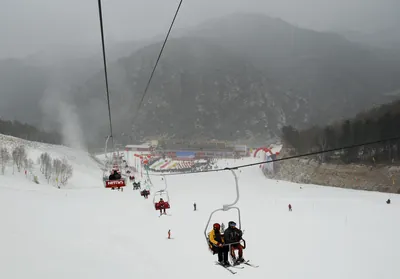
Jiangjunshan is the city resort. It opened on 30 October 2026 and sits 1.6 km from Altay’s main square, which makes it the only high-mountain ski area in China you can reach on a ¥2 city bus. It has 67 runs across 74 km, 8 lifts and 11 magic carpets, 460 m of vertical, two FIS-certified runs, and a night session that runs until late. The terrain suits intermediates best: the upper mountain is steeper than the vertical suggests, but the runout is forgiving.
Keketuohai is the early-season and advanced mountain. It opened on 20 October, the first outdoor resort in the country to do so, and its 2025-26 season ran 199 days from 12 October to 28 April, with 640,000 visits. There are 23 built runs over 61 km, 8 lifts, a top station at 3,100 m and a maximum vertical of 1,350 m. The resort sits above Koktokay town in Fuyun county, which means a shuttle rather than a walk. The snow holds late into April here when everything else in China has closed.
Jikepulin is the big one, above Hemu in Burqin county. It publishes 103 runs, 108 km of piste, 1,466 m of vertical and a longest run of 11,176 m, which makes it the largest lift-served terrain in the country by its own numbers. It began trial operation on 4 November 2026, with a formal opening event on 15 November, and has run into May. The honest description is that the mountain is finished and the village is catching up: lifts and terrain are serious, accommodation and services are still thin, and the wind at the top can shut the upper chairs without much notice.
Qinggelilangshan, in Qinghe county, is the value option and the one almost no international visitor knows. Two zones, A for beginners and B for more confident skiers, plus a cable-car sightseeing ticket for people who want the view without the descent.
| Resort | Base town | Vertical | Runs | 2026-27 opening |
|---|---|---|---|---|
| Jiangjunshan | Altay city | 460 m | 67 runs / 74 km | 30 October |
| Keketuohai | Koktokay, Fuyun | 1,350 m | 23 runs / 61 km | 20 October |
| Jikepulin | Hemu, Burqin | 1,466 m | 103 runs / 108 km | 4 November (trial) |
| Qinggelilangshan | Qinghe | not published | two zones | late November |
What a lift ticket costs in 2026-27
Prices below are the published gate rates for the 2026-27 season, split into weekday, weekend and public holiday. Holidays means New Year and Spring Festival, which in 2027 falls in early February.
| Resort | Full day, mid/advanced | With rental | Night session |
|---|---|---|---|
| Jiangjunshan | ¥310 / ¥360 / ¥460 | ¥360 / ¥410 / ¥510 | ¥140 / ¥140 / ¥240 |
| Keketuohai | ¥360 / ¥440 / ¥470 | ¥480 / ¥560 / ¥590 | not offered |
| Jikepulin | ¥399 / ¥499 | ¥499 / ¥599 | limited |
Jiangjunshan also sells a four-hour beginner ticket at ¥245 on weekdays, which is the cheapest way to try the sport at a resort of this standard. Rental at all four covers skis, boots and poles. Jackets, trousers, goggles and helmets are separate, and a full outfit rental in town costs less than on the mountain.
Two discounts sit underneath the gate price. Xinjiang residents, students, serving military, police and firefighters pay 30 percent of the gate rate. Altay residents ski free with ID. Both are excluded during Spring Festival. Neither applies to a visitor arriving on an international passport, but they explain why the lift queues on a January weekend are full of locals who paid ¥108 for a ticket you paid ¥360 for.
The free ski day for fly-in visitors
This is the single best deal in Chinese skiing, and it is not a marketing rumour. Arrive at any of the three airports that serve Altay prefecture, keep your boarding pass, and you get one free day of skiing or sightseeing at one of the four resorts.
The details matter. The window is five natural days counted from your landing day. The pass can be paper or electronic, but an electronic pass must display that you have arrived. Transfers count, so a Urumqi connection works. It is one use per boarding pass, not one per person per trip. Rentals and lessons are not included. Spring Festival is excluded. And you have to present yourself in person at the resort, because a screenshot will not be accepted.
The scheme was published by Fuyun county’s culture and tourism bureau on 15 October 2026 and applies across Jiangjunshan, Keketuohai, Jikepulin and Qinggelilangshan. Confirm it at the ticket window before you build a day around it, because these schemes are renewed season by season and the terms are set locally.
One practical note: if the free day is the reason you are flying in, use it at Keketuohai or Jikepulin. A free day at Jiangjunshan saves ¥310. A free day at Jikepulin saves ¥399 and gets you the biggest terrain in the country.
Getting to Altay
There are three airports and they serve different resorts. Altay Xuedu (AAT) is 15 km from Altay city and the natural gateway to Jiangjunshan. Burqin Kanas (KJI) is the closest airport to Jikepulin and Hemu, and it stays open through the winter, with a daily Urumqi rotation and new Urumqi services added from 10 December. Fuyun Koktokay (FYN) is about an hour from Keketuohai, with a 50 minute flight from Urumqi four days a week.
The 2026-27 winter schedule at Altay Xuedu is better than most people assume. Beijing has one to two flights a day, Shanghai two to three, Chengdu and Xi’an two to three each, Hangzhou and Chongqing one a day, Guangzhou four a week and Shenzhen three a week. From 15 December, Nanjing, Wuhan and Changsha are added at two to three a week. That is a real winter schedule rather than a summer timetable with a ski note attached.
If you are coming from outside China, the usual routing is a flight to Beijing, Shanghai or Urumqi and a domestic connection. Urumqi to Altay is 75 to 90 minutes with five or more flights a day, and fares from about ¥390. Urumqi to Fuyun is 50 minutes from ¥640. Our domestic flights guide covers how the booking works with a non-Chinese passport.
Trains exist and are slower. Urumqi to Fuyun on the K9751 takes 5 hours 41 minutes. Altay to Fuyun is 1 hour 30 minutes for ¥23.5. There is no high-speed rail into Altay prefecture, and in winter the flights are not a luxury, they are the sensible option.
From Altay airport to the city is 26 to 30 minutes and about ¥30 by taxi. The railway station is 20 km out. Jiangjunshan runs a city bus from the centre for ¥1 to ¥2, with a ski rack, plus hotel shuttles and taxis at ¥10 to ¥15.
Kanas and Hemu in winter
Kanas is the reason to come if you are not only skiing. The scenic area covers Kanas Lake, Hemu village and Baihaba, and it runs a winter season from 16 October 2026 to 30 April 2027.

The ticket is one of the simplest in China: ¥100 per person for three days, covering all three areas. Capacity is capped at 14,000 a day, and booking is by real name through the official Kanas scenic area mini-program or the Yuanxingwang app. Bring the passport you booked with.
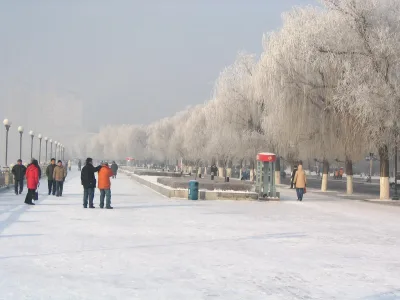
What you get for that is a frozen lake with a channel of open water where the current runs, larch forest under a metre of snow, and Hemu’s wooden village roofs steaming in the morning. The winter population is a fraction of the summer one, and the light in December and January is low and blue for most of the day.
One thing to settle before you go: the official winter notice covers vehicles rather than shuttle fares. driving into Hemu requires a parking reservation through the Yuanxingwang mini-program, and without one you park at the Hemu visitor centre and take the scenic-area shuttle in. Kanas and Baihaba villages can be driven into, with parking in designated areas, in a 4WD on snow tyres. Whether the ¥100 ticket covers any internal shuttle ride is still not stated, so budget separately and confirm at the gate or on 400-111-0906.
Baihaba is the third village and the one to think about carefully. See the passport section below.
Driving the Ahe highway
The road from Altay city to Hemu is the Ahe highway, 209 km of mountain road with no fuel station and no service area along its entire length. From 16 October to 14 May it operates in winter mode, and the rules are enforced at the barrier.
Vehicles must be seven seats or fewer, four-wheel drive, with snow tyres fitted. The Altay to Hemu section opens between 10:00 and 14:00 in both directions. The Altay to Yekaxia section opens 10:00 to 17:00. Every vehicle must be off the road by 20:00. Temporary closures happen without much warning when there is heavy snow, ice or avalanche risk, and there was one on 15 October 2026 before the season had properly started.
That schedule is the single most important constraint on a winter itinerary. Miss the 14:00 window and you are not going to Hemu that day. The alternatives are a flight into Kanas airport, or a hired driver who knows the road and the timing. If you are renting a car, the rental must be a 4WD with winter tyres, and most airport rental counters will not have one unless you booked it in advance.
Where to base yourself
Altay city is the easiest base and the right one for a short trip. Hotels are cheap by Chinese city standards, the airport is 30 minutes away, Jiangjunshan is a bus ride from the centre, and there are enough restaurants to eat well for a week. The downside is that Keketuohai is a two hour drive and Jikepulin is three to four hours on the Ahe highway.
Koktokay town, below Keketuohai, is the base for the early-season mountain. The resort shuttle picks up from the hotels in town from about 08:30, and the ride is 15 km. Town to Fuyun county is another 54 km, which matters if you are arriving by air.
Hemu is the base for Jikepulin and for the snow country itself. It is a village of wooden houses rather than a resort, and accommodation is guesthouse-scale. Stay two or three nights if you want mornings in the village and days on the mountain. Do not treat it as a day trip from Altay city in winter, because the road window makes that a five hour round trip with no margin.
A sensible split for a week: three nights in Altay city for Jiangjunshan and the city, then two nights in Koktokay for the bigger mountain, then two in Hemu if the road is open. Or skip Koktokay and give Hemu four nights.
The cold, honestly
Kanas in December has a mean temperature around minus 12°C, and January around minus 16°C. Nighttime lows of minus 20 to minus 30°C are normal, and cold snaps take it to minus 35 or lower. Altay city is milder but not by much.
That is cold enough to change how you pack. A single heavy jacket over a T-shirt will not do it: you want a base layer, a fleece or down mid layer, and a shell, plus a balaclava or buff, goggles that do not fog, mittens rather than gloves, and boots rated for the temperature. Hand warmers are worth the ¥10. Phone batteries die in the cold, so keep the phone inside your jacket and carry a power bank.
The China packing guide covers layering for the north in more detail. The short version is that every piece of gear you would take to Hokkaido works here, and the rental shops cover skis and boots but not clothing.
Passports, permits and the Baihaba problem
Xinjiang has border areas that require a permit, and the rules for non-Chinese passports are stricter than the published rules suggest.
Baihaba is the clearest case. It sits on the border with Kazakhstan and requires a border-area permit, which since April 2026 can be applied for online by Chinese residents but must be done in person by everyone else. Multiple 2026 trip reports say that non-Chinese passport holders are turned back at the checkpoint regardless, with some adding that Hong Kong and Taiwan residents can enter after registering locally. There is no official notice that states this. Treat it as the working reality and skip Baihaba unless the hotline tells you otherwise.
Kanas and Hemu themselves are open to international visitors and need no permit beyond the scenic area ticket. Carry your passport, since tickets and hotel registration are both real-name.
On visas: the 240-hour visa-free transit policy explicitly excludes Xinjiang, so you cannot use it to enter or visit the province. The unilateral visa-free scheme for 48 countries allows 30 days and does cover Xinjiang, but as of November 2026 it runs only to 24:00 on 31 December 2026. If you are travelling in January or February 2027, plan on a tourist visa unless a new announcement extends it. Our Xinjiang first-timer guide covers hotel registration, connectivity and the security environment in more depth.
What still isn’t settled
Three things will change between now and mid-season, and each one can move a trip.
Jikepulin’s opening date is officially mid-November, with reports of a trial operation starting earlier in the month. Trial and full opening are not the same thing: expect limited lifts and terrain in the first week whenever it happens.
The ¥100 Kanas winter ticket covers entry to the three areas; internal shuttle fares are not specified in the official winter notice. Budget separately for any shuttle ride and confirm at the gate.
And the winter flight schedule is still being filled in. The Nanjing, Wuhan and Changsha routes from 15 December are announced but not yet flown, and winter schedules in western China get trimmed when loads are thin.
The response to all three is the same: book refundable where you can, keep a buffer day at each end, and check the resort’s WeChat account the week you travel. Altay rewards people who plan around its constraints, and punishes people who treat it like a resort in the Alps.
Frequently asked questions
When does the ski season start in Xinjiang?
Earlier than anywhere else in China. Keketuohai opened on 20 October 2026, Jiangjunshan followed on 30 October, and Jikepulin began trial operation on 4 November, with its formal opening event set for 15 November. The season runs to the end of April at the first two, and Jikepulin has run into May in past years. December to March is the core window, when all four Altay resorts are fully open and the snow base is deepest.
How much is a lift ticket in Altay?
For the 2026-27 season, a full-mountain day pass at Jiangjunshan costs ¥310 on a weekday, ¥360 at the weekend and ¥460 on public holidays. Keketuohai charges ¥360, ¥440 and ¥470 for mid and advanced terrain, and Jikepulin about ¥399 to ¥499. Adding rental gear is roughly ¥50 to ¥120 more. Rentals cover skis, boots and poles only, not clothing.
Is the free ski day with a boarding pass real?
Yes, and it is the best-value offer in Chinese skiing. Land at Altay, Kanas or Fuyun airport, and your boarding pass gets you one free day of skiing or sightseeing at any one of the four Altay resorts, within five natural days of arrival. It does not cover rentals or lessons, it is excluded during Spring Festival, it is limited to one use per boarding pass, and an electronic pass must show that you have arrived. Turn up in person with the pass.
How do I get to Altay from Beijing or Shanghai?
Fly. In the 2026-27 winter schedule Altay has one to two daily flights from Beijing, two to three from Shanghai, and two to three each from Chengdu and Xi’an, plus four a week from Guangzhou and three from Shenzhen. From 15 December, Nanjing, Wuhan and Changsha are added. Most routes take four to five hours, and a connection through Urumqi adds a 75 to 90 minute hop with five or more flights a day.
Can I visit Kanas and Hemu in winter?
Yes. The scenic area runs a winter season from 16 October 2026 to 30 April 2027, with a single ticket of ¥100 per person covering Kanas, Hemu and Baihaba for three days. Daily capacity is capped at 14,000, and tickets are booked by real name through the official Kanas WeChat mini-program. Roads in are ploughed but weather-dependent, and Hemu requires a parking reservation if you drive in.
Can I go to Baihaba with a non-Chinese passport?
In practice, no. Baihaba sits on the border and requires a border-area permit, and multiple 2026 trip reports say non-Chinese passport holders are turned back at the checkpoint even with a permit arranged. No official notice publishes this rule, so treat it as the working reality rather than law. If Baihaba matters to your trip, call the scenic area hotline on 400-111-0906 before you build an itinerary around it.