Qixing Mountain Via Ferrata: Zhangjiajie's 168-Meter Sky Ladder
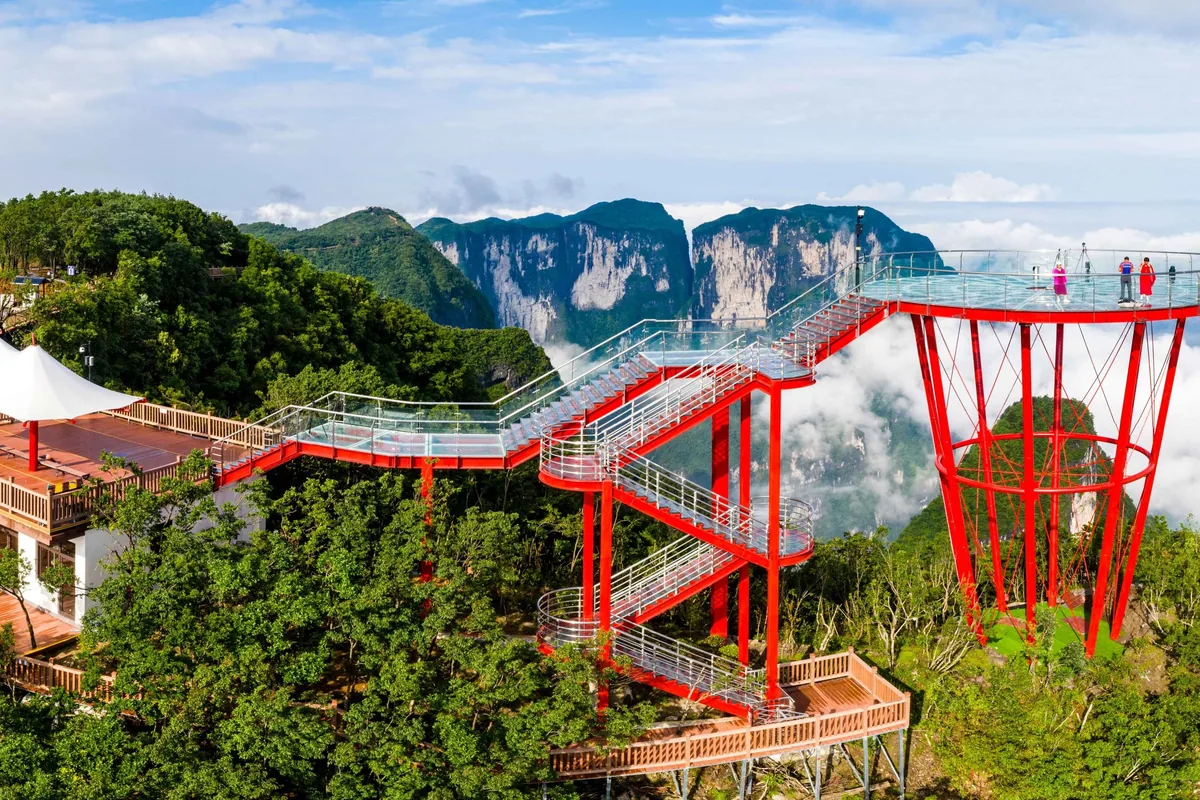
Zhangjiajie has three famous parks and one that almost nobody outside China has heard of. Qixing Mountain sits in Yongding district, about 13 km from the city centre and roughly the same distance from Tianmen in the other direction. It is not the sandstone forest at Wulingyuan and it is not the glass bridge. It is a single mountain with a cable car up one flank and a via ferrata bolted to the cliff on the other.
If you have seen a video of someone climbing a steel ladder that appears to hang off the edge of the world, this is where that was filmed.
What the mountain actually is
Qixing means seven stars. The summit is a little over 1,500 m, which makes it shorter than Tianmen and much shorter than the Wulingyuan pillars. That is not why people come.
People come for two things. The first is the cable car, the Qixing Ropeway, which runs 2,003 m with a vertical rise of 708 m and is routinely described as one of the steepest sightseeing cableways in Asia. The ride takes six to eight minutes. The second is the via ferrata, a protected climbing route where you clip into a steel cable and work your way along the rock face. It opened in November 2024 and has since become the mountain’s reason for existing.
Two numbers explain why it caught on. Nearly 150,000 people have climbed the route since it opened, and around 27,000 of them came from outside China, from 42 countries. Its signature feature is a 168 m ladder called the Lingyun Sky Ladder, standing at an incline of more than 50 degrees high on a face above 1,480 m.
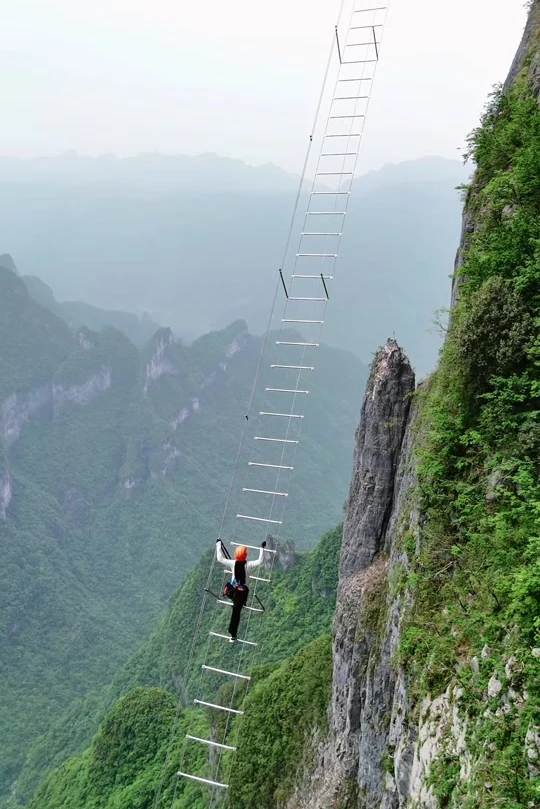
The sky ladder, honestly
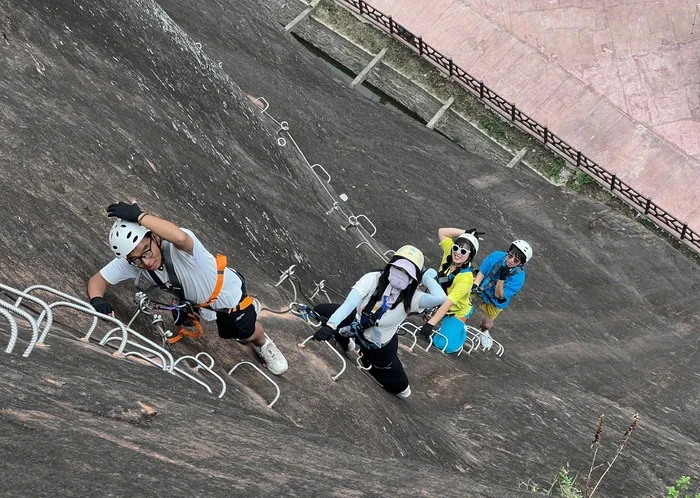
Here is what the ladder is. Not a gentle staircase with a handrail. It is a steel rung ladder fixed to the rock, running at roughly 50 degrees, with the valley floor a long way below and nothing between you and it except the cable you are clipped to. It is the centrepiece of the route rather than a short section of it.
Here is what makes it survivable for ordinary people. The route runs on a dual lifeline: two separate 12 mm steel cables, one for the continuous safety line and one threading the handholds themselves, so a failure in the hardware does not drop you onto a single point. You wear a harness with two locking carabiners, one of which cannot be opened without a tool and never comes off the line. A guide leads the group for the whole route. The operation holds a high-risk sports business licence, number 43080220240004, which is the Chinese permit category the government requires for exactly this kind of activity.
And here is the part the videos leave out. There is no exit partway. Once you are on, you finish. If you freeze at the ladder, the group waits with you.
Line 1 or Line 2
The via ferrata has two routes, and picking wrong is the main way to have a bad day.
Line 1 is the classic. Around 1.2 km, roughly three hours, and it includes the Lingyun Sky Ladder. It is built for people with no climbing experience and moderate fitness. This is the one almost everybody books.
Line 2 is the extreme version. Around 1.1 km but about four hours on the rock, with negative-angle overhangs where the wall leans out over you, more ladder sections, and an 80 m steel cable bridge. It is for people who have done this before.
Book Line 1 unless you have a specific reason not to. The ladder is on Line 1.
Who gets turned away
This is the section to read before you book flights. The via ferrata is a licensed high-risk activity, and the restrictions are enforced, not advisory.
| Rule | Line 1 | Line 2 |
|---|---|---|
| Minimum age | 12 | 16 |
| Maximum age | 60 | 55 |
| Minimum height | 1.4 m | 1.4 m |
| Maximum weight | 100 kg | 90 kg |
| Under 18 | Must be accompanied | Must be accompanied |
On top of the table, the operator does not accept anyone with high blood pressure, high blood sugar, high blood lipids or a heart condition, at any age. If you are over 60, or if any of that describes you, the route is closed to you regardless of how fit you feel. Pregnancy rules you out as well.
Two more things worth knowing. The mountain caps the via ferrata at 150 climbers a day, and it closes the route in ice, thunderstorms, heavy rain or high wind. Both of those mean your date can be moved at short notice, so do not make it the only reason for the trip.
What it costs
The park ticket and the via ferrata are separate purchases, and the ticketing is not simple.
The standard park package is ¥239, which is the gate ticket at ¥56, the cableway round trip at ¥156 and the shuttle bus at ¥27, bundled. Concession tiers exist at ¥120 and ¥92 for children, students, seniors and other qualifying groups, with documentation checked in person.
The via ferrata is charged on top of that, quoted at around ¥380, and most people end up buying a combined package that is advertised at about ¥780 all in. Treat the exact split as something to confirm at the moment you book rather than a number to budget from, because published figures from different channels do not reconcile cleanly, and concession rules interact with the package price.
Zhangjiajie’s development commission sets these prices and last extended the relevant schedule to the end of 2026. The practical move is to book through the Qixing Mountain official WeChat mini program, which is also where cancellations and weather closures are announced. GetYourGuide and Trip.com both list the mountain if you would rather book in a language you read, and both generally cost more.
Getting there
The cheapest way is the free shuttle, which runs from the Huatian Hotel in Zhangjiajie city from 09:00 to 16:00 at roughly 30-minute intervals and takes about half an hour to the cableway lower station. Nothing about it is obvious to a first-time visitor, which is why it gets missed.
A taxi from the city costs around ¥50 and takes about 25 minutes. From Zhangjiajie West railway station, where the high-speed trains arrive, it is roughly 40 minutes. If you are coming from the Wulingyuan side, where most of the hotels are, budget an hour and treat it as a separate day rather than something to bolt onto a forest park morning.
One warning worth passing on: at the railway station and the airport, unofficial drivers approach visitors and offer trips to the mountain. Some of them go elsewhere. Use the official shuttle or a ride-hailing app.
When to go
The mountain opens at 08:30 and closes at 18:00, but the last entry to the via ferrata is 13:00, which catches people out. You cannot start the route in the afternoon.
Aim for a dry day in spring or autumn. Summer works if you start early, because the rock face is exposed and the ladder has no shade. Winter is the risk, because Zhangjiajie does get ice and ice closes the route outright, not just the ladder. Check the weather the day before, not the week before, and check the mountain’s own channel rather than a booking site.
The rest of the mountain
The summit is not only the via ferrata. There is the Sky Eye, a circular glass platform at 1,520 m that cantilevers 16 m out over the drop, and a glass walkway called the Ruyi Bridge at 1,314 m that runs just under 200 m along the cliff. Both are included with the park ticket and neither is difficult.
There is also a 1,000 m alpine coaster down the mountain, charged separately, which is the standard way to finish the day if your legs are done.
What this is not
Three clarifications, because the names in this part of Hunan are a trap.
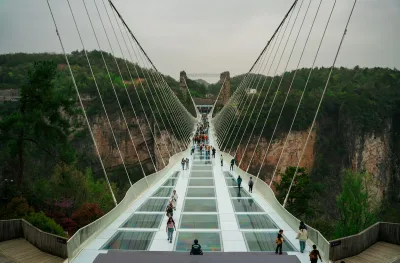
This is not the Grand Canyon. The glass bridge and its bungee jump are at a different park about an hour east, and the Grand Canyon has its own via ferrata on the canyon wall, which is a shorter, simpler route sold as part of an activity combo. If you want one via ferrata and you want the famous ladder, come here.
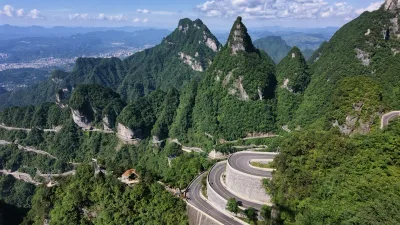
This is not Tianmen. Tianmen is the mountain with the hole in it and the wingsuit championship, and it has its own guide, which also covers the 999 steps and the cableway situation. You can do both in one trip. They are not the same day.
And this is not Wulingyuan. The Avatar pillars are 30 km north on a completely separate ticket system, and confusing the two is the single most common planning mistake in Zhangjiajie. Our guide to the three parks sorts out how they fit together, and the ticket guide covers booking mechanics and the passport rules, which apply to Qixing too.
Frequently asked questions
Do I need climbing experience for the via ferrata?
No, for Line 1. It is designed for beginners, you are clipped in the entire time, and a guide leads the group. What you do need is a head for heights on the ladder itself and the fitness to spend about three hours on a rock face. Line 2 is a different proposition and expects experience.
Is the sky ladder safe?
It is a licensed high-risk sports operation with a dual cable safety system, two locking carabiners per climber, and a guide throughout. It is also a 168 m ladder on a cliff at over 1,480 m, and the operator screens out anyone with heart or blood-pressure conditions for a reason. The honest framing is that the equipment and procedures are serious and the risk is real but managed.
Can I book Qixing Mountain with a foreign passport?
Yes. Ticketing is real-name and the passport is the document you register, then scan at the gate. Booking is easiest through the official WeChat mini program or an international platform, and if you book through a platform, check that your nationality is not excluded, because some package products carry regional restrictions.
How far in advance should I book?
About seven days. The daily cap is 150 climbers, which is low for a site with this reputation, and peak dates sell out.
What happens if it rains?
The route closes in heavy rain, thunderstorms, ice or high wind, and the mountain announces it on its own channels. Refunds or date changes are normally straightforward when the closure is on their side. Build a spare day into your itinerary if the via ferrata is the point of the trip.
Is the via ferrata worth it?
If you want the ladder, yes, and there is nothing else like it in China that is open to non-climbers. If you mainly want the scenery, the cable car and the glass platforms give you most of it for the price of the standard package, and you can skip the climbing entirely.