Wansui Mountain Martial Arts City: Iron-Flower Show and Ticket Traps

The park built on a lost imperial garden
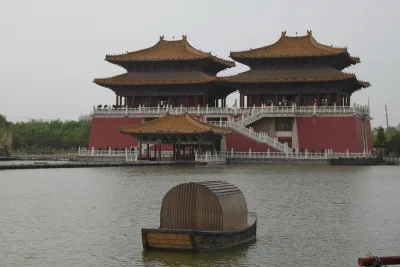
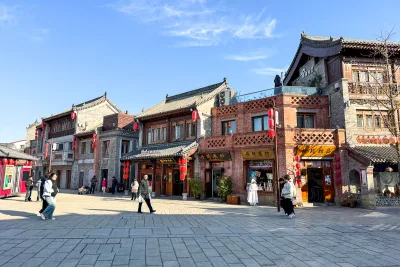
Wansui Mountain Martial Arts City occupies a stretch of Dongjing Avenue in Kaifeng’s Longting district, on the site of Genyue, the rock garden the Northern Song emperors built and then lost when the Jin took the city in 1127. Nothing of the original survives above ground. What stands there now is a national AAAA theme park about martial-arts fiction: a Water Margin street, a walled arena, a lake, and costumed actors who outnumber the visitors on a quiet weekday and are outnumbered by them on a busy one.
It is not a heritage site and it does not pretend to be. The buildings are new, the storytelling is Song-dynasty pulp, and the reason to go is the schedule rather than the architecture. The park says it stages around 4,000 shows a year, a figure that includes every two-minute street skit, and the honest way to plan a visit is to pick two or three things you actually want to see and let the rest happen around you.
That framing matters because most first-time visitors spend their money on the wrong risk. They worry about which gate, which ticket tier and whether the park is worth the entry fee. The thing that actually ruins the day is arriving without a ticket on a holiday, or walking in at seven in the evening and discovering that the show everyone came for needed a reservation they did not know existed.
If Kaifeng is one stop on a longer Henan trip, the Zhengzhou base guide lays out the day-trip maths, and the four capitals rail route puts the city in sequence with Luoyang and Anyang.
Tickets: ¥100, three days, four parks
The gate price is ¥100 for a full ticket and ¥50 for a half ticket, unchanged since it went up from the old ¥80 on 1 October 2025. The rise was announced in April 2025 and by now most of the English and Chinese guides have caught up, but a stubborn set of listings still shows ¥80, ¥60 or a night ticket that no longer exists. If a price you found is below ¥100, it is old.
The ticket is not only for Wansui Mountain. It covers four sites: Wansui Mountain itself, Hanyuan Stele Forest next door, the Kaifeng city wall, and Iron Pagoda Park across town. Hanyuan is a few minutes’ walk away. The wall is walkable or cyclable from the same cluster. Iron Pagoda Park is the odd one out and needs a short bus ride, which is the single most useful thing to know about the four-park bundle: it is a two-day ticket in disguise, not a one-day itinerary.
One detail that catches people out is how the three days work. A paper ticket bought at the window gives you one entry at each of the four sites within three calendar days of purchase. A real-name electronic ticket is better: it gives unlimited re-entry at each site, and the three-day clock starts at your first face scan at the gate, not at the moment you paid. Buy online, scan once, and you can come back the next morning without paying again.
The rules bend around holidays. For Spring Festival 2026, from 17 February to 4 March, Wansui Mountain dropped to a single entry within three days while the other three parks kept the usual terms. For 25 and 26 September and again from 1 to 5 October 2026, the park switched to unlimited entries within one single day, then went back to the normal four-park, three-day rule on 6 October. If you are travelling during a Chinese public holiday, the holiday calendar survival guide is worth reading before you book anything, and the Golden Week guide explains why the first two days of October behave differently from the rest.

The iron-flower show, and the reservation nobody mentions
Datiehua, iron-flower, is the reason most people come. Molten iron heated to roughly 1,600 °C is scooped from a furnace and struck with a wooden paddle against a cold surface, and it bursts into a shower of orange sparks that arcs over the arena and dies before it lands. The craft is claimed as Northern Song and was added to China’s national intangible cultural heritage list in 2008. The performers work close to the furnace, traditionally bare-chested with a gourd ladle as a face guard, and the trade rule is to strike white, not red.
At Wansui Mountain the show runs in the Fortress Battlefield arena, a walled pit inside the park, and it lasts about 25 to 30 minutes. The same arena stages a second reservation-only production, a live equestrian battle show with real horses, wire work and fire. Both are free with your ticket, and both require a booking that most visitors do not know about until they are standing outside a full arena.
Here is the part that matters. You cannot reserve before you arrive. The reservation channel only unlocks after the gate scan creates your same-day entry record, which is the park’s way of stopping people from holding seats they never turn up for. Once you are inside, the flow is: the park’s WeChat account, then the knight-service menu, then show reservations, then pick the show and the session and enter your details. You get a confirmation with a seat link. It is one booking per person per show per day, seats are assigned, and the quota resets the next morning.
So the sequence for an evening visit is entry first, booking second. Arriving at 19:00 and expecting to sit down at 19:30 is the mistake. Come in around 17:00, book the moment you are through the gate, eat something in the park, and then walk to the arena. Guides who have done it repeatedly suggest arriving 40 to 60 minutes before the show and aiming for the middle-to-back rows of the middle sections, which are outside the arc of falling sparks and still have a full view.
And the times? Nobody publishes a fixed timetable, and the versions in circulation disagree: 19:30 and 21:00, or 19:30 and 20:30, or 19:30 and 21:30, or a single show at 19:30 with extra performances on holidays. The park’s answer to all of it is the same-day programme in the mini-program. Snow, rain and strong wind cancel the show, and it has been cancelled for all three.
The big ticket trap, and the small ones
The main trap at Wansui Mountain is structural, and it is not the price. The park caps daily numbers at 100,000 and stops selling when the crowd approaches the cap, under the standard “limited, time-slotted, off-peak” formula Chinese scenic areas use. Around National Day 2026 that produced seven capacity notices in four days: sales were stopped on 1, 2 and 3 October, and on 4 October the park stopped both online and on-site sales. Visitors who already had tickets were still admitted; everyone else was told to buy for the next day and come back.
Read that again, because it is the whole article. On the busiest days of the year, the gate stops selling tickets, so a visitor who planned to buy on arrival has no ticket and no way to get one. Book a day ahead, online, and the trap does not exist for you.
The second trap is the reservation scalper. Free, quota-limited, real-name reservations are exactly the conditions that breed a resale market, and in May 2026 the park issued a statement saying it had never authorised any non-official platform to handle show reservations. A Dahe Daily report described a visitor who paid ¥88 to a middleman for a reservation slot and was then blocked. If someone is selling you a seat for a show that is free, you are buying a screenshot at best.
The third is quieter. The park’s in-park currency, paper silver notes handed out by costumed staff, is meant to be collected during the day and exchanged for small gifts. Counterfeit notes circulate on second-hand platforms, which is only a problem if you are the sort of person who buys a theme park’s props online.
The fourth is not a scam at all, just the accumulated sludge of the internet. Prices of ¥80 and ¥60, a ¥40 night ticket, a nightly show at a fixed eight o’clock, a park that closes in winter: all of it was true at some point and none of it is true now. The price change in October 2025 is the single event that made most of the stale content stale.
Getting there from either station
Kaifeng has two stations and neither is called Kaifeng East. From Kaifeng North, the high-speed station, Wansui Mountain is about 10 km away. A metered taxi takes 15 to 20 minutes and costs ¥15 to ¥20; ride-hailing is thin at the station, so join the taxi queue rather than standing on the kerb refreshing an app. Tourist bus loops 3 and 4 run from the north station to the park’s north gate in about 25 minutes and operate from 08:00 to 18:00.
From Kaifeng station, in the old city, it is closer and cheaper: about ¥10 and ten minutes by taxi. There is also a themed bus, introduced for the park’s Matchmaker Wang Po street show, that runs from the station straight to the park, 8 km for ¥2 between 09:00 and 18:00. City buses 1, 15 and 33 stop at a bus stop named after the park itself, which is the easiest thing to say to a driver or type into a map.
Kaifeng has no metro, and the address on Dongjing Avenue has no house number, so give a driver the park name rather than a street number.
The address is the middle section of Dongjing Avenue, Longting district, opposite the municipal Party School. If you are coming from Zhengzhou by train and want to combine Kaifeng with the rest of the province, the multi-ride rail ticket covers Kaifeng on its Zhengzhou-Luoyang-Kaifeng route, and the hidden cities guide explains why this city rewards an overnight stay rather than a rushed day trip.

If you only have one evening
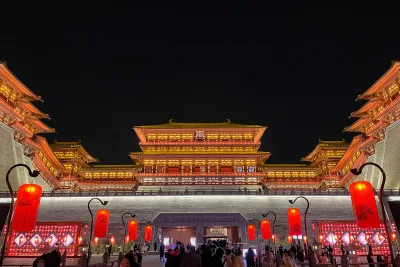
Go in during the afternoon rather than at nightfall, and treat the evening as the headline and the afternoon as the warm-up. The lighting comes on around 18:00 and the night programme runs roughly from 19:00 to 22:00, and the night zones are the part of the park people rave about: the lantern streets, the costumed crowd, and the show. Last admission is around 21:00, so a very late arrival risks missing the iron-flower show entirely, on top of the reservation problem.
The park is open until 23:00, which is late enough that a Kaifeng evening can be built around it. If you are choosing between Kaifeng’s two big costume parks, Qingming Shanghe Garden is the one built from a painting, with a large water-stage night show of its own and a ticket structure that hides a ¥120 mistake of a different kind. Wansui Mountain is the rougher, louder, better-value one.
A note on safety that the park itself has had to address. In April 2026 a poplar branch snapped in high wind near the middle gate and three visitors were lightly injured; the park apologised the next day and announced a full sweep of trees and facilities. In April 2025 the show-reservation mini-program crashed under demand and a crowd at the gate chanted for refunds. Neither incident is a reason to skip the park. Both are a reason to book ahead, arrive early, and not to treat a capacity-limited, weather-dependent show as a guaranteed appointment.

Frequently asked questions
Is the iron-flower show included in the ticket?
Yes, and it is the best value in the park. The datiehua show at the Fortress Battlefield arena costs nothing extra on top of the ¥100 gate ticket. What it does need is a free reservation made inside the park on the same day, and seats are assigned, so the reservation is the real ticket.
How do you reserve the iron-flower show?
Walk in first. The booking channel only unlocks after the gate scan creates your same-day entry record, so nobody can book it for you in advance. Then open the park’s WeChat account, Wansui Mountain Martial Arts City, go to the knight-service menu and then show reservations, pick the show and session, and enter your details. You get a confirmation with a seat link. One booking per person per show per day.
What time does the iron-flower show start?
There is no published fixed timetable, and the times quoted online disagree with each other: some say 19:30 and 21:00, others 19:30 and 20:30, others a single show at 19:30. Check the same-day programme in the mini-program when you arrive, or ask at the service desk. Shows are cancelled in strong wind, rain or snow.
Can you book with a passport?
The park lists a passport among the accepted real-name documents for entry, and international visitors are handled at a manual gate channel. Entry is fine. The show reservation runs through a WeChat real-name system, and no English-language account I could find documents an international visitor completing it, so treat your passport as the thing to take to the visitor service desk as soon as you are inside and let them book it for you.
Why do tickets sell out at Wansui Mountain?
The park caps daily visitors at 100,000 and stops selling when it gets close. Around National Day 2026 it issued seven capacity notices in four days, and on 4 October it stopped both online and on-site sales. If you turn up at the gate on a holiday without a ticket, you may simply be turned away, so buy the day before and buy online.
Is the ¥40 night ticket real?
No, or at least not anymore. A cheap night-only ticket circulates in old guides and resale listings, but it predates the price change on 1 October 2025, when the gate price went from ¥80 to ¥100. There is no verified night-only ticket now. The honest way to do an evening is to buy the normal ¥100 ticket, go in during the afternoon and stay for the night shows.