Zhangjiajie Hiking Trails: Walk Past the Cable Car Queues
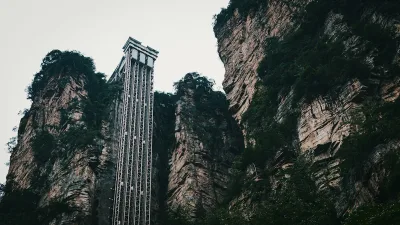
Zhangjiajie has a cable car problem, and it is not a shortage of cable cars. The Bailong Elevator can run to two hours of queue in peak season, and the Ten-Mile Gallery train can have you standing in line for 90 minutes by mid-morning. Underneath all that machinery, the trails are half empty by nine.
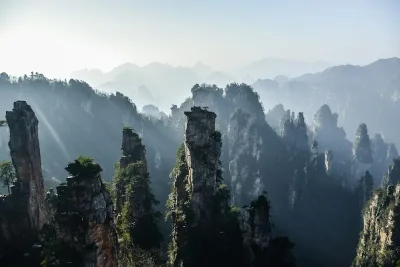
This is a park of quartz sandstone pillars, and the walking routes thread between them at valley level and along cliff tops. Some are flat. One is 3,878 steps. Almost none of them need a lift ticket, and none of them put you behind forty people moving at the pace of the slowest member of a tour group.
If you have not yet worked out how the three Zhangjiajie parks fit together, read our overview of the three areas first. You also need a timed reservation just to get through the gate. Everything below assumes you already have one.
What walking here actually means
Wulingyuan Scenic Area covers 26,000 hectares in four pieces: the national forest park proper, Suoxiyu, Tianzi Mountain and Yangjiajie. The four-day entry ticket covers every trail inside it plus the eco-bus network, and runs around ¥228. Cable cars, the Bailong Elevator and the Ten-Mile Gallery train are all extra.
Two things catch people out. There is no loop. The eco-buses run fixed directions between fixed stops, so the order you do things in decides how much you walk rather than how much you ride. And the park publishes its own list of walk-up diversion routes for busy days, which barely appear in English-language guides. We will come back to those.
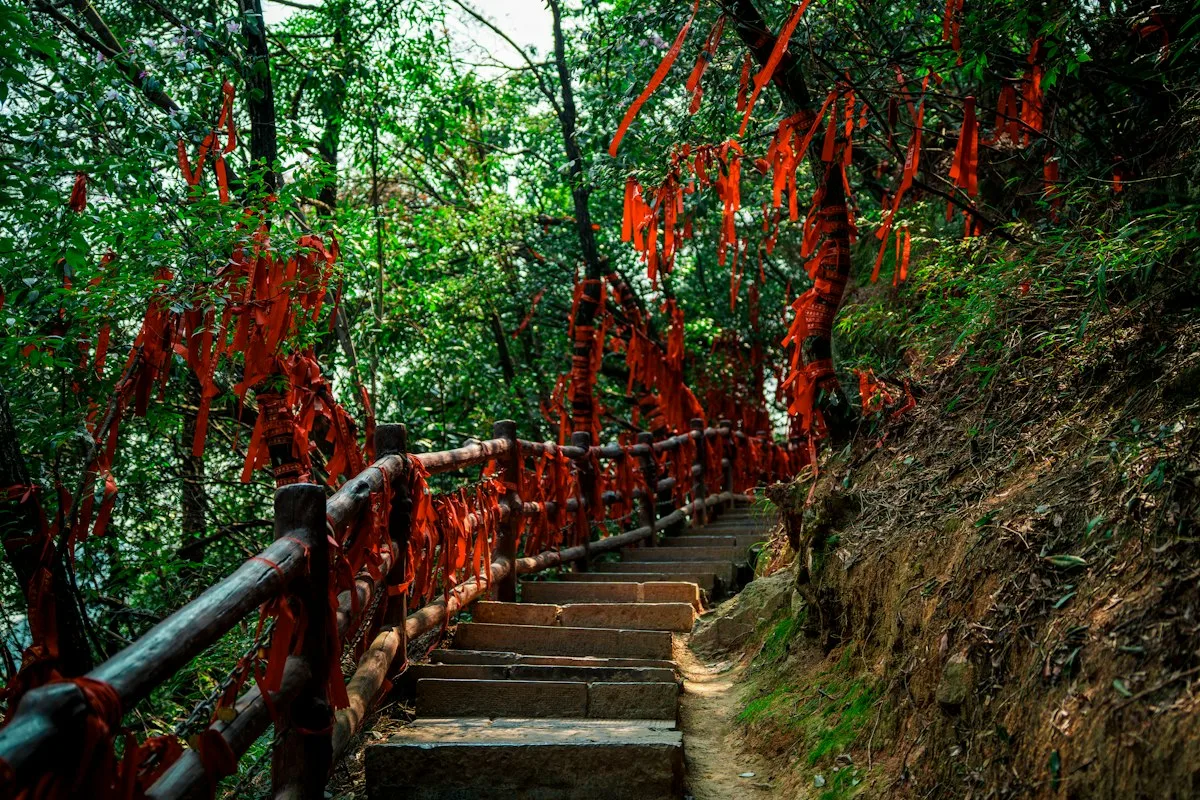
The trails themselves fall into two groups. Valley trails are paved or boardwalked, follow water, and are the ones your knees will forgive. Cliff and ridge trails are staircases. Chinese signage usually tells you the distance and rarely tells you the step count, which is the number that matters.
Golden Whip Stream: seven and a half flat kilometres
The best walking in the park, and the easiest. Golden Whip Stream runs 7.5 km from the Big Oxygen Bar square near the Forest Park gate down to Water Winding Four Gates, at the base of the Bailong Elevator. It is stone paving and boardwalk, with only a few short rises and no real climb.
Figure on two and a half to three and a half hours with stops. Water is the thing to plan around: there are stalls at both ends and a couple of small shops mid-route, but the quiet middle stretch has nothing, so carry a litre and a half. The park’s own two-day itinerary budgets two hours for the stream, which is honest only if you do not stop to look at anything.
The rocks along it have names, and the names are the point. Golden Whip Rock stands 380 m above the valley floor. Further along come God Eagle Protecting Whip, Splitting Mountain to Save Mother, and Thousand-Mile Meeting, a cluster of pillars that reads as a group of figures from the right angle.
The reason to walk it early is not scenery. It is that coach groups turn back about a quarter of the way in, because their schedule has them queuing for the elevator instead. Past that point the path empties out, and you get the valley to yourself while several thousand people stand in a line 300 m above your head. One warning: the stone near the water grows moss and turns genuinely slick after rain. This is a flat trail, not a safe one for smooth soles.
Ten-Mile Gallery is two kilometres, not ten li
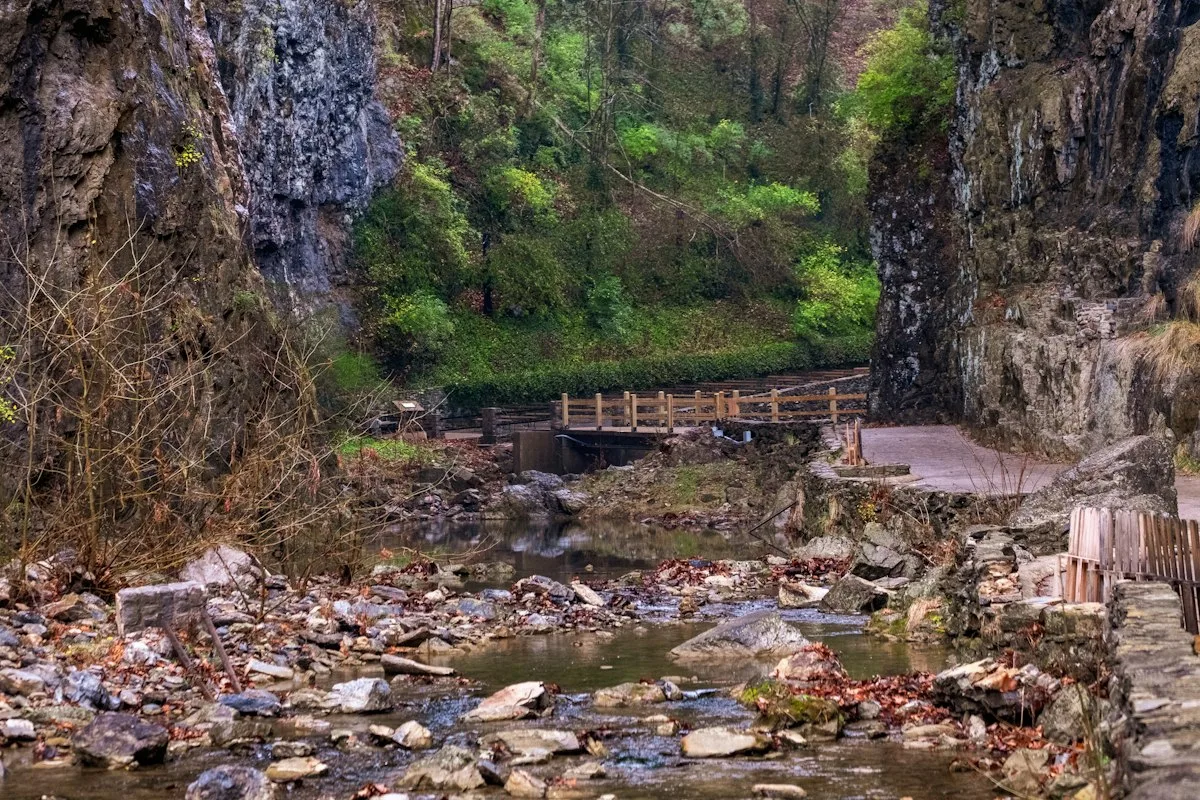
The name promises a gorge ten li long, and the tourism office quotes 5.8 km. Walkers who have measured it put the walkable section at about 2 km one way, which is 4 km if you go down and back. Twenty-five to forty minutes each way. It is flat the whole way.
The mini-train runs the same stretch in five minutes and is the single most oversold thing in the park. Tour groups buy it because it is included in their package; independent walkers queue up to 90 minutes for it between ten and three. The station sign quotes 5.6 km, which is close to triple what your legs will actually measure.
Do it the other way round. Ride down, walk back. The return leg is very slightly downhill, and you will pass every train passenger standing in a photo scrum at the two named viewpoints.
Huangshizhai: 3,878 steps, or a cable car
Huangshizhai, also called Yellow Stone Village, is a flat-topped mesa at 1,080 m with a loop of viewpoints on top. The climb is the point of the place, and the number to hold in your head is 3,878 steps. English guides sometimes round this to “more than 4,500”, which is the kind of rounding that changes whether you attempt it.
The path up is about 4.8 km with roughly 900 m of gain. Fit walkers do it in 100 minutes; most people take two hours or a little more and are useless for the afternoon. At the top there is a summit circuit, 1.3 km short version or 2.5 km long version, and both are flat.
The cable car is 990 m long, rises about 430 m, and takes ten minutes. One way is around ¥65. The return fare is quoted as both ¥118 and ¥130 depending on whose 2026 price list you read, which is worth knowing before you decide to walk up and ride down. Riding up and walking down is the harder option on your knees, not the easier one.
My view: walk it. The staircase is shaded, the steps are even, and the alternative is eight minutes in a glass box with forty people. If anyone in your party has knee trouble, put them on the cable car and meet them at the top.
The diversion routes the park publishes
This is the part that no English guide mentions. In its own 2026 holiday notice, the park lists four walking routes as official alternatives to queueing:
| Diversion route | What it replaces |
|---|---|
| Tianzi Pavilion to South Heaven Gate via Moon Pass | Tianzi cableway |
| Huangshizhai front slope | Huangshizhai cableway |
| Yangjiajie Wulong Village to Balipo | Yangjiajie cableway |
| Back Garden to Thousand-Mile Meeting via Luancuanpo | Bailong Elevator |
Read that last one carefully, because Luancuanpo is the cheap way up to Yuanjiajie and its status is contested. Some ticket platforms still list it as closed until the end of 2027, while the park’s own September 2026 notice lists it as an active diversion. It is 2,000 to 3,000 steps through forest with almost no views, and it exists to save you the elevator queue and the elevator fare. Phone the park on 0744-5719217 before you build a day around it.
Yangjiajie, Wulong Village and Tianbo Mansion
If you want the park without the crowds, this is where you go. Yangjiajie is the least-visited of the four zones, and the Wulong Village route is the reason. It reopened on 30 September 2025 after a long closure.
The route goes from Wulong Village through a slot called One-Line Sky, where you turn sideways to pass, then up near-vertical stone steps with iron chains bolted to the rock as handholds, finishing at the Tianbo Mansion platform at 1,043 m. Mapped, it is about 6.4 km and roughly 400 m of gain. Two and a half to three hours for the main route.
It is not a beginner’s trail and it is not dangerous either, provided you are comfortable on steep steps and you do not do it in the rain. What it is, is empty. The West Gate walk-up, Balipo, is a different matter: 4 km of poorly maintained, wet, viewless path that nobody uses. Take it as a descent if you must, not as an ascent.
Daguantai: where the tour groups do not go
Daguantai, the Grand Viewing Platform, sits in the Tianzi Mountain zone near a village called Dingxiangrong, reachable by eco-bus. Tour groups rarely make it this far, which is the entire argument for going.
From the steps to the left of the platform you drop to a disused kiosk where the path splits. Left is Rooster Pecking at Food and One Step Too Hard, about 30 minutes return. Right is Immortal Bridge and Tianzi Seat, around 90 minutes return. Allow three hours if you do both branches properly.
Two safety notes. Immortal Bridge is a natural stone span about 1.5 m wide with no railings on either side, and the entrance is now wired shut: look at it, do not walk it. One Step Too Hard was once a gap you jumped; a visitor died there, and it has since been bridged and netted. Sunrise from Daguantai is around 05:00 in summer and 07:00 in winter, which means staying in the village the night before.
Yaozizhai: shut for ten years, reopened in 2025
Yaozizhai closed in early 2016 under the provincial heritage protection regulations so the ecology could recover. It stayed shut for about a decade, and it reopened on 27 September 2025. The park grades it five stars out of five for difficulty, its hardest listed walking route.
There is no cable car and no transport of any kind. It is 5.3 km one way from the Golden Whip Stream oxygen bar area, past landmarks called Hundred Echo Valley, Golden Snail Asking Heaven and Eagle Beak, up to a 1,050 m summit with cliffs on three sides. Allow a full day, bring lunch, and start near the Forest Park gate.
The circuit is around 10 km and takes five to seven hours. The front half is gentle and the back half is steep, with sections along the cliff edge that have no railing. The downhill eco-bus runs roughly once an hour, and last uphill admissions are around 16:00. Even now, few visitors go, which after ten years of closure is exactly the appeal.
Shadaogou and the walk-ups worth skipping
Shadaogou enters from the Golden Whip Stream road and climbs about 8 km through a rough ravine to the Back Garden area. Everyone who has walked it says the same two things: the scenery is the best of any route up to Yuanjiajie, and almost nobody walks it. It is earth and loose stone, unmaintained, with no facilities and no supplies. Trip.com currently lists the area as suspended, and no other source corroborates that, so treat its status as unconfirmed. Every Chinese guide that mentions it adds the same line: do not go alone.
Luancuanpo we covered above. It is a staircase with no views, and its closure status is unclear. If you want to walk up to the cliff-top zone rather than ride, Yaozizhai and the Yangjiajie side are the better uses of your legs.
Which routes are hard on your knees
The park does not publish step counts, and the numbers below come from Chinese hiking forums and field reports rather than official notices. The flat ones are reliable; the stair ones are estimates and the sources disagree.
| Route | Character | Steps |
|---|---|---|
| Golden Whip Stream | Paved valley trail, minimal climb | Few |
| Ten-Mile Gallery | Flat, ~2 km each way | Few |
| Yuanjiajie cliff-top walkway | Mostly flat, ~1,500 m | ~100, at the First Bridge |
| Daguantai branches | Stone steps, moderate | Few hundred |
| Luancuanpo | Forest staircase, no views | 2,000 to 3,000 |
| Huangshizhai ascent | Shaded stone staircase | 3,878 |
| Wulong Village to Tianbo Mansion | Near-vertical steps, chains | Steep throughout |
| Yaozizhai | Front gentle, back steep, cliff edge | 5 to 7 hours |
| Wolong Ridge descent | Five ridges, up and down | Commonly quoted as 8,888 |
That last figure, 8,888, is folklore rather than a survey, and 7,000 is the more defensible number. What is not in dispute is the shape of it: five ridges, each one up and then down, on a descent from Tianzi Mountain toward the Ten-Mile Gallery. Multiple sources say the same thing about it, which is that you should take the Tianzi cable car instead if your knees are not good.
Monkeys, wet stone and the rules for walkers
The macaques along Golden Whip Stream are wild, and they are the most common cause of injury in the park: a mother scratched a visitor there, and a child was mobbed for food. Do not feed them, do not make eye contact, do not carry a visible plastic bag, and do not try to snatch anything back once it is taken. Solitary males and mothers with infants are the ones to give a wide berth.
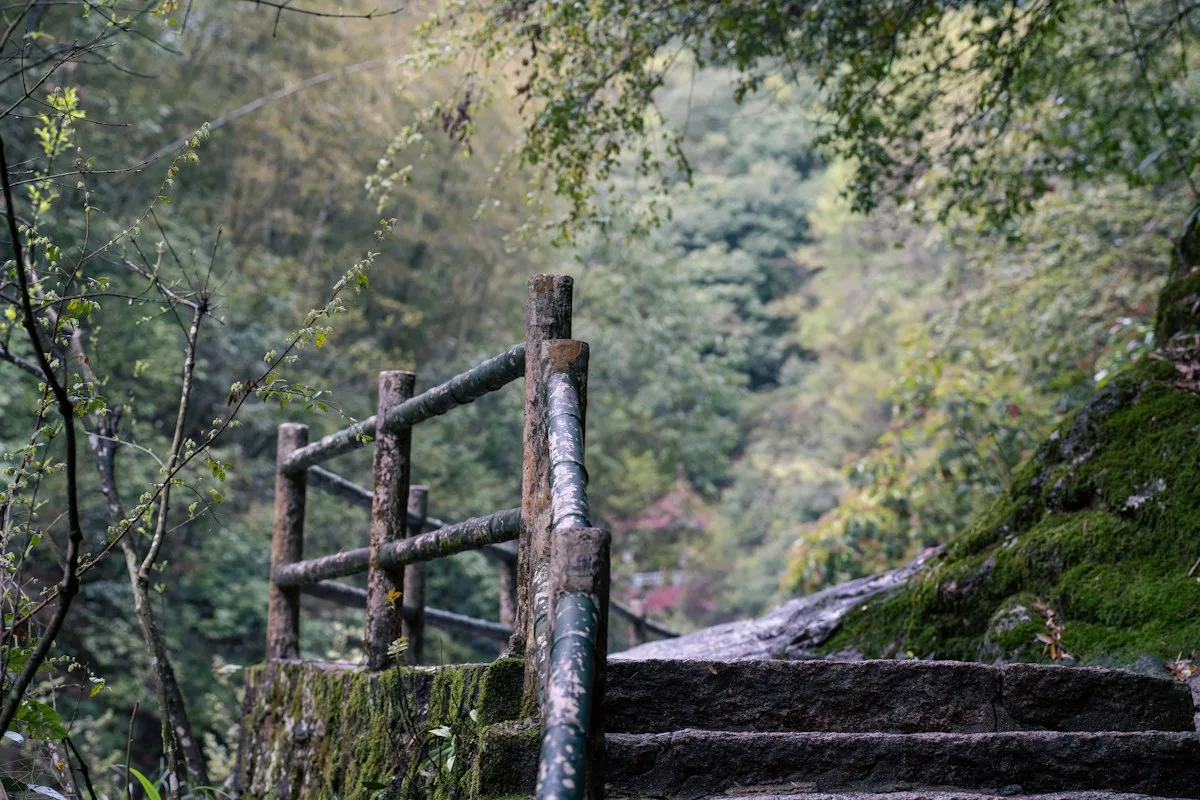
Stone steps here turn slick in rain, and the mossy boardwalk near water is worse than the steps. Wear shoes with tread, and bring a poncho rather than an umbrella so both hands stay free for railings. The park ropes off low streamside platforms after heavy rain and posts yellow alerts advising against stream wading.
Two rules that surprise people. Camping and overnight stays inside the park are banned; you go in and out the same day. And since June 2025 the park caps entry at 53,000 people a day across all five gates, counting both first entries and re-entries, so a second day on the trails needs a fresh reservation.
Cost, if you are weighing the whole trip, is worth checking against what a similar number of days costs elsewhere in China. If you are travelling over a public holiday, the Golden Week crowds change every calculation, and the park’s diversion routes stop being optional and start being the only sane plan.
One last distinction, because it comes up constantly. Tianmen Mountain, the one with the 999 steps and the glass walkways, is a separate park 30 km away in Zhangjiajie city, and it is not a hiking mountain: you ride to the top and walk around it. The Grand Canyon and its glass bridge are a third park again. Wulingyuan, where all the trails above are, is the one worth bringing proper shoes for.
Frequently asked questions
How many days do I need for the trails?
Two full days for the valley and cliff-top essentials, three if you want Yaozizhai or the Yangjiajie side properly. The four-day ticket makes three days cheap, and the 53,000-a-day cap means each day needs its own reservation.
Is Golden Whip Stream flat?
Effectively yes. It is 7.5 km of paving and boardwalk with only a few short rises. It is not, however, accessible: there are uneven stones, narrow bridges and sections that turn slippery after rain.
Can I walk up instead of taking the cable car?
Yes, and the park actively encourages it on busy days. Huangshizhai is 3,878 steps up and takes two hours. Yangjiajie and the Yaozizhai route are walk-ups with no lift at all. Luancuanpo is the walk-up to Yuanjiajie, but its closure status is disputed, so phone before relying on it.
Which Zhangjiajie trail is quietest?
Yaozizhai, which reopened in September 2025 after ten years closed, and the Wulong Village route in Yangjiajie. Golden Whip Stream is quiet past the first quarter, because coach groups turn back early. Yuanjiajie’s cliff-top walkway and the Ten-Mile Gallery train are the two places to avoid between ten and three.
Do I need hiking boots?
Shoes with real tread, yes. The stone steps are slick in rain and the mossy boardwalk beside the streams is worse. Boots are not necessary on the valley trails, but smooth-soled trainers are a bad idea anywhere in the park.
Is there anywhere to stay inside the park?
No. Camping and overnight stays are banned, and you must exit the same day you enter. Stay in Wulingyuan town by the East Gate, or near the Forest Park gate if you want an early start on Golden Whip Stream or Yaozizhai.