China in February: Weather, Crowds and Where to Go

February is the month where the calendar does more damage than the thermometer. Guangzhou averages 20.0°C in the afternoon. Harbin averages −5.9°C and drops to −17.8°C at night. Neither number is a problem. The problem is the nine days in the middle of the month when the entire country travels at once.
Every other month of the Chinese year you plan around weather. February you plan around a holiday. Chinese New Year’s Day falls on 6 February 2027, and the State Council has fixed the public holiday at 5 to 13 February, with working weekends on 31 January and 14 February to pay for it. That single block sets hotel rates, train availability and opening hours for weeks on either side.
There is a second change from January, and it is administrative rather than meteorological. The 30-day visa-free scheme for 50 countries ran out at midnight on 31 December 2026. Unless it has been renewed by the time you read this, February is the first month in two years when most visitors need a visa in advance.
Every temperature below is the 1991–2020 climate normal from the China Meteorological Administration. They describe what February usually does, not what it will do this year.
What February actually feels like
| City | Average high | Average low | Rain days | The short version |
|---|---|---|---|---|
| Harbin | −5.9°C | −17.8°C | 3.6 | Ice park in its final weeks, nights near −20°C |
| Beijing | 6.1°C | −4.2°C | 2.3 | Cold, dry, the clearest skies of winter |
| Xi’an | 9.3°C | −1.1°C | 4.7 | Warmer afternoons, haze in still air |
| Lhasa | 10.4°C | −4.2°C | 1.2 | Bright days, hard frost at night |
| Chengdu | 12.1°C | 4.9°C | 7.9 | Grey and damp, no heating |
| Shanghai | 10.7°C | 4.1°C | 10.4 | Wettest of the eight |
| Kunming | 18.5°C | 5.8°C | 3.7 | Warmest and driest corner of the country |
| Guangzhou | 20.0°C | 12.5°C | 9.4 | Mild, humid, rain starting to return |
Rain days means days with at least 0.1 mm of precipitation. The interesting number in this table is not the temperature but the gap between north and south, because February is when that gap starts to close. Against January, Harbin gains 5.9 degrees by day and Xi’an 4.3, while Guangzhou gains 1.3 and Shanghai 2.0. The difference between Harbin and Guangzhou shrinks from 30.5 degrees to 25.9 in a single month. The north is doing the warming; the south has already arrived where it is going.
Precipitation tells the opposite story. Shanghai stays the wettest of the eight with 10.4 rain days and 65 mm, still damp and still unpleasant indoors. Guangzhou’s rain days jump from 7.2 to 9.4, the first sign of the wet season that will define the south from March onward. Kunming goes the other way and dries out: 3.7 rain days and 11.9 mm, the driest month of its year, which is why February is the month Yunnan looks best in photographs. Lhasa records measurable precipitation on 1.2 days, Beijing on 2.3.
Daylight is now clearly on your side. Beijing’s sunset moves from about 17:30 at the start of February to about 18:00 at the end, and Harbin gains roughly forty minutes of evening light, from about 16:30 to about 17:10. In the northeast that still leaves a short sightseeing day, but the worst of the 16:00 darkness is over.
On the traditional calendar, spring begins before the new year does. Lichun, the first solar term, falls at 09:46 on 4 February 2027, two days before Chinese New Year’s Day. Yushui, the start of the rains, arrives at 05:33 on 19 February. Neither date changes the temperature. They do explain why the light feels different by the end of the month.
February is three trips in one month
The most useful thing to understand about February is that the first four days, the holiday and the last two weeks are not the same country to travel in. Prices, transport and opening hours all move together.
1 to 4 February: the quiet before the storm
This is the calmest window of the month and, in most years, one of the cheapest stretches of the Chinese winter. The New Year holiday is over, the Spring Festival rush has not yet peaked, and hotels in the big cities are still priced for low season.
It is also the week when China starts to close. Migrant workers leave the coastal cities early to beat the rush, small restaurants and shops shut for the holiday well before the official dates, and some attractions trim their programmes. You get low prices and short queues, at the cost of a country that is visibly winding down. If your plan is palaces, walls, museums and mountains, that trade is worth taking. If your plan depends on a specific restaurant or a family-run guesthouse, confirm it is open before you build a day around it.
Train tickets go on sale 15 days before departure, which means the 5 February trains appear on 22 January. That date matters more than it sounds, because the first hour of sales decides whether the holiday week is possible by rail at all.
5 to 13 February: the holiday
Nine days, from New Year’s Eve to the day after the seventh day of the new year. The country sends people home and then sends them out again, and the ticketed attractions absorb the difference.
What this looks like in practice: timed-entry slots at the Palace Museum, the Terracotta Army and the big city museums disappear days ahead. Hotel rates in Harbin, Sanya, Chongli and the historic towns commonly double or triple; the same room at the same hotel is a different price bracket on 3 February and on 6 February. Trains on the popular corridors sell out within seconds of release, and the guide to the Spring Festival travel rush explains why booking earlier does not solve it.

What you get for the trouble is a festival with no real equivalent elsewhere. Temple fairs run in parks and old streets for the first six days, with opera stages, sugar-figure sellers, candied hawthorn and paper lanterns. Cities put on lantern displays that stay up until the Lantern Festival. Fireworks, banned in most city centres for the rest of the year, are tolerated in designated spots. If that is the reason for the trip, the crowds are the price of admission and the honest advice is to stay in one city rather than tour five.
The other side of the holiday is worth knowing. As workers leave, the coastal megacities empty out. Shenzhen and Guangzhou lose much of their street life for a week, some restaurants close entirely, and the roads clear. You can have an unnaturally quiet city and a completely jammed railway station on the same afternoon. For a photographer, that contrast is the best week of the year.
14 to 28 February: the rebound
The 14th is a working Saturday, and it is also the return peak, with the last of the holiday traffic heading back to the coast. After that, the domestic market goes home and the country resets.
This is the value window. Hotel rates fall back within days rather than weeks, attraction slots open up again, and the south is at its most pleasant before the spring rains arrive. For anyone who wants Harbin without paying holiday prices, the second half of February is the answer, with one caveat: the ice is beginning to soften, and the park closes when it does.
The Lantern Festival falls on 20 February 2027, a Saturday, and closes the season. Streets and parks that have been lit since New Year’s Eve run their final displays, and families eat tangyuan, the sweet glutinous rice balls that give the festival its name. It is a gentler night than New Year’s Eve and, in most cities, much easier to move around in.
Harbin in February: the last of the ice
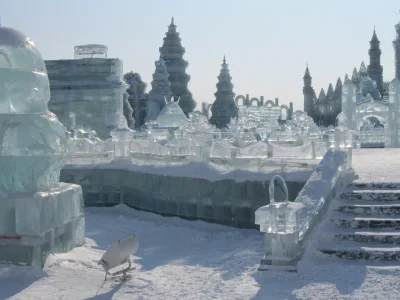
At a press conference on 10 November 2026 the city confirmed the window for the 28th Ice and Snow World: it opens in mid-December and runs into late February. February is therefore the last month in which the park exists, and the second half of it is a countdown rather than a season. It is a real risk rather than a formality: the 2025-26 park closed early, on 21 February, after a run of warm weather cut the season short before its planned end date.
The scale does not shrink with the calendar. The site covers 1.25 million square metres, roughly 175 football fields, with a Frozen-themed zone built with Disney China, around 100 ice slides and a 120-metre Ferris wheel. By February everything has been standing long enough to look settled, and the ice is at its thickest rather than its thinnest for most of the month.
Prices for 2026-27 had still not been published as of mid-November 2026. Last season remains the only honest guide: ¥328 for a standard adult ticket, ¥298 in the opening week, ¥800 for a VIP pass that skips the queues at the big slides and the wheel. Sun Island’s snow sculpture expo was ¥198 and the Zhaolin Park ice lantern garden around ¥150 in 2025-26. Treat those as last season’s numbers until the park posts new ones, and buy through the official WeChat mini-program rather than a reseller.
The weather is the reason February works. Average nights are −17.8°C and average days −5.9°C, which is cold enough to keep the ice intact and roughly five degrees easier than January at both ends of the day. The practical rule is unchanged: treat the park as a series of short outdoor shifts. Arrive around 14:00 and see the sculptures in daylight, when the ice looks like pale jade, stay for the lights after 17:00, and duck into a heated pavilion every half hour. Phone batteries still die within an hour in the cold, so keep the phone in an inside pocket and carry a power bank. The pavement is packed snow, not tarmac, which makes boot tread more important than a fourth layer on your chest.
The Harbin ice festival guide has the current season details and the transport options from the city centre.
Where February is at its best
Yunnan and the southwest
Kunming averages 18.5°C by day and 5.8°C at night in February, with 3.7 rain days and 11.9 mm across the month. That is the driest month of its year and the warmest February of the eight cities here. Days are warm enough for a shirt, evenings are not, and the dry air keeps the light clean.
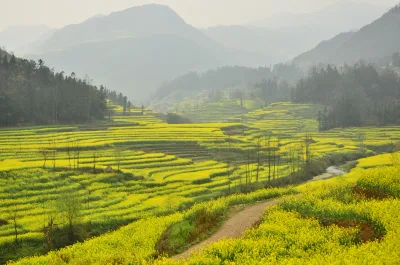
This is also the month the countryside does its thing. The rice terraces around Yuanyang are flooded and reflecting the sky from December through March, and February sits in the middle of that window, with mist in the valleys most mornings and almost no foreign visitors. Farther east, the rapeseed around Luoping comes into flower from mid-February and turns the hills yellow for a few weeks. Neither place is in the climate table above, and neither appears in package tours, which is the point.
If you are thinking about a month rather than a week, the Yunnan winter long-stay guide covers rents and which towns hold up through the cold months.
Beijing and the north
Beijing averages 6.1°C by day and −4.2°C at night, with 5.8 mm of precipitation across 2.3 days. This is the city at its clearest. The crowds that ruin the palaces in summer are absent outside the holiday week, and midweek in the second half of February some Great Wall sections are close to empty.

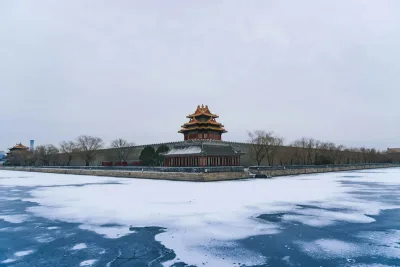
One honest caveat: 2.3 precipitation days does not mean snow on the ground. Beijing often goes through February with bare pavements and a hard frost instead, and a snowy Wall is luck rather than a plan. If snow on the palace roofs is the reason for the trip, give yourself a week in the city rather than two days and book nothing non-refundable on the strength of a forecast. The section-by-section Wall guide explains which stretches stay accessible in ice and wind.
The Palace Museum keeps winter hours until 31 March, 8:30 to 16:30 with last entry at 15:30, closed on Mondays. Book through the official channel with your passport, not a reseller, and read the Beijing first-timer guide before you build a day around opening times.
Shanghai and the delta
Shanghai averages 10.7°C by day and 4.1°C at night, with 10.4 rain days and 65 mm. It is the wettest of the eight cities again, and February is when the damp stops being atmospheric and starts being a logistics problem.
There is no municipal heating south of the Qinling-Huaihe line, so the indoors sit at a damp 10°C to 14°C while the outdoors is merely cool. A February afternoon in Shanghai can feel worse than a colder one in Beijing. Hotels usually run air conditioning in heat mode rather than radiators, older guesthouses may not have it at all, and a south-facing room matters more than a star rating. The guide to southern China in winter covers what to ask before booking.
The compensation is the Lantern Festival. The Yuyuan garden fair runs through the holiday period and peaks on 20 February, with lanterns filling the old streets and the City God Temple packed after dark. Outside the holiday week, Shanghai’s museums are walk-in and the Bund is bearable.
Lhasa and the plateau
Lhasa records 10.4°C by day, −4.2°C at night and 1.9 mm of precipitation across 1.2 days, which makes February one of the driest and brightest months on the plateau. The Potala in winter light is the reason photographers go in this season rather than in summer.
Costs stay at their annual low and the summer coach groups are gone. The trade-offs are the ones December and January share: nights well below freezing, indoor air dry enough to crack your lips, a number of guesthouses and restaurants closed for the season, and a permit that still has to be arranged through a registered agency. Snow can close mountain roads with little notice, so build slack into anything that leaves the Lhasa valley. The Tibet travel guide sets out the permit process and a realistic acclimatisation schedule.
Hainan and the tropical south
Guangzhou averages 20.0°C by day and 12.5°C at night, which is jacket weather rather than beach weather. For the beach you need Hainan, and February is squarely in its peak season, which runs from 1 October to 30 April, with the single most expensive week of the winter around Chinese New Year.
The trick is timing rather than destination. A Sanya hotel on 6 February costs what a Sanya hotel costs on 6 February, and no amount of searching changes it. The same room after 14 February is a different price bracket. The Sanya and Hainan guide covers the island’s visa-free scheme and the bay-by-bay comparison.
Skiing in the second half of the season
February is the month Chinese skiing stops being a gamble. Chongli’s resorts, two hours from Beijing by high-speed rail, have full terrain and a settled base. Changbaishan’s Wanda resort opened on 21 November. Beidahu and Songhua Lake in Jilin have been running since November. Yabuli, about ninety minutes by high-speed rail from Harbin, is the oldest and largest ski area in China, and the Altay resorts in Xinjiang hold the deepest natural snow in the country.
Two things change in February. The first is the end of the Winter Universiade, which ran in Changchun from 15 to 25 January and tightened beds and lift tickets across Jilin for that fortnight. From the start of February those constraints are gone. The second is daylight: a ski day in January ends at 16:00 in the northeast, and a February day gives you an extra hour on the hill.
The catch is the thaw. Late February afternoons soften the snow at low altitude, and resorts near Beijing start losing their base before the high ones do. If snow quality matters more than convenience, go early in the month and go high. The comparison of Chinese ski resorts covers snow reliability, altitude and cost, and the Chongli guide handles the logistics from Beijing.
The visa question, one month later
This is the fact that most changes a February trip compared with a January one. The 30-day unilateral visa-free scheme for passport holders from 50 countries, including most of Europe, the UK, Australia, Canada, Japan, South Korea and Brazil, ran to midnight on 31 December 2026. No extension had been announced as of 17 November 2026.
Read that as an arrival deadline that has already passed. A December entry was covered, and the 30 days ran from the day you landed, so arriving on 28 December carried you into late February. A February arrival is not covered unless the scheme has been renewed.
There is one exception worth knowing. Russian passport holders travel under a separate bilateral arrangement that both governments extended to 31 December 2027, so the deadline does not apply to them. Everyone else needs a tourist visa, or one of the narrower routes: the 240-hour transit scheme for travellers passing through China to a third country, or Hainan’s island-only entry.
Apply early. Visa application centres in most countries close for several days around Chinese New Year, and appointments in January fill up with exactly the people who left it late. The visa-free entry guide tracks the current country lists and any renewal, and it is worth checking it before you book anything non-refundable.
What to pack for February
Pack for the coldest place on your route, then add layers you can shed indoors. Harbin still needs real winter gear in February: a down coat rated below −15°C, insulated boots with tread, a hat that covers the ears, gloves you can use a phone in. Beijing needs a heavy coat and something lighter for overheated interiors. Shanghai and Chengdu need a waterproof shell and a warm mid-layer, because the cold there is humid and the buildings are not heated. Lhasa adds altitude sun: sunglasses, high-factor sunscreen, lip balm.
One February addition: rain. The south is wetter this month than in January, and a compact umbrella earns its place in a day bag. A power bank is still not optional in the north, where cold drains batteries within an hour of outdoor photography. The full packing list has the layer-by-layer version, and if your trip starts in the last days of January, the January guide covers that transition. If it runs into March, the March guide explains what changes when the holiday ends and the heating goes off.
Who February suits
It suits anyone who wants the festival itself: temple fairs, lantern displays, fireworks, and the one week a year when Chinese cities feel like the thing you read about. It suits budget travellers who can move after 14 February, when the same rooms cost a fraction of the holiday rate. It suits skiers, who get the best combination of base depth and daylight. And it suits anyone heading for Yunnan, where February is the driest and warmest month of the winter.
It does not suit a multi-city itinerary during the holiday week. It does not suit a first trip planned around efficiency, because the nine days in the middle work against efficiency by design. It does not suit anyone who assumed the visa-free scheme would be extended. And it does not suit travellers who need guaranteed snow, since February in Beijing is more often hard frost than snowfall.
The honest summary is that February offers the mildest weather of the Chinese winter and the worst logistics, in the same four weeks. The fix is not to avoid the month but to place yourself correctly inside it. Arrive before the fifth or after the fourteenth, sort the visa in December rather than January, and February is the most comfortable winter month China has.
Frequently asked questions
Is February a good time to visit China?
The weather is the friendliest of the Chinese winter, but the calendar is not. A nine-day national holiday runs from 5 to 13 February 2027 and takes over trains, hotels and the main attractions. Arrive in the first four days or after 14 February and you get mild weather, low-season rates and half-empty sights. Arrive in the middle and you get a cultural event with no equivalent anywhere else, at holiday prices.
What is the weather like in China in February?
In the 1991–2020 normals, average daily highs run from −5.9°C in Harbin to 20.0°C in Guangzhou. Beijing averages 6.1°C by day and −4.2°C at night, Shanghai 10.7°C and 4.1°C, Kunming 18.5°C and 5.8°C, Lhasa 10.4°C and −4.2°C. Harbin gains almost six degrees on January, the largest jump of these eight cities, while Guangzhou gains only 1.3. Shanghai is the wet one, with 10.4 rain days and 65 mm.
When is Chinese New Year 2027 and how long is the holiday?
Chinese New Year’s Day falls on 6 February 2027, the start of the Year of the Goat. The State Council published the official calendar on 5 November 2026: the holiday runs nine days, from 5 February (New Year’s Eve) to 13 February, with working weekends on 31 January and 14 February. The Lantern Festival closes the season on 20 February.
Is it crowded in China in February?
The month splits into three very different weeks. From 1 to 4 February the country is quiet and hotels are cheap. From 5 to 13 February the holiday fills every train, hotel and ticketed attraction. From 14 February onward the domestic market goes home, prices fall back within days, and the rest of the month is one of the cheapest stretches of the Chinese year.
Can I enter China visa-free in February 2027?
Not under the 30-day scheme, unless it has been renewed. That arrangement for 50 countries expired at midnight on 31 December 2026 and no extension had been announced as of 17 November 2026. Russian passport holders are an exception, covered by a bilateral arrangement extended to 31 December 2027. Everyone else needs a tourist visa, or one of the narrower routes: the 240-hour transit scheme or Hainan’s island-only entry.
Is Harbin worth visiting in February?
Yes, and it is the last chance of the season. The 28th Ice and Snow World opens in mid-December and runs into late February, so a February visit catches a fully built park with the crowds of the holiday behind it after 14 February. Expect −17.8°C average nights and a daytime high near −5.9°C, both several degrees easier than January. Ticket prices for 2026-27 had not been published as of mid-November 2026.