China in December: Weather, Crowds and Where to Go

December splits China wider than any other month. Guangzhou averages 20.7°C in the afternoon; Harbin averages −9.8°C, and falls to −19.1°C at night. A direct flight between the two takes about four and a half hours and crosses thirty degrees of latitude-driven climate.
The month also has a spine that November lacks. Harbin’s ice park opens in mid-December, after weeks of cutting blocks out of the frozen Songhua and stacking them into towers. The ski resorts are running at full terrain. The New Year holiday runs 1 to 3 January 2027, which turns the last week of December into the most expensive of the winter. And the visa-free scheme for 50 countries expires at midnight on 31 December, which decides whether a December trip can slide into January.
Every temperature below is the 1991–2020 climate normal from the China Meteorological Administration. These describe what December usually does, not what it will do this year.
What December actually feels like
| City | Average high | Average low | Rain days | The short version |
|---|---|---|---|---|
| Harbin | −9.8°C | −19.1°C | 6.9 | Dark at 15:51, ice park open |
| Beijing | 3.7°C | −5.0°C | 1.6 | Clear, dry, hard frost at night |
| Xi’an | 6.6°C | −2.7°C | 3.5 | Cold mornings, haze in still weather |
| Lhasa | 9.7°C | −6.3°C | 0.5 | Bright sun, freezing after dark |
| Chengdu | 10.7°C | 4.2°C | 6.2 | Grey, damp, no heating |
| Shanghai | 11.3°C | 5.3°C | 8.5 | Damp cold, wettest of the eight |
| Kunming | 16.0°C | 4.8°C | 3.7 | Warm afternoons, cold nights |
| Guangzhou | 20.7°C | 11.9°C | 5.7 | Mild days, jacket after sunset |
Rain days means days with at least 0.1 mm of precipitation. Two things stand out. First, the dry half of the country is genuinely dry: Beijing gets 2.2 mm across 1.6 days, Lhasa 0.7 mm across 0.5. Second, what falls in Harbin mostly stays on the ground. The city records 7.6 mm over 6.9 days, and the snow that lands in early December is often still there in February.
The wet winter belongs to the Yangtze delta. Shanghai’s 8.5 rain days are the most of these eight cities, and Chengdu’s drizzle is light but nearly constant, with a sky that stays the colour of wet concrete for days. Neither is a reason to cancel. Both are a reason to pack a shell rather than an umbrella, which the wind will destroy within a block.
Daylight is the constraint nobody plans for. The winter solstice falls at 04:50 Beijing time on 22 December, and on that day the sun sets at 16:52 in Beijing and 15:51 in Harbin. Add the half hour most sights shave off last entry in winter and the sightseeing day in the northeast effectively ends at three in the afternoon. Start early, or accept that the last two hours belong to a museum or a restaurant.
The ice city opens in the middle of the month
At a press conference on 10 November 2026, Harbin confirmed the window for the 28th Ice and Snow World: mid-December. It did not give a date. It did not publish the 2026-27 ticket prices either, and neither had appeared by 15 November.
That is normal for a park built out of a river. The opening day depends on ice thickness, the harvest schedule and a final safety inspection, and the city publishes it about a week ahead. This season the park expands to 1.25 million square metres, roughly 175 football fields, with a Frozen-themed zone built with Disney China, around 100 ice slides and a 120-metre Ferris wheel. The full guide to the festival covers the transport, the hotels and the rest of the city.

What is confirmed, and what is not
Confirmed: the edition, the size, the theme zone, the mid-December window, the rough run into late February.
Not confirmed: the opening day and every price. Last season is the only honest guide. A standard adult ticket cost ¥328, the opening week ran at ¥298, and a VIP pass at ¥800 skipped the queues for the big slides and the wheel. Treat those as 2025-26 numbers until the park posts new ones.
Which means any page quoting a firm 2026-27 date today is guessing. One article circulating this week gives 17 December at ¥328, and 17 December was last season’s opening day. That is a copied number wearing a new label, not an announcement. Buy from the official WeChat mini-program once it opens, and ignore anyone selling dated tickets in November.
What a −20°C afternoon feels like
The cold is manageable if you treat the park as a series of short outdoor shifts rather than one long walk. The pattern that works: arrive around 14:00, see the ice in daylight when it looks like pale jade, stay for the lights after 16:30, and duck into the heated pavilion every half hour. Nobody stays outside for five hours at −25°C, whatever they claim afterwards.
Two practical details. Phone batteries die fast in this cold, so keep the phone in an inside pocket and carry a power bank. And the pavement is packed snow, not tarmac, so boots with grip matter more than the fourth layer on your chest.
Where December is at its best
Beijing and the north
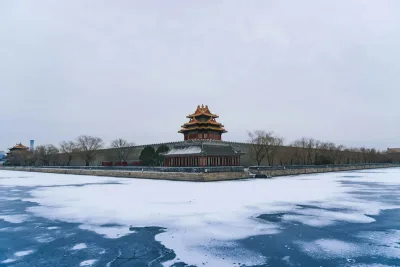
Beijing averages 3.7°C by day and −5.0°C at night in December, with rain or snow on 1.6 days, which ties it with January as the driest month of its year. Snow is not guaranteed, but when it comes the palace roofs and the Wall are worth the trip on their own, and the crowds that ruin both in summer are largely absent. Midweek in the first three weeks of the month, some Great Wall sections are close to empty; the section-by-section guide explains which ones work in cold weather.
The Palace Museum is on winter hours from 1 November to 31 March, 8:30 to 16:30 with last entry at 15:30, closed on Mondays. Book through the official channel with your passport, not a reseller, and read the Beijing first-timer guide before you build a day around opening times.
The ski resorts
December is when Chinese skiing stops being a preview. Chongli’s resorts, two hours from Beijing by high-speed rail, are fully open; Changbaishan’s Wanda resort announced 21 November for the season; Beidahu and Songhua Lake in Jilin have been running since November; and the Altay resorts in Xinjiang have the deepest natural base in the country. If you are weighing regions rather than chasing one opening day, the comparison of Chinese ski resorts covers snow reliability, altitude and cost.
Two booking notes for this winter. Prices jump over the New Year week and again for Spring Festival, whose holiday runs 5 to 13 February 2027. And the Winter Universiade runs 15 to 25 January 2027 in Changchun and Jilin City, with 36 of its 97 medal events at Beidahu and Songhua Lake, so Jilin beds and lift tickets tighten in mid-January. The Universiade guide explains what is open to spectators.
For logistics out of Beijing, see skiing Chongli from Beijing; for the northeast, Jilin’s rime ice and skiing; for the far northwest, skiing in Xinjiang.
Lhasa and the plateau
Lhasa records 9.7°C by day, −6.3°C at night and 0.7 mm of precipitation across the whole of December, with measurable rain or snow on half a day. This is the clearest month on the plateau: hard low sun on the Potala, no summer coach groups, and hotel rates at their annual low.
The costs are the same as November’s, only sharper. Nights are well below freezing, indoor air is dry enough to crack your lips, a few guesthouses and restaurants shut for the season, and independent travel still needs a permit arranged through a registered agency. The Tibet travel guide sets out the permit process and a realistic acclimatisation schedule.
Yunnan and the warm south
Kunming averages 16.0°C by day and 4.8°C at night in December, with 3.7 rain days. Days are warm enough for a shirt, evenings are not, and the dry season means the light is clean. The black-headed gulls that winter on Dianchi peak in late November and December, when thousands of them crowd the Haigeng Dam and the city treats feeding them as a civic ritual. It is one of the few genuinely December-only sights in the south.
Farther south, Hainan is the escape hatch. Sanya runs 25°C to 29°C and is in peak season, which on the island’s official price calendar means 1 October to 30 April: paid attractions cost more, Yalong Bay fills, and the week around New Year is the most expensive of the winter. The Sanya and Hainan guide has the visa-free island scheme and the bay-by-bay comparison.

If you are thinking about a month rather than a week, the Yunnan winter long-stay guide covers rents and which towns hold up through the cold months.
The cold that follows you indoors
North of the Qinling-Huaihe line, buildings are heated by administrative boundary. The official season runs from 15 November to 15 March, and indoor temperatures settle around 20°C to 22°C while it is below zero outside. Overheating is the more common complaint in Beijing hotels.
South of the line there is no municipal heating at all, which is why an 11.3°C afternoon in Shanghai can feel worse than a 3.7°C afternoon in Beijing. Outside is mild, inside is a damp 10°C to 14°C, and nothing dries. Hotels usually run air conditioning in heat mode rather than radiators, older guesthouses may not have it, and a south-facing room matters more than a star rating. The guide to southern China in winter covers what to ask before booking.
Crowds, prices and the New Year window
December has no public holiday until the last day. The State Council published the 2027 schedule on 5 November 2026, and New Year runs 1 to 3 January, Friday to Sunday, three days with no make-up workdays. Because it lands on a natural weekend, it produces a short, sharp domestic spike rather than the week-long displacement of Golden Week.
In practice: the first three weeks of December are the cheapest and quietest stretch of the winter. Rates start climbing around 20 December, peak between 30 December and 2 January, and fall back by 4 January. If you want Harbin or a ski resort and you have flexibility, go before 20 December. You get the same ice, shorter queues and a room that costs a third less.
Book the things that run out. Train tickets open 15 days before departure on 12306, and the passport you book with has to be the one you travel on. Timed-entry sites sell slots by passport number, often released a few days to a week ahead, and they do sell out over New Year even in low season; the guide to sold-out attractions explains the mechanics per site. The holiday calendar guide has the rest of the 2027 dates.
The 31 December deadline that decides your trip
The 30-day visa-free scheme for passport holders from 50 countries, including most of Europe, the UK, Australia, Canada, Japan, South Korea and Brazil, currently runs to midnight on 31 December 2026. No extension had been announced as of mid-November 2026.
Read that as an arrival deadline, not a departure one. Entry has to happen on or before 31 December, and the 30 days run from the day you land, so arriving on 28 December gives you until late January. Arriving in January depends on a renewal that has not been published. If your plan is Harbin in January or the Universiade in mid-January, check the visa-free entry guide before you book anything non-refundable, and price an L visa as the fallback.
What to pack for December
Pack for the coldest place on your route, then add a layer you can shed indoors. Harbin needs real winter gear: a down coat rated below −15°C, insulated boots with tread, a hat that covers the ears, gloves you can keep on while using a phone. Beijing needs a heavy coat and something for the overheated interiors. Shanghai and Chengdu need a waterproof shell and a warm mid-layer, because the cold there is humid and the buildings are not heated. Lhasa adds altitude sun: sunglasses, high-factor sunscreen, lip balm.
A power bank is not optional in the north, where cold drains batteries in an hour of outdoor photography. The full packing list has the layer-by-layer version, and if your trip starts in the last days of November, the November guide covers that transition.
Who December suits
It suits anyone whose reason for coming is winter: the ice park, the ski resorts, the Wall under snow, Lhasa’s clear light. It suits budget travellers who can travel before 20 December, when the same rooms cost a third less than they will two weeks later. And it suits people who would rather see Beijing at 3.7°C with empty pavements than at 30°C in a queue.
It does not suit anyone hoping to move between north and south without repacking, or anyone who expects a Chinese hotel room to be warm because the country is cold. It also does not suit a January arrival that depends on a visa waiver still being renewed.
The honest summary is that December is the month China’s winter becomes worth the trouble. November has the cold without the ice, January has the ice without the daylight. December has both, and for three weeks it is still quiet.
Frequently asked questions
Is December a good time to visit China?
For winter travel, it is the best month of the year. Harbin’s ice park opens in mid-December, the ski resorts have full terrain, Lhasa has its clearest skies, and the cities are quiet until the last week of the month. It is a poor month for anyone who wants warmth without flying south, and the visa-free window closes on 31 December.
What is the weather like in China in December?
In the 1991–2020 normals, average daily highs run from −9.8°C in Harbin to 20.7°C in Guangzhou. Beijing averages 3.7°C by day and −5.0°C at night, Shanghai 11.3°C and 5.3°C, Kunming 16.0°C and 4.8°C, Lhasa 9.7°C and −6.3°C. The north and west are dry: Beijing records rain or snow on 1.6 days, Lhasa on 0.5. The Yangtze delta is the wet part, with 8.5 days in Shanghai.
Is the Harbin Ice Festival open in December?
Yes, from mid-December. The city confirmed the window for the 28th Ice and Snow World at a press conference on 10 November 2026, but had not published the exact opening day or the 2026-27 ticket prices by 15 November. The park runs into late February. Last season’s standard adult ticket was ¥328, with ¥298 in the opening week, and those are the only prices worth planning around until new ones appear.
Where is the warmest place in China in December?
Hainan. Sanya runs 25°C to 29°C through the winter and is in its high season, with peak-season pricing from 1 October to 30 April. Guangzhou is mild rather than hot, at 20.7°C by day and 11.9°C at night, and Kunming manages 16.0°C in the afternoon with nights near 4.8°C. Anything north of the Yangtze is cold, and indoors it can feel colder than outside.
Is December crowded in China?
Not until the last week. December has no public holiday, so the first three weeks are among the quietest of the year for domestic travel and hotel rates sit at their winter low. The 2027 New Year holiday runs 1 to 3 January, which pulls crowds and prices up from about 30 December, and the week between Christmas and New Year is the most expensive of the month.
Can I still enter China visa-free in December?
Only if you arrive on or before 31 December 2026. The 30-day unilateral scheme for 50 countries currently expires at midnight that day, and no extension had been announced as of mid-November 2026. The 30 days run from your arrival date, so a late-December entry carries you into January, but a January arrival depends on a renewal that has not been published.