China tech shock: 15 technologies that surprise every visitor

You land in Shanghai, take the maglev into the city at 431 km/h, and walk into a FamilyMart to buy a bottle of water. The person ahead of you waves their phone at a plastic QR code stand. The cashier looks at you, waiting. You pull out a ¥50 note. The cashier blinks. They have not touched physical cash in three days. They dig through three drawers to find change.
Welcome to China. Not the China of temples, tea, and ancient history , the China of the near future, where everyday technology has evolved in a direction most Western countries have not taken. These are not exhibition-hall demos. These are the things that will actually happen to you, repeatedly, starting from your first hour in the country.
1. Your wallet is an app
In China, cash is a niche payment method used by tourists and the occasional elderly person who refused to adapt. Everyone else pays by scanning a QR code with Alipay or WeChat Pay. Street musicians in pedestrian underpasses display a laminated QR code for tips. Beggars carry one. Temple donation boxes come with QR codes printed below the slot. Vegetable vendors at wet markets have a small cardboard sign with a QR code propped against their cabbage pile.
The speed difference is the first thing you notice. A convenience store transaction takes about three seconds: the cashier scans your items, you open Alipay and flash your QR code at a scanner, and you are gone. No fumbling for cards, no PIN entry, no waiting for a chip reader to process. The second thing you notice is that nobody carries a wallet. Chinese people carry their phones and occasionally an ID card. That is it.
If you have not set up Alipay before arriving, stop reading and set it up now. It takes 15 minutes with your passport and a foreign Visa or Mastercard. Without it, you are playing on hard mode.
2. Your face is your ticket, your key, and your ID
The first time happens at hotel check-in. You hand over your passport, and the front desk clerk points to a small camera on the counter. Look at it. Click. Your face is now matched to your passport, and that match is uploaded to the Public Security Bureau system. Every hotel in China does this, by law.
Then you notice it everywhere else. At Shanghai Hongqiao railway station, the security gates scan your face against your ID before you even reach the ticket checkpoint. In Shenzhen, some subway stations let you walk through a face-scan lane , no ticket tap, no phone, just your face. At Shanghai Disneyland, the entry gate scans your face to verify your ticket. Even some public toilets in Beijing require a face scan before dispensing toilet paper, though this is becoming less common.
It is convenient. It is also unsettling the first dozen times. You get used to it faster than you expect.
3. There are robots on the sidewalk, and they are delivering dinner
Walking through Shenzhen’s Futian district or Beijing’s Zhongguancun, you encounter a small white box on four wheels, about the size of a large cooler, rolling along the sidewalk. It stops at a crosswalk, waits for the light, then trundles across. It is a Meituan delivery robot, and inside it is someone’s lunch.
Meituan operates thousands of these autonomous delivery vehicles across Chinese cities. They carry food orders, groceries, and packages. They have cameras, lidar sensors, and collision avoidance. They yield to pedestrians, navigate around parked scooters, and wait patiently at red lights. When they arrive at your building, the app sends you a code to unlock the compartment. The food is still hot.
Hotels in China use similar robots. You order extra towels from the front desk, and five minutes later a knee-high robot with a screen for a face calls your room phone and tells you to open the door. It is standing in the hallway. You take your towels. It chirps and rolls back to the elevator. The elevator knows it is coming and holds the door.
4. The streets have gone silent
This one creeps up on you. You walk around for a day or two and something feels different, but you cannot place it. Then you realize: you cannot hear engines.
Over half of new cars sold in China in 2025 were electric or plug-in hybrid. Beijing, Shanghai, Shenzhen, and Guangzhou have aggressive EV-only license plate policies that make buying a gasoline car expensive and slow. The result is that Chinese city streets sound fundamentally different from streets in London, New York, or Sydney. Cars accelerate with a low electric whine. The dominant noise is tire hum, not engine roar. Buses, taxis, and even construction vehicles are going electric.
The green license plates , China issues a special green plate for new energy vehicles , are everywhere. In Shanghai, roughly one in every three cars on the road is a pure EV. The EV factory tours in Beijing, Hefei, and Guangzhou are where you can see how these cars are built, at a scale that has no Western parallel.
5. The train that makes flying feel slow
A friend of mine flew from Shanghai to Beijing recently. The flight took two hours and ten minutes. Door to door, from his Shanghai apartment to his Beijing hotel, it took him five and a half hours: 40 minutes to Pudong airport, 90 minutes of check-in and security, the flight itself, baggage claim, and a one-hour taxi into Beijing.

Three weeks later he took the train instead. The high-speed train left Shanghai Hongqiao at 9:00 and pulled into Beijing South at 13:28. Four hours and twenty-eight minutes. He walked from his Shanghai apartment to the metro, rode 25 minutes to Hongqiao station, arrived 20 minutes before departure, walked through a security check that took three minutes, boarded, and worked on his laptop the whole way. Door to door: five hours and ten minutes. He saved 20 minutes and had a comfortable seat, a power outlet, and a view of rice paddies the entire way.
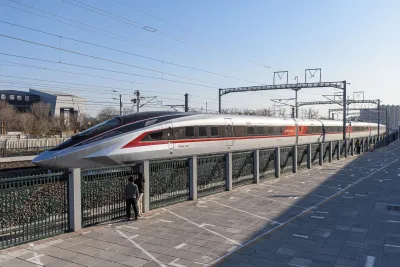
That is the China high-speed rail reality: for distances under 1,200 kilometers, the train is faster door-to-door than flying. The network covers over 45,000 kilometers. A second-class ticket is comfortable , more legroom than a European economy flight. If you are planning intercity travel, read the full high-speed rail guide before you book anything.
6. Drones dropping from the sky with your order
In Shenzhen’s Nanshan district and parts of Shanghai, Meituan and SF Express operate drone delivery services. You order through the app, a drone picks up your package from a distribution hub, flies a pre-programmed route at about 60 meters altitude, and drops its payload into a pickup box at your location. You get a notification, walk to the box, scan a code, and retrieve your order.
The most surreal detail is the pickup box itself. It looks like a tall, white locker with a door at waist height. The drone does not land , it hovers above the box, lowers the package on a cable, and releases it. The box door opens after you scan your code. The whole sequence feels less like a delivery and more like a supply drop from a sci-fi movie.
Drone delivery is still limited to specific neighborhoods and a handful of approved flight corridors. It is not something a short-term tourist can easily arrange. But if you know someone in Shenzhen who can demonstrate it, watching a drone lower your coffee order into a street-side locker is the kind of moment that recalibrates your sense of what is normal.
7. A taxi with nobody in the driver’s seat
Autonomous ride-hailing in China is not a pilot program. Apollo Go (Baidu’s robotaxi service) completed over 8 million rides by early 2026 and operates across most of Wuhan , the entire urban area, not just a geofenced test zone. Pony.ai and WeRide run similar services in Beijing, Shanghai, and Shenzhen.
The experience is deeply strange. You request a ride through the app. A white SUV with a spinning lidar sensor on the roof pulls up, and there is nobody behind the wheel. The steering wheel turns as the car adjusts its position. You get in, confirm your identity on a rear-seat screen, and the car pulls into traffic while your brain keeps registering the empty driver’s seat. It merges, changes lanes, yields to pedestrians, and handles intersections. It drives cautiously, sometimes frustratingly so , it hesitates at complex junctions and drives like a student taking their first driving test. But it works.
The cost is the real shock. A 6-kilometer Apollo Go ride in Wuhan costs about ¥4 ($0.55). It is cheaper than the bus. The price is artificially subsidized (Baidu loses money on every ride), and the apps are Chinese-only, which means most tourists never experience it. If you want to try one, you need a Chinese-speaking friend to set up the app. For a broader overview of China’s robot and AI tourism scene, we have a separate guide covering humanoid robots, robot restaurants, and the Unitree Experience Center.
8. The QR code ate the menu, the waiter, and the cash register
You sit down at a restaurant. There is no menu. There is a QR code sticker on the table. You scan it with WeChat, and a digital menu opens on your phone. You scroll through photos, tap what you want, and submit the order. Fifteen minutes later, food arrives. When you are done, you scan another QR code on your receipt, pay through WeChat, and walk out. You have exchanged zero words with a human being.

This system is universal in China, from high-end hot pot chains to a noodle shop in a train station basement. There are benefits: you can browse with photos, the menu auto-translates if you use WeChat’s built-in translation, and there is no misunderstanding your order. There are downsides: it kills the social dynamic of asking a server for recommendations, and many of these mini-program menus are Chinese-only. But for efficiency, nothing beats it. Lunch from sitting down to walking out in 35 minutes, without ever waiting for a check.
9. One app does literally everything
WeChat is not a messaging app. It is an operating system that happens to run inside your phone. Chinese people use WeChat to message their boss, pay their electricity bill, book a doctor’s appointment, split a restaurant bill with six friends, hail a taxi, buy movie tickets, file their taxes, rent a shared power bank, unlock a shared bike, check into a hotel, order groceries, donate to charity, send money to their parents for Lunar New Year, apply for a visa, find a date, and play games that run inside the app without installation.
The “mini-program” system is the key. Within WeChat, thousands of lightweight sub-applications handle specific services. These mini-programs do not need to be downloaded , you scan a QR code, the mini-program opens, you complete your task, and you close it. A single app replacing 40 standalone apps. For a traveler, only a small fraction of this is accessible: the menus will be in Chinese, and many mini-programs require a Chinese ID. But the sheer scope of what one app does is worth observing, because it is the reason Chinese people live entirely through their phones in a way that Western smartphone users do not.
10. Walk through a subway gate with your face
In Shenzhen’s Metro Line 11 and Beijing’s Daxing Airport Express, there is a special lane at the fare gates. It has a small screen at face height. You walk toward it, it scans your face , matched against a photo you registered in the metro app weeks ago , and the gate opens. You do not stop. You do not tap a card. You do not pull out your phone.
For tourists, the face-scan metro lanes are mostly inaccessible because registration requires a Chinese ID. But you can still use the phone-based QR code entry, which is nearly as fast: open the Alipay transport mini-program, generate a QR code, scan it at the gate. The metro systems in Beijing, Shanghai, Guangzhou, Shenzhen, and Chengdu all accept Alipay QR codes for fare payment. No ticket machines, no single-journey cards, no fumbling for coins. If you want a detailed walkthrough, our China subway guide covers fare payment, route planning, and the quirks of each city’s system.
11. Your online order arrives this afternoon
China’s e-commerce logistics operate at a speed that makes Amazon Prime look sluggish. JD.com, the country’s largest direct retailer, has a promise called “211”: orders placed before 11:00 a.m. arrive the same day; orders placed before 11:00 p.m. arrive the next morning. This is not a premium service. It is the default.
The infrastructure behind this is worth understanding. JD.com operates over 1,500 warehouses across China. Most urban orders ship from a warehouse within 50 kilometers of the delivery address. The last mile is handled by a fleet of electric tricycles and scooter couriers who navigate apartment complexes with a level of local knowledge that GPS cannot replicate. Rural villages in Guizhou and Yunnan get next-day delivery. If you order a phone charger to your Beijing hotel at 9:00 p.m., it is at the front desk when you come down for breakfast.
12. Power banks, umbrellas, basketballs , the sharing economy that actually works
China’s sharing economy survived the 2017-2018 bubble that killed shared umbrellas, shared basketballs, and shared massage chairs as business models. What remains is genuinely useful.
Shared power banks are the standout. Bright-colored charging stations , orange for Meituan, blue for Jiedian, green for Laidian , sit on the counter of every convenience store, restaurant, and shopping mall. You scan a QR code, a power bank pops out of the dock, and you rent it for ¥2-4 per hour ($0.30-0.55). When your phone is charged, you find any station from the same brand and slot it back in. The network is so dense that you are never more than 50 meters from a return point in any Chinese city center. In a country where your phone is your wallet, your metro card, your map, and your translator, a dead battery is a minor crisis. The power bank network solves it entirely.
Shared bikes are similarly dense. Meituan, Hello, and DiDi bikes , tens of millions of them , line every sidewalk. Scan the QR code on the handlebar, the lock clicks open, and you ride. ¥1.5 ($0.20) per ride. Return it to any designated parking zone, push down the lock, and walk away.
13. Traffic lights that watch the road
Chinese cities deploy AI-powered traffic management at a scale that most countries have not attempted. In Hangzhou, Alibaba’s City Brain system adjusts traffic light timing in real time based on camera feeds and vehicle flow data. The result, according to city data, is a 15% reduction in average commute times across the urban core.
You notice it as a pedestrian. At a major intersection in Shanghai or Shenzhen, the pedestrian countdown timer does not use a fixed cycle , it adjusts based on real traffic conditions. The traffic light turns green for your crosswalk and the timer reads 28 seconds instead of the standard 30, because the system detected fewer vehicles waiting on the cross street. It is a small thing, but it accumulates. Over a day of walking through a Chinese city, you spend measurably less time standing at intersections than you would in a city with fixed-cycle lights.
Digital displays at bus stops show arrival times to the second. Electronic road signs update with congestion pricing and route recommendations. The smart city infrastructure is not a showcase project , it is baked into the daily operation of 50-plus Chinese cities, and the gap with most Western urban infrastructure is widening.
14. Twenty million shared bikes, and you are never more than a block from one
The scale of bike sharing in China is hard to internalize until you see it. Meituan alone operates over 8 million bikes. Hello has another 6 million. DiDi has millions more. In total, there are roughly 20 million shared bikes in Chinese cities. For comparison, the entire Citi Bike system in New York has about 40,000 bikes. London’s Santander Cycles has about 15,000.

The density means you never plan around bike availability. You leave a restaurant, scan the nearest bike, ride 15 minutes to your next stop, lock it, and forget about it. There is no docking station to find, no membership required , just Alipay or WeChat, and you are riding. The bikes are heavy, single-speed, and built to survive vandalism and weather rather than be pleasant to ride. But they cost ¥1-2 per trip and they are always there. For getting between metro stations and destinations in the 1-to-3-kilometer range, they are faster than DiDi and more pleasant than walking.
15. Money as a social gesture
During Chinese New Year, over a billion WeChat red envelopes change hands digitally. A “red envelope” (hongbao) is a traditional cash gift in a red paper packet. WeChat digitized it into a feature where you send money to friends through the app , but the money arrives inside a virtual red envelope that the recipient must tap to open. The amount is displayed only after opening.
The mutual and social nature of this is worth noting because it reveals something about the Chinese relationship with technology. In the West, sending someone money through an app feels transactional, slightly awkward. In China, it is woven into social rituals: you send hongbao to friends on their birthday, to colleagues during Spring Festival, to your younger relatives at family gatherings. Groups on WeChat play “red envelope games” where people take turns sending packets and whoever grabs the smallest amount sends the next one. It is gambling, gifting, and group chat entertainment in one feature.
For a traveler, you will probably never send or receive a WeChat red envelope , the feature requires a Chinese bank account for personal transfers. But observing it tells you something about why these technologies took root here and not elsewhere. It was never just about convenience. It was about weaving technology into the social fabric in a way that felt natural, not alien.
Why these technologies exist in China and not where you live
The obvious question: if these technologies are so useful, why did they not emerge in the West?
Three structural reasons. First, China skipped the credit card era. When mobile payments arrived in the mid-2010s, most Chinese consumers had never owned a credit card. Alipay and WeChat Pay did not have to displace entrenched payment habits , they filled a vacuum. In the US and Europe, contactless cards and Apple Pay were already good enough that QR-code payments never reached critical mass.
Second, density changes everything. Delivery robots are viable when your delivery radius contains 50,000 people. Drone delivery works when you have approved flight corridors over dense urban neighborhoods. Shared bikes work when there are 20 million people in a metropolitan area. Most of these technologies require the population density of a Chinese city to reach unit economics that make sense.
Third, regulation. Chinese cities grant drone flight corridors, autonomous vehicle permits, and facial recognition deployments at a speed that Western regulatory frameworks cannot match , for better and for worse. The tradeoff is visible on every street corner: more technology, less privacy. Whether that tradeoff is worth it is a judgment you will make for yourself, repeatedly, during your visit.
Frequently asked questions
Do I need a Chinese bank account to use mobile payments in China?
No. Both Alipay and WeChat Pay let you link a foreign Visa or Mastercard directly. You verify your passport through the app, and you can pay at 99% of QR code terminals. The setup takes about 15 minutes at home before you fly. The only thing a foreign card cannot do is send money to individual users through WeChat personal transfers. For paying merchants , street food stalls, shopping malls, metro ticket machines, even temple donation boxes , your foreign card works. There is a per-transaction fee of about 3% above ¥200, so for large purchases you might prefer cash or a Chinese friend’s help. For the full step-by-step setup, see our mobile payment guide.
Is facial recognition used on tourists in China?
Yes. When you check into any hotel in China, the front desk scans your face and matches it against your passport photo. This is not optional; it is a Public Security Bureau requirement for all guests, Chinese and international. Airport security gates use facial recognition for domestic flights. Some subway stations in Shenzhen and Beijing have face-scan lanes. At tourist attractions like the Forbidden City or Shanghai Disneyland, your ticket is linked to your passport and verified with a face scan at the gate. It is everywhere. The data is collected under China’s Personal Information Protection Law, which in theory limits how it can be used, but the practical reality is that your face will be scanned dozens of times during a two-week trip.
How fast is China’s high-speed rail compared to trains in Europe or Japan?
China’s high-speed rail operates at 350 km/h on major corridors, which is faster than Japan’s Shinkansen (320 km/h), France’s TGV (320 km/h), and Germany’s ICE (300 km/h). The Beijing-Shanghai line covers 1,318 kilometers in 4 hours and 18 minutes. For comparison, Paris-Marseille is about 800 kilometers and takes 3 hours , you cover nearly double the distance in roughly the same time. The network is also vastly larger: over 45,000 kilometers of high-speed track, more than the rest of the world combined. Stations are airport-scale in size, the trains depart with Swiss-level punctuality, and a second-class seat Beijing to Shanghai costs about ¥550 ($76). The window of viability where flying beats the train is surprisingly narrow , anything under 1,200 kilometers, the train wins door-to-door.
Can tourists ride in a driverless taxi in China?
Yes, and it is not a test program. Apollo Go (Baidu), Pony.ai, and WeRide operate commercial driverless ride-hailing in multiple cities. In Wuhan, Apollo Go covers most of the urban area and can even operate from the airport. In Beijing’s Yizhuang development zone, all three services accept passengers. The practical barrier is setup: each company has its own Chinese-language app, most require a Chinese phone number for registration, and pickup points are designated stops rather than your exact location. Once set up, the ride itself involves zero language interaction , you confirm your identity on a screen, the door unlocks, and the steering wheel begins turning on its own. The cost is absurdly low: ¥4 to ¥15 for a typical trip, heavily subsidized. If you have a Chinese-speaking friend or hotel concierge who can help with the initial app setup, this is one of the most memorable experiences you can have in China.
Will my phone work with Chinese apps like WeChat and Alipay?
Yes, with some caveats. WeChat and Alipay are available on both the iOS App Store and Google Play Store internationally. You can download them before you leave home, and the international versions support English, passport verification, and foreign card linking. The main limitation is mini-programs , WeChat’s mini-program ecosystem contains hundreds of thousands of lightweight apps for ordering food, renting bikes, buying metro tickets, and booking attractions, and the vast majority of these mini-programs are Chinese-language only. You will also need a VPN to access Google services, Gmail, Instagram, WhatsApp, and most Western platforms while in China. Set up your VPN before you arrive; the Google Play Store and many VPN provider websites are blocked inside China. For a comprehensive app setup guide, see our digital survival checklist.
Which of these technologies matter most for a short trip under one week?
Focus on three things. First, set up Alipay or WeChat Pay before you fly , without mobile payment, you will struggle with cash-only situations and miss the speed and convenience that locals enjoy. Second, install a translation app with offline Chinese support; Google Translate and Baidu Translate both work, but download the Chinese language pack before you leave. Third, get a rideshare app , DiDi has an English interface and accepts foreign cards, and it works in every Chinese city. High-speed rail is great if your itinerary includes multiple cities, but for a single-city trip, the metro plus DiDi covers everything. Robotaxis and drone delivery are fun extras, not essentials. Facial recognition you cannot opt out of, so just expect it. The technology that will actually change your daily experience is mobile payment , everything else builds on top of it.