Beijing Arrival Guide: Capital vs Daxing Airport to the City

Beijing gives you a choice it did not have a decade ago: two international airports, on opposite sides of the city, with no train between them. The choice is made for you at booking, and then you live with it. Land at the wrong one relative to your hotel and you have added an hour and a hundred yuan to a trip that should have started with a forty-minute train ride.
This is the practical part. Which airport your ticket actually means, what the two express lines cost and when they stop, what a taxi meter does after dark, and what to do when you clear immigration at eleven at night and the last train has gone.
Two airports, one city, and a 67-km gap
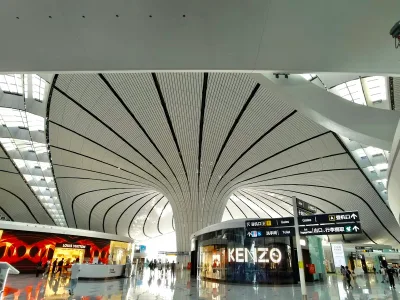
Beijing Capital (PEK) is the old one, northeast of the city, opened in stages from 1958 and rebuilt around Terminal 3 for the 2008 Olympics. Beijing Daxing (PKX) is the new one, far to the south, opened in September 2019 with a single terminal under one roof.
The straight-line distance between the two is 67 km, which is the number the civil aviation authority uses. By road it is closer to 80 to 100 km, and a car takes about an hour and a half without traffic. There is no rail connection. Airlines do run a coach between them, which I will get to.
The old rule of thumb was that Air China and its partners used Capital while China Eastern and China Southern used Daxing. Treat that as unreliable now. China Southern left the SkyTeam alliance at the start of 2020, and Air China runs flights from Daxing too, adding Daxing to Frankfurt and Milan in the 2026 summer schedule. Read the three-letter code on your booking, and if you are buying a domestic connection, check the code again for each leg. Booking domestic flights in China is where a PEK-to-PKX self-transfer usually goes wrong.
The Capital Airport Express: the simplest ¥25 you will spend
One fare, ¥25, no matter where you get on or off. That flat price is the reason this line is easier to explain than its southern cousin.
The route has five stops: Beixinqiao on Line 5, Dongzhimen on Lines 2 and 13, Sanyuanqiao on Line 10, then Terminal 3 and Terminal 2. Trains run about every ten minutes. From Terminal 3 the first train leaves at 06:22 and the last at 22:52. From Terminal 2 it is 06:36 to 23:10. Heading out to the airport, the first train leaves Dongzhimen at 06:00 and the last at 22:30. Dongzhimen to Terminal 3 takes roughly 25 minutes, which beats a taxi by a wide margin between 07:00 and 09:00.
Dongzhimen is the useful stop for most people. It puts you on the Line 2 loop and Line 13, and it is where the airport line connects to the rest of the network. Sanyuanqiao is the better bet if your hotel sits along Line 10, and Beixinqiao matters if you are staying near the Drum Tower or Nanluoguxiang. If you are still working out how the metro system fits together, the guide to Chinese city subways covers fares, apps and transfers.
Buy your ticket at the machine or the staffed window. Cash works. The metro’s QR code payment through Alipay or WeChat works once you have it set up. A foreign contactless card is not something to count on at the gate, so have a plan for the first hour.
The Daxing Airport Express: a fare that depends on distance
Daxing charges by distance, and this is where a lot of published guides get it wrong. The fare is ¥10 for journeys up to 20 km, ¥25 for 20 to 30 km, and ¥35 beyond 30 km. From Caoqiao, the inner-city terminus, you pay ¥35. There is a business-class option at ¥50, which buys a wider seat rather than a separate carriage. It is not the line you take to save money on a short hop.
The full run from Caoqiao to the airport takes 19 minutes. Trains leave Caoqiao from 05:30 to 22:30. Coming from the airport, the first train is at 06:00 and the last at 23:00, with a 23:30 last train on Sundays.
Caoqiao connects to Line 10 and Line 19, so you can reach most of the city with one change. Lize is not open yet. The city terminal there is scheduled to begin operation at the end of June 2027, which means any route that starts “take the Daxing Express from Lize” is describing a station you cannot use. The paid area also has a four-hour limit, so it is not a place to sit out a long connection.

Taxis: the meter, the surcharge and the night rate
Beijing taxis run on a meter and the rates are published, which makes the cost predictable in a way that the queue is not.
Flag fall is ¥13 for the first 3 km. After that it is ¥2.3 per km. Between 23:00 and 05:00 the per-kilometre rate goes up 20 percent, to about ¥2.76. Past 15 km, the excess distance carries a 50 percent surcharge, around ¥3.45 per km. Add a ¥1 fuel surcharge per trip, and ¥5 to ¥6 if you booked the car rather than hailing it.
Run the arithmetic and a daytime ride from Capital Terminal 3 to somewhere central like Dongzhimen or Sanlitun comes out around ¥75 to ¥90, depending on the route and the traffic. From Daxing to the same area, at roughly double the distance, expect ¥160 to ¥190. Those are calculations from the published rates, not quotes, and motorway tolls are on top.
Two rules save arguments. Use the official taxi rank, which is signed inside the terminal and staffed. And do not accept a flat price from someone approaching you in the arrivals hall, because the meter is cheaper and the flat price is not a taxi.

Airport buses and the one that links the two airports
Buses are the cheapest way in if you are staying on a route and do not mind waiting for one to fill.
From Capital, the city routes cost ¥20, ¥25 or ¥30 depending on where they end. The line to Fengtai railway station went up to ¥35 in April 2026. From Daxing, fares run from ¥20 to ¥55, with the ¥55 being the long run across the city to Capital Airport.
That cross-city coach is the only direct link between the two airports, and it is not a connection you can rely on. It costs roughly ¥45 to ¥65 and leaves Daxing at 14:00, 16:00 and 18:30. Three departures a day will not fit a tight transfer. If you have booked a self-transfer between PEK and PKX, budget an hour and a half by road, more in the morning peak, and consider whether the connection is worth it at all.
Ride-hailing at the curb
Didi works at both airports and is usually cheaper than the rank, especially for the long run from Daxing. The catch is meeting the car. Beijing’s airports have designated e-hailing pickup areas, and the app pin is what matters, not a letter or a zone number you read in a blog post. Signage inside the terminal points to the pickup area; follow it, then follow the pin.
There is one app trap worth knowing before you land. DiDi China: Ride Hailing works in mainland China. DiDi Rider, the international version, does not. The full guide to using Didi in China covers the two apps, foreign phone numbers, card binding and what cash can and cannot pay for. Short version: Express, Premier and Luxe rides are billed in the app and cannot be settled in cash, while the Taxi category can, if the driver agrees.
Which terminal you land at, and why it matters
Capital spreads international and domestic traffic across T2 and T3. T3 is the big one, with an internal people mover linking the main building to the international concourse, so an arrival involves a train ride before you ever reach baggage reclaim. T2 is smaller and quicker to walk, and handles a mix of domestic and international flights. Both have their own station on the airport express, which is the reason the train is worth considering even when your hotel is not obviously on the line.
Daxing is a single terminal, so you never change buildings, but single does not mean small. The walk from an international gate to the express station takes a while, and the terminal is designed so that everything funnels through the centre. Allow more time than the map suggests.
The practical point: an hour from wheels down to the taxi rank is realistic at T3 when two or three widebodies land together. At Daxing, the immigration hall is fast and the walk is long, which roughly evens out.
Arriving after the trains stop
The last express trains are not late. Capital’s last train leaves Terminal 2 at 23:10 and Terminal 3 at 22:52. Daxing’s last train to Caoqiao is at 23:00, or 23:30 on Sundays. Plenty of long-haul arrivals land after that.
When the trains have gone, you have two options and neither is a bargain. The taxi rank is still staffed and still metered, with the 20 percent night surcharge applied. Ride-hailing works too, though pickup areas are quieter and the app pin can be hard to match to a kerb at midnight. There is no night metro, and anyone who tells you Beijing’s subway runs around the clock is thinking of a different city.
If you are landing near midnight with a hotel across town, price the airport hotel before you price the taxi. A room at the terminal for one night is often close to the fare, and it turns a bad arrival into a normal morning.
The return leg: leaving enough time
The mistake people make is treating the outbound trip as the mirror image of the arrival. It is not, because the trains stop earlier in the city than they do at the airport.
The last express leaves Dongzhimen at 22:30 and the last Daxing train leaves Caoqiao at 22:30. First trains in the morning are early enough for most flights, but check the time against your check-in counter, not against your departure time. International counters typically close 45 to 60 minutes before departure, and the queues at Capital T3 in the morning are not short.
Beijing traffic has two peaks, roughly 07:00 to 09:00 and 17:00 to 20:00. A taxi that takes 40 minutes at noon takes 80 at eight in the morning. On those two windows, the express train is not a budget choice, it is the reliable one. If your flight leaves in the late morning, take the train and eat at the airport.
Before you land: what to have ready
Three things make the arrival quick and one thing makes it slow.
Set up a payment app before you fly. Alipay and WeChat Pay both accept foreign cards, and the set-up takes ten minutes at home and considerably longer in a arrivals hall with no working data. Sort out data too: either an eSIM bought before you leave or roaming that actually covers China, because the airport wifi wants a Chinese phone number for verification.
Have your hotel address written in Chinese characters, on your phone and ideally on paper. Drivers will not read a romanised street name, and the difference between two hotels with similar English names is a real problem.
The slow one is paperwork. If you are arriving on the 240-hour transit scheme rather than a visa, you need an onward ticket to a third country and you need to know which ports and regions your permission covers. The 240-hour transit rules are stricter than most summaries suggest, and the desk will check. Arriving with a visa or under the 30-day visa-free scheme is simpler, but the officer still wants a return ticket and an address.
Once you are through, the first day is mostly logistics. A first-timer’s guide to Beijing covers the things that catch people in the first 24 hours, and a four-day Beijing itinerary is a sensible way to use the days you have without crossing the city twice a day.
Frequently asked questions
How do I know whether I land at Capital or Daxing?
Look at the airport code on your booking: PEK is Capital, PKX is Daxing. Do not infer it from the airline. China Southern left the SkyTeam alliance in 2020 and Air China now flies from Daxing as well, so the old alliance rule no longer holds. Check the code on every leg of a multi-city ticket.
How much is the airport train in Beijing?
The Capital Airport Express is a flat ¥25 from any station to any station. The Daxing Airport Express charges by distance: ¥10 up to 20 km, ¥25 for 20 to 30 km, and ¥35 beyond that, which is the fare from Caoqiao. A business-class seat on the Daxing line costs ¥50.
Can I use a regular metro ticket on the airport express?
No. Both airport lines charge their own fare on top of the normal metro system, and the flat ¥25 or the distance-based Daxing fare replaces the standard ticket rather than adding to it. You change onto the regular network at Dongzhimen, Sanyuanqiao and Beixinqiao on the Capital line, or at Caoqiao on the Daxing line.
How much is a taxi from Beijing airport to the city?
The meter starts at ¥13 for 3 km, then charges ¥2.3 per km, with 20 percent added between 23:00 and 05:00, a 50 percent surcharge on distance beyond 15 km, and ¥1 fuel surcharge. That works out around ¥75 to ¥90 from Capital to the centre and ¥160 to ¥190 from Daxing, before tolls.
Is there a train between Capital and Daxing airports?
No. The two airports are 67 km apart in a straight line and around 80 to 100 km by road, with no rail link. A coach connects them for roughly ¥45 to ¥65, leaving Daxing at 14:00, 16:00 and 18:30. A taxi takes about an hour and a half outside peak hours.
What time is the last airport train?
The Capital Airport Express leaves Terminal 3 at 22:52 and Terminal 2 at 23:10. The Daxing Airport Express leaves the airport at 23:00, or 23:30 on Sundays. Going the other way, the last trains leave Dongzhimen and Caoqiao at 22:30. After that, only taxis and ride-hailing.