China Night Market Guide: What to Eat and What to Skip
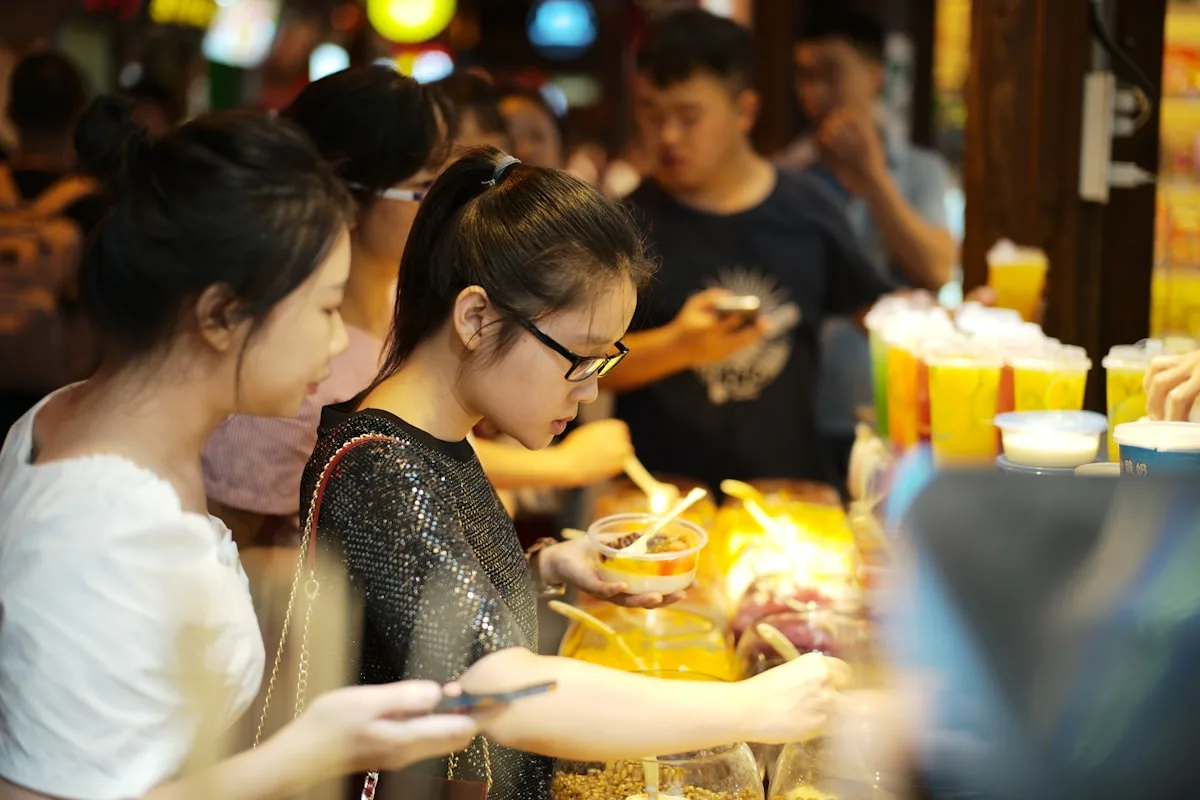
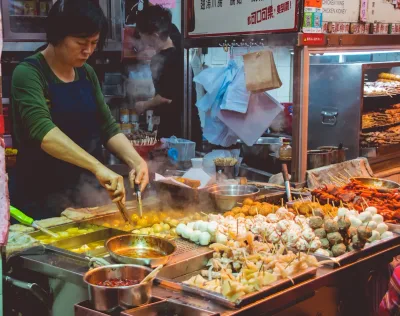
A Chinese night market at 9 PM on a Saturday in July is one of the great food experiences on earth. Smoke from charcoal grills rolls through narrow alleys. Skewers of lamb fat drip onto hot coals. Woks the size of satellite dishes toss noodles through flames. The air smells like cumin, chili, and caramelizing sugar all at once. A plate of pan-fried pork buns costs ¥12. A bowl of hand-pulled noodles with beef costs ¥15. You eat standing up, elbow to elbow with strangers, grease on your chin, and it tastes better than meals you have paid $60 for at home.
It can also go wrong. Not “this tastes mediocre” wrong. “You will not leave the hotel bathroom for 36 hours” wrong.
The difference is not luck. It is knowing which stalls to trust, which foods carry higher risk, and what to do when your stomach turns anyway. After eating my way through night markets in a dozen Chinese cities, and paying the price more than once, here is what I know.
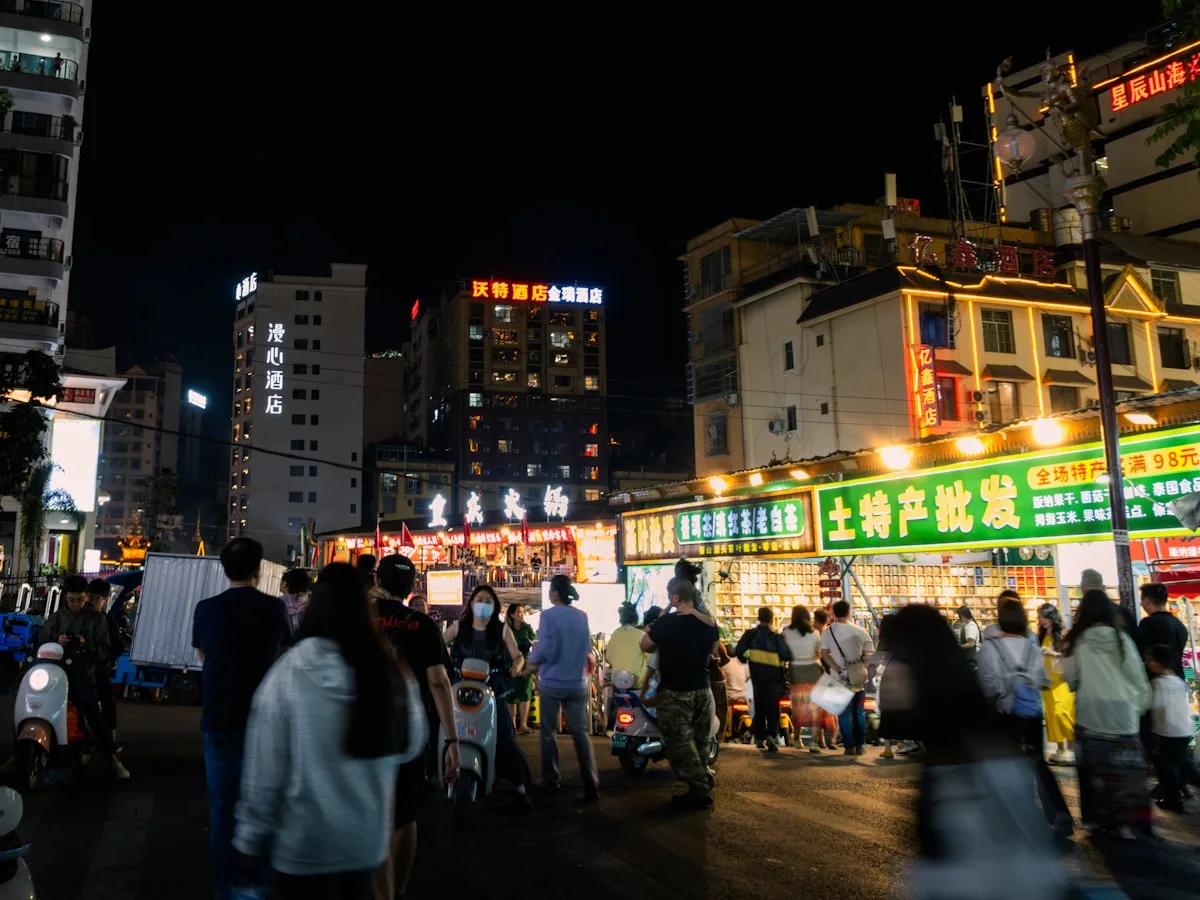
How to read a stall in 30 seconds
You do not need to speak Chinese to size up a street food stall. You need to look at three things.
Queue length. Chinese diners are ruthless about food quality. A stall with a line of locals at 9:30 PM is serving something worth eating. A stall that is empty while its neighbors have crowds is empty for a reason. This rule is not foolproof, sometimes a bad stall gets a line because of a viral Douyin post, but it is right nine times out of ten.
Turnover speed. Look at how fast food moves from the cooking surface to customers. High turnover means ingredients are not sitting around. A grill master working through a pile of skewers in fifteen minutes is handling fresh meat. A pot of broth that has been simmering since 5 PM with occasional top-ups is a bacterial gamble you are about to take. Pick the busy grill, not the neglected stew.
Ingredient visibility. The best stalls cook in front of you. You can see the vegetable crate, the meat on skewers, the oil in the wok. The stalls where everything happens behind a curtain or inside a closed cart, those are the ones that make you sick. This is not a cultural judgment. It is the same principle that applies to restaurants everywhere: if they are hiding the kitchen, do not eat there.
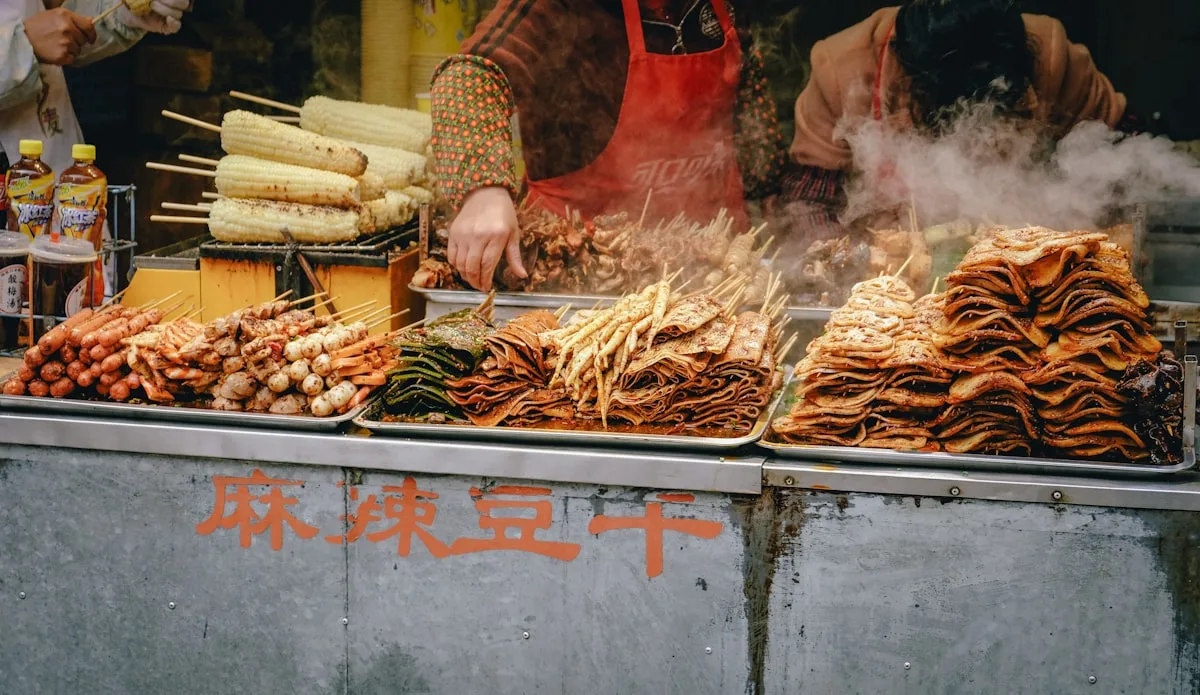
Clean hands, not clean floor. Do not judge a night market stall by how the ground around it looks. The ground is always dirty, it is a night market. Judge it by whether the cook’s hands and tools look clean, whether raw and cooked items stay separate, and whether the vendor handles money and food with the same hand. Many experienced vendors use tongs for food and bare hands for cash. Some wear disposable gloves. The ones who touch your skewer with the same fingers that just made change, skip them.
What to eat
Some night market foods are safer than others by design. High heat, short cooking time, served immediately.
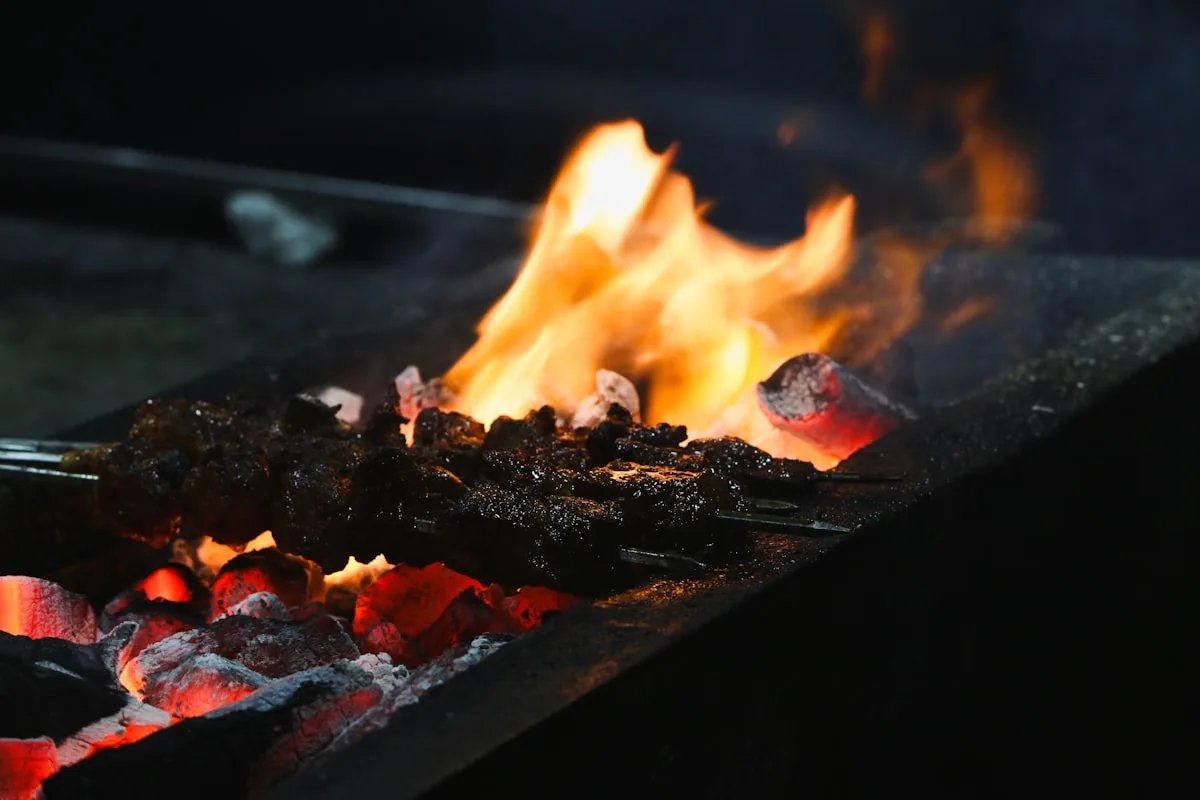
Grilled skewers (烧烤). The safest category in any Chinese night market. Meat on a stick, cooked over charcoal or gas flame at high temperature, seasoned aggressively with cumin, chili, and salt. The heat kills bacteria. The salt and spices slow regrowth. Lamb skewers (羊肉串), chicken wings, grilled squid, and grilled mantou (steamed bun crisped over coals) are all low-risk picks. If you eat nothing else, eat skewers.
Hand-pulled noodles (拉面 / 手擀面). Noodles made to order, boiled in rolling water, served in hot broth. The boiling step matters. It is not a guarantee, the broth could have been sitting at unsafe temperature, but fresh noodles pulled and boiled in front of you are a solid bet. Lanzhou beef noodle stalls and knife-cut noodle (刀削面) vendors are common in night markets across the country.
Fresh dumplings and potstickers (饺子 / 锅贴). Made on-site, boiled or pan-fried to order. The filling was mixed that day if the stall is busy enough. Watch for vendors wrapping dumplings as orders come in, that is the gold standard. Pre-wrapped dumplings from a bag are less reassuring but still cooked through. The risk is low as long as they hit boiling water or a hot pan.
Stinky tofu (臭豆腐). This divides people. The smell is real and it lingers on your clothes. But stinky tofu is deep-fried at high temperature, which makes it safe in the strict food-safety sense. Whether you want it is a separate question. The fermented version from Changsha is the most intense. The Shaoxing version is milder. Both get dropped in hot oil and served with chili sauce. The frying kills what the fermentation started.
Scallion pancakes (葱油饼). Dough fried on a flat griddle, layered with scallions and oil. Cheap, filling, and cooked at a temperature that leaves very little to worry about. A good backup food when you are hungry and nothing else looks right.
Tanghulu (糖葫芦). Candied hawthorn on a stick. The sugar shell is boiled to hard-crack stage, roughly 150°C. Nothing microbial survives that. The hawthorn inside is tart and fibrous. It is candy, not dinner, but it is the safest thing you will eat all night.
For a broader catalog of 15 essential Chinese street foods — from Beijing jianbing to Chengdu chili-oil wontons, with prices and ordering phrases for each — see our Chinese street food guide.
What to skip (or approach with caution)
Cold dishes (凉菜). This is the category where most night market stomach problems begin. Cold noodles, smashed cucumber salad, wood ear mushroom salad, delicious, and sitting in open trays at ambient temperature for hours. No heat step between preparation and your mouth. If you really want cold dishes, eat them at a sit-down restaurant where turnover is visible and refrigeration exists. At a night market, pass.
Pre-cooked seafood on display. A tray of crawfish or clams sitting on a bed of ice at 7 PM is fine. The same tray at 10:30 PM, after the ice has melted and the shellfish have been warming in July humidity for three hours, is a trip to the pharmacy waiting to happen. Seafood spoils faster than meat, and the consequences are more aggressive. Eat seafood at restaurants or at stalls where it is cooked to order from a cooler you can see.
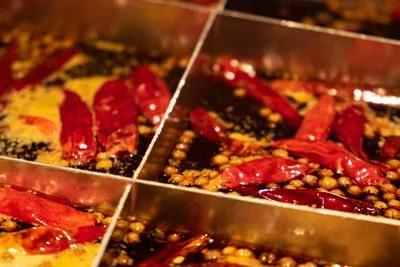
Buffet-style hotpot or malatang (麻辣烫). The communal pot model, everyone dipping their own skewers into shared broth, is less risky than it sounds because the broth stays at a rolling boil. The higher risk is the self-serve malatang stall where ingredients sit in open bins for customers to pick through with shared tongs. Every pair of hands that touched those tongs before you also touched money, phones, and subway handrails. If the stall boils your selections in fresh broth after you hand them over, you are probably fine. If ingredients sit at room temperature with no final cooking step, steer clear.
Raw or undercooked freshwater fish and crab. Drunken crab (醉蟹), raw freshwater crab marinated in rice wine, is a delicacy in Shanghai and Jiangsu. It is also a known vector for liver flukes. The rice wine does not kill parasites. It just makes them drunk, which is less helpful than it sounds. Drunken shrimp (醉虾) carries the same risk. If you want the experience, eat it at a reputable restaurant that flash-freezes its seafood. Do not eat it from a night market stall.
Unlabeled drinks in open containers. That tub of pale liquid with floating grains is probably sweet fermented rice drink (醪糟 / 酒酿), which is delicious and usually fine. But sometimes it is something that has been sitting in the sun since 2 PM. Bottled and canned drinks are always safe. Fresh coconut with a straw is fine if you watch them open it. Everything else, use your judgment about how long it has been sitting out.
Cut fruit from a stationary tray. Whole fruit is fine. Fruit cut to order is fine. Fruit that was sliced three hours ago and arranged on a tray, skip it. The knife, the cutting board, and the ambient temperature all work against you.
City-by-city: what matters where
| City | Most famous market(s) | Signature food to eat | Notes |
|---|---|---|---|
| Beijing | Donghuamen, Wangfujing | Lamb skewers, jianbing (煎饼) | Wangfujing’s scorpion-on-a-stick is a tourist stunt. The actual good eating is on the side streets parallel to the main drag. Donghuamen has better food but both are tourist-heavy. For a more local scene, try the Guijie (簋街) strip. |
| Shanghai | Shouning Road, Changli Road | Pan-fried pork buns (生煎包), crayfish (小龙虾) | Shouning Road is the crayfish capital, dozens of stalls, all cooking the same thing, competition keeps quality up. Changli Road in Pudong is where locals go; fewer English menus, better food. |
| Xi’an | Muslim Quarter (回民街) | Lamb skewers, yangrou paomo, persimmon cakes | The main street is tourist chaos. The alleyways branching off it, Xiyangshi, Dapiyuan, Sajinqiao, are where the actual Muslim Quarter food culture lives. Same food, less crowd, better quality. |
| Chengdu | Jinli, Yulin, Wenjun Lane | Chuanchuan (skewer hotpot), dan dan noodles, sweet water noodles (甜水面) | Jinli is touristy but the food is competent. Yulin’s night market is more local and more interesting. Chengdu street food tends toward cleaner preparation than in some other cities, the local standards are high. |
| Chongqing | Jiefangbei area, Nanbin Road | Hotpot (obviously), grilled fish, suan la fen (酸辣粉) | Chongqing night markets run late, past midnight on weekends. The heat and humidity accelerate food spoilage here. Stick to stalls that cook to order, and do not eat seafood that has been sitting out. |
| Guangzhou | Shangxiajiu, Beijing Road | Rice noodle rolls (肠粉), claypot rice, double-skin milk (双皮奶) | Guangzhou’s street food is some of the safest in the country because most of it is cooked to order in steamers or woks. Cantonese food culture values freshness to a degree that works in your favor. The night market scene here is the best entry point for cautious eaters. |
| Changsha | Taiping Street, Pozi Street | Stinky tofu, crayfish, sugar oil ba (糖油粑粑) | Changsha’s food is aggressive on chili heat. The turnover at Pozi Street stalls is so fast that food safety is less of a concern, nothing sits long enough to go bad. Bring water. |
| Lanzhou | Zhengning Road | Lanzhou beef noodles, lamb skewers, niangpizi (酿皮子) | Zhengning Road is one of the best night market strips in northwest China. The Hui Muslim influence means lamb dominates, and halal preparation standards are generally high. |
Stomach survival kit
Pack these before you walk into a night market.
Hand sanitizer. Use it after handling money, before picking up food. Chinese night markets rarely have hand-washing stations for customers. You will be eating with your hands, skewers, buns, pancakes, and the money you handed the vendor thirty seconds ago went through a dozen hands before yours.
Tissues. Most stalls do not provide napkins. Bring a small pack. You will need them.
Imodium (loperamide) and oral rehydration salts. You can buy these at any Chinese pharmacy (药房). Imodium stops the symptoms. Rehydration salts replace what you lost. The pharmacy phrase for diarrhea is 拉肚子 (lā dùzi). The pharmacist will know what you need. Pharmacies are everywhere in Chinese cities, look for the green cross sign, and the staff can usually help without a prescription.
Know when to get help. Most night market stomach issues resolve in 12-24 hours. If you have blood in your stool, a fever above 38.5°C, or symptoms lasting more than 48 hours, go to a hospital. Chinese hospitals are efficient and used to treating travelers with food-related illness. International clinics in major cities have English-speaking staff. Your hotel front desk can direct you to the nearest one.
The one rule that matters
Some of the best food I have eaten in China came from a metal cart with no English menu, no health-department sticker, and no seats. Some of the worst stomach experiences of my life came from restaurants with tablecloths, air conditioning, and laminated English menus.
The rule is not “street food is risky” or “restaurants are safe.” The rule is: food that is cooked to order at high heat by a busy vendor with visible ingredients is safer than food that has been sitting around, regardless of what the establishment looks like.
A lamb skewer from a Uyghur vendor working a charcoal grill in the Muslim Quarter, pulled off the fire and handed to you thirty seconds later, is a safer bet than a cold appetizer from a four-star hotel buffet that was laid out at noon.
Eat what is hot. Eat what is busy. Eat what is cooked while you watch. And bring hand sanitizer.
How to order without speaking Chinese
You can point, gesture, and use a calculator to negotiate at most night market stalls. Here is what works across China.
Point and nod. Walk up to a stall, point at what the person ahead of you just ordered, and hold up one finger. The universal sign for “I will have what they are having.” Nobody considers this rude. It happens at every busy stall in every night market in the country. This method also solves the menu-reading problem, you see the food before you commit.
Use the calculator method for price. Vendors at market stalls rarely speak English, but every single one carries a phone. Open your calculator app, hand it over, and let them type the price. If you want to bargain, clear the number and type a lower one. This is faster and less error-prone than any translation app, and the vendor has been doing it with tourists for years.
Learn six characters. Screenshot or write down these before you go: 羊肉 (lamb), 牛肉 (beef), 鸡肉 (chicken), 辣 (spicy), 不辣 (not spicy), and 多少钱 (how much). The first three tell you what is on the stick. The next two control your heat level. The last one works everywhere. With these six characters, you can navigate any night market in China without speaking a word of Mandarin.
Cash or scan. Most night market stalls accept WeChat Pay and Alipay, but some older vendors prefer cash. Carry ¥100 in small bills, ¥5, ¥10, and ¥20 notes, as backup. A fully loaded night market dinner for one person rarely exceeds ¥50-80, so small bills cover it. For setting up mobile payments before your trip, see our mobile payment guide.
Frequently asked questions
Is street food in China safe for tourists?
Yes, if you pick stalls the way locals do. Look for high turnover, food cooked to order at high heat, and visible ingredients. Millions of people eat street food daily in China without issue. The stalls that cause problems are the ones with food sitting out at room temperature, skip cold dishes, pre-cooked seafood on display, and cut fruit from stationary trays. A lamb skewer pulled off a charcoal grill thirty seconds before you eat it is safer than a cold appetizer from a hotel buffet.
How do I spot a safe night market stall?
Check three things in 30 seconds. First, queue length, a stall with a line of locals at 9:30 PM is serving something worth eating. Second, turnover speed, high turnover means ingredients are not sitting around. Third, ingredient visibility, the best stalls cook in front of you so you can see the meat, vegetables, and oil. Also watch whether the vendor handles money and food with the same hand. Vendors who use tongs for food and bare hands for cash are safer bets.
What are the safest foods to eat at a Chinese night market?
Grilled skewers are the safest category, meat cooked over charcoal at high temperature and seasoned aggressively with cumin, chili, and salt. Hand-pulled noodles boiled to order, fresh dumplings and potstickers cooked through, scallion pancakes fried on a flat griddle, and tanghulu (candied hawthorn dipped in sugar boiled to 150°C) are all low-risk. The common thread: high heat, short cooking time, served immediately.
Which foods should I avoid at a night market?
Cold dishes are where most stomach problems start, they sit in open trays at ambient temperature with no final heat step. Pre-cooked seafood on display, especially after ice has melted in summer humidity, is risky. Raw or undercooked freshwater fish and crab can carry liver flukes that rice wine does not kill. Also avoid cut fruit from stationary trays and unlabeled drinks in open containers that may have been sitting in the sun.
What should I do if I get sick from street food in China?
Most night market stomach issues resolve in 12-24 hours. Pack Imodium (loperamide) and oral rehydration salts before you go. Both are available at any Chinese pharmacy, look for the green cross sign and say “la duzi” (diarrhea). If you have blood in your stool, a fever above 38.5°C, or symptoms lasting more than 48 hours, go to a hospital. Chinese hospitals are efficient with food-related illness, and international clinics in major cities have English-speaking staff.
Which Chinese city has the best night market for beginners?
Guangzhou is the best entry point for cautious eaters. Cantonese food culture values freshness, and most street food there is cooked to order in steamers or woks. For the most famous experience, Xi’an’s Muslim Quarter alleyways serve incredible lamb skewers. Chengdu’s night markets have high local standards. For pure intensity, Changsha’s Pozi Street stalls have such fast turnover that food safety is rarely an issue, nothing sits long enough to go bad.
If night markets have made you curious about the broader Chinese food landscape, our Xi’an food guide and Beijing food guide cover the restaurant and street food scenes in depth. For getting around to all these night markets, the China subway guide covers metro systems in every city listed above. If you want a more structured introduction to Chinese street food, food tours on Klook offer English-guided walks through night markets in Beijing, Shanghai, Xi’an, and Chengdu, a good option if you want the experience without the guesswork. New to China travel? Our first-timer’s guide covers everything from visas to what to eat.