Kaifeng's Woodblock New Year Prints: Print Your Own at Zhuxian Town

A town that prints its own year
Every January, thousands of Chinese households stick a pair of fierce generals on their front door and leave them there for twelve months. The generals are Qin Qiong and Yuchi Gong, bodyguards of the Tang emperor Taizong, and the story is that they stood at his bedroom door to keep his nightmares out until he had their portraits painted instead. That is a good story and it may even be true. What is not in doubt is that somebody has to print those generals, and one of the places that has been doing it longest is a small town 20 kilometres southwest of Kaifeng.
Zhuxian Town is not a theme park. It is a working town of about 50,000 people on the edge of the Yellow River flood plain, listed in 2008 as a Chinese historical and cultural town and, in the Ming and Qing, counted among the four great market towns of China alongside Foshan, Jingdezhen and Hankou. Its woodblock New Year prints, listed in the first batch of national intangible cultural heritage in 2006, are still made the slow way, with hand-carved pear-wood blocks and pigments boiled from plants and minerals.
The reason to go is not a museum. It is that the shops on the old street will let you have a turn at the block.
What a Zhuxian print actually is
A finished print looks simple: two warriors, a lot of red, a border. Getting there is not simple.
The block is pear wood, ideally from a tree at least ten years old, cut, soaked and dried for the better part of a year before anyone carves it. The line block is cut first, in a style called steep-knife standing-line, where the knife goes in vertically and leaves a crisp ridge, and a good block survives thirty or forty years of printing. Then comes one block per colour, so a five-colour print means five blocks and five passes through the press, each one aligned by eye.
The ink is the part that surprises people. Black comes from pine soot or from the smoke of burnt bamboo. Red comes from sappanwood or cinnabar. Yellow is boiled from pagoda tree buds. Purple is cooked out of sunflower seed husks. There is a workshop in town that still refuses chemical pigments on principle, which is either admirable or stubborn depending on whether you are the one stirring the pot.
The subjects are a fixed repertoire: door gods, Zhong Kui the demon queller, the kitchen god, chubby babies holding carp, qilin delivering sons. Zhuxian’s version of all of them is broader and cruder than the southern schools, with thicker lines and flatter colour, and it is meant to be seen from three metres away on a door rather than studied up close.
A note on the famous claim. You will read that Zhuxian is one of China’s four great New Year print traditions. The four are usually listed as Yangliuqing in Tianjin, Wuqiang in Hebei, Taohua Wu in Suzhou and Mianzhu in Sichuan, with Zhuxian swapped in depending on who is counting. What Chinese state media say instead, and what the local museums repeat, is that Zhuxian is the oldest lineage and the source the others grew from. That version is safer, and it is also more interesting.

Printing one yourself
This is the part that makes the trip worth it, and it is also the part that English-language guides get wrong. There is no bookable workshop product here. What exists is about twenty old family shops along the old street, several of which keep a table out front, and a walk-in visitor can take a brush, ink the block, lay a sheet, run the squeegee and peel off a print.
The price is in the ¥20 to ¥50 range for a print you make yourself, higher if you want a mounted or framed piece or a larger format. Cash works everywhere, WeChat Pay works in most shops, and English does not work in any of them. Bring a translation app, point at the sample on the wall, and you will be printing within five minutes. Nobody will ask you to book.
The shop names to look for include Yinshi Laotiancheng, one of the oldest surviving houses, and the museum in town is free and shows the full process with a hands-on area, so it is a sensible first stop if you want to understand what you are looking at before you pay for it. Kaifeng Museum, back in the city, has a permanent Zhuxian New Year print hall with its own printing corner and is free as well, though it closes on Mondays.
Two things to know before you buy. First, machine-printed reproductions are everywhere and look fine in a photograph, so check the print itself: hand-pulled sheets have slightly misaligned colour layers and visible paper fibre, and the ink sits on the surface rather than soaking in. Second, a hand-pulled print on thin paper travels badly. Ask the shop to roll it rather than fold it, and put it in your hand luggage.

Getting to Zhuxian Town
Bus 306 is the practical route. It leaves from Kaifeng West bus station and runs to the edge of Zhuxian Town in about 40 minutes, dropping passengers near the entrance to the Qifeng garden site, from where it is a short walk into the old street. The fare is around ¥5 to ¥6 and buses leave every 13 to 17 minutes from about 07:00 until early evening. There is no official published timetable for the route and the Chinese travel sites disagree on the exact last departure, so ask at the station or check with the driver on the way out. Missing the last bus means a taxi back, and there are not many of those waiting in the town after dark.
A taxi or ride-hailing car from central Kaifeng takes about 40 minutes and is the better option if you are three or four people, or if you want to be there before the shops open. There is parking at the town entrance if you have hired a car.
By rail it does not work. There is no station at Zhuxian Town, and the nearest high-speed rail stops are in Kaifeng itself, which puts you back on the bus. If you are arriving in Kaifeng from elsewhere in Henan, the four ancient capitals rail route covers the connections, and using Zhengzhou as a base is worth reading if you are deciding which city to sleep in.
When to go
The prints are a Spring Festival object, so the two weeks before Chinese New Year are when the town is at its loudest. New Year falls on 6 February in 2027, which puts the run-up in late January. That is when shops print in volume, households buy in stacks, and the smell of drying ink is everywhere. It is also when the town is busiest and when the guesthouse prices in Kaifeng spike, so book early if that is your window.
Outside that fortnight, printing demonstrations run year-round and you will still get a turn at the block, with the advantage that nobody is waiting behind you. Spring brings the town’s festival season and autumn overlaps with Kaifeng’s chrysanthemum season, which is when the city fills up for reasons that have nothing to do with prints. Midweek in March or November is the sweet spot: quiet shops, unhurried craftsmen, and no queue.
Note that the 2027 mainland public holiday schedule had not been published at the time of writing, so if your trip depends on the exact holiday dates, check the official announcement closer to the date. The Spring Festival travel guide covers what the holiday period does to trains and hotels.
What else is in the town
Zhuxian Town is small enough to walk in an afternoon, and three things are worth the detour beyond the print shops.
The Yue Fei Temple is the one that surprises people. Built in 1478, it is counted among the four great Yue Fei temples in China and became a nationally protected heritage site in 2013. Yue Fei was the Song general who fought the Jin from this ground, and the temple’s stone tablets and the statue out front are the reason it still draws pilgrims. Entry is around ¥25.
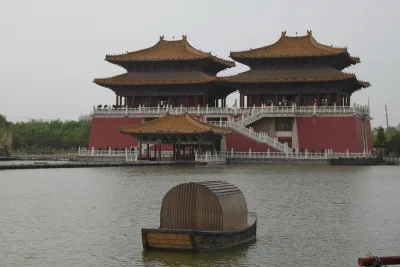
The Qifeng garden site, marketed as an AAAA scenic area, reconstructs the old canal town with a lake, bridges and a rebuilt street. Tickets are listed at ¥60 with a half-price tier at ¥30, and online prices are often lower. It is pleasant and a bit artificial, and families like it more than independent travellers do.

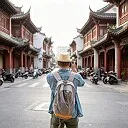
The old street itself is free and is the actual reason to come. It is a working street rather than a rebuilt one, with the print shops, a mosque, a Qing-era stone bridge and the low brick houses that show what a Henan market town looked like before tourism arrived. Give it an hour, and give the print shops longer.
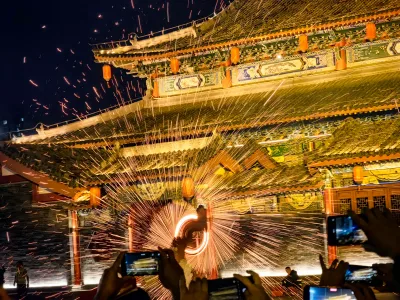
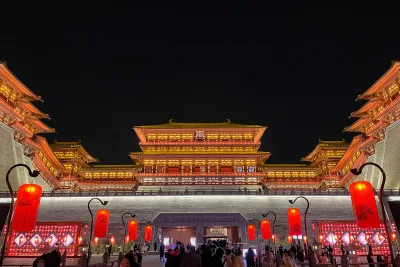
If you are staying in Kaifeng and want the rest of the city, the Qingming Shanghe Garden guide covers the big theme park on the east side, and the Wansui Mountain guide covers the iron-flower show that runs on the other side of town.
Frequently asked questions
Can you print a New Year picture yourself in Zhuxian Town?
Yes, and it is easier than the English-language guides suggest. About twenty old shops line the old street, and several let walk-in visitors ink a block and pull a print by hand for ¥20 to ¥50. There is no booking system and no English signage, so you point at what you want and pay in cash or by WeChat.
How do you get to Zhuxian Town from Kaifeng?
Bus 306 runs from Kaifeng West bus station to the edge of the town in about 40 minutes for roughly ¥5 to ¥6, leaving every 13 to 17 minutes from about 07:00 until early evening. A taxi takes about 40 minutes and costs far more. There are no published timetables, so confirm the last return bus when you arrive.
When is the best time to see the prints being made?
The two weeks before Chinese New Year, which falls on 6 February in 2027. That is when shops print in volume and households buy. Spring and autumn also bring the town’s festival seasons, and printing demonstrations run year-round for visitors, so a mid-week visit outside the holidays is calmer and still gets you a hands-on turn.
Is Zhuxian Town one of China’s four great New Year print centres?
That claim is contested and you should treat it carefully. The set of four is usually listed as Yangliuqing, Wuqiang, Taohua Wu and Mianzhu, with Zhuxian sometimes swapped in. What is not disputed is that Zhuxian is the oldest lineage, and Chinese state media describe it as the source from which the other schools developed.
How much does a woodblock print cost to buy?
Between roughly ¥20 and ¥60 for a single sheet depending on size and how many colours it carries. Prints that come off a machine look similar at a distance and cost a third as much, so check that the colour edges sit slightly off-register and that the paper has visible fibre. Those are the marks of a hand-pulled print.
Is Zhuxian Town worth a half day from Kaifeng?
Yes if you care about craft, and it pairs naturally with the old street, the Yue Fei Temple and the site of the old city wall. If you are in Kaifeng purely for the theme parks, the trip out will feel like a detour. The town is 20 to 22 kilometres southwest of the city and the whole visit fits into four or five hours.